The Joke Is Usually Better When It Has Consequences

Ashley Miller, 21
16 reviews on RNKD · 9 min read
SPOILERS Spoilers throughout, including several poems that end badly for everyone involved.
The first thing I noticed about Where the Sidewalk Ends is that it understands the appeal of refusing instructions. Not in the fake inspirational way where a person ignores all advice and is rewarded with a startup, a scholarship, and a tasteful apartment. Silverstein’s children are usually refusing something specific. They will not take out the garbage. They will not hatch. They will not go to school. They will not accept that the crocodile’s dentist has a reasonable safety plan. Sometimes this gets them freedom. Sometimes it gets them eaten, flattened, stuck, or left standing at a traffic light for months. The book is much funnier when disobedience has an actual cost.
I expected this to be a collection I could read in one sitting, which is technically true but not especially useful. There are 153 sections in this edition, and many of them are only a few lines long. The book works better as something you dip into when you have five minutes before class or while waiting for a drink to finish pulling. You read three poems, laugh at one, wonder what exactly happened in another, and then put it down. Reading all of it consecutively makes the repeated structure more obvious. Someone announces a strange premise, the language starts bouncing around, and then the ending arrives with either a reversal, a death, or a joke that is deliberately worse than the setup.
The good news is that Silverstein is very good at knowing how long a poem can survive. “The Loser” takes the idea of a child losing his head literally and keeps following the practical consequences. He cannot look for his head because his eyes are in it. He cannot call to it because his mouth is in it. The joke works because it keeps applying its own rule instead of explaining it. “Smart” does the same thing with money. The narrator trades one dollar for two quarters, then three dimes, then four nickels, then five pennies, because he believes a larger number means a better deal. His father’s red face and silence are better than a lecture would have been. The kid has not learned anything, but the reader has.
I also liked how often these poems treat objects as problems to solve. A boat without a bottom is not a metaphor first. It is a boat that will sink. A light plugged into the sun fails because the cord is not long enough. A hat gets stuck because it was put on too tightly. A pancake is more than breakfast when one child wants the top and another wants the middle. This practical cause-and-effect is part of why the poems still feel readable. Even when the subject is a giant, a flying kid, or a creature called a Yipiyuk, the joke usually starts with a physical detail. The poem asks what would happen if this absurd thing were treated as an ordinary household problem.
That is also where the darker humor gets its force. Silverstein does not consistently protect children from consequences. Sarah Cynthia Sylvia Stout refuses to take out the garbage, and the garbage piles up until it reaches across the state. The poem ends by saying she met an awful fate and then refuses to describe it because the hour is too late, a very effective way to make a child imagine something worse than the author could have written. “Someone Ate the Baby” is even more direct. The baby is gone, the adults accept this with disturbing calm, and the final burp makes the whole thing disgusting and funny at the same time. “Hungry Mungry” eats his parents, his town, the country, the planet, and finally himself because he has consumed everything else. It is basically an appetite joke that keeps applying for more funding until nothing remains.
I laughed at those poems. I also kept thinking about how casually the book turns punishment into entertainment. A child who talks with his mouth full has his mouth glued shut. A dentist pulls the crocodile’s teeth one by one and then gets eaten when the crocodile closes his jaws. A baby disappears. The little engine from the familiar “I think I can” story makes it almost to the top and then crashes into engine hash. That last one is especially funny because Silverstein takes a lesson many children are handed as moral equipment and throws it down a hill. Positive thinking is not enough if the track is rough. That is not exactly a comforting message, but it is more honest than pretending determination guarantees a result.
The book is also skeptical of adults who present rules as wisdom. “Listen to the Mustn’ts” tells children to hear every warning and prohibition, then says anything can happen. “Don’t Tell Me” is more convincing because it rejects the kind of moral instruction that is only words. Do not tell me to hug, care, share, or be kind. Let me see you do it, and then maybe I will. That poem felt unusually sharp because it understands that children notice hypocrisy long before adults want credit for teaching them values. “Helping” makes the same point in a less angry way. Some kinds of help are real help, while some create another task for the person who was already doing the work. I recognized that distinction immediately. If someone “helps” by making the mess bigger, they have created a second shift.
Silverstein’s best poems do more than rebel. They are interested in who gets to define normal. “Hector the Collector” loves broken dolls, bent nails, cracked cups, and objects that other people call junk. The poem does not turn his collection into an investment or reveal that he was secretly correct according to a museum. Hector loves the things because he loves them. That is enough. “The Long-Haired Boy” is more openly sentimental, but the emotional mechanism is still good. People mock the boy until his long hair lets him fly away. The town immediately decides he is a hero and wants him to come back for a ceremony. He does not. He has already learned what their approval is worth.
“Where the Sidewalk Ends” is the obvious centerpiece, but I liked it more after reading the poems around it. The place beyond the smoke, asphalt, and dark streets is not presented as a productivity retreat. It is a place where children know the directions and adults do not. The escape is gentle, but it is still an escape from a world that has become ugly and overbuilt. “Tree House” makes the same request in a smaller way. A street house is neat and requires wiping your feet. A tree house is better. This is not subtle, but I do not think it is trying to be. Sometimes a person wants a place where the rules are less stupid.
The poems about work and authority are more interesting than I expected. “The Farmer and the Queen” is a small joke about everyone giving terrible advice, but the queen passes through while the farmer performs respect for animals who have no useful answer. “The Generals” is much darker. Two generals agree that war is boring and that they would rather go to the beach, then invent enough reasons to stay afraid of the beach and return to fighting. They die. The poem does not make war noble or complicated. It makes it look like a bad decision sustained by administrative cowardice. “Fish?” does something similar in four lines by asking whether the reader knows people like the big fish who eat everything beneath them. The book can be silly and still understand power.
Not every poem earns its space. Some are built almost entirely from a pun. “The Toucan” keeps cycling through who can catch, ride, glue, or write about the bird. “Fred?” spends most of its time arguing over the amphibian’s name and ends with him being dead. “Jumping Rope” is a joke about a poem failing to remain a jumping rope. These are fine in small doses, but in a collection this long they begin to feel like the literary version of a café order that is technically correct but contains no reason to remember it. I also got tired of the poems that rely on nonsense words without adding a second idea. A Yipiyuk is funny because it will not let go, not because it has an unusual name. The name is just the receipt.
There are moments when the gender and family jokes feel dated in a way the book does not seem interested in examining. “My Rules” is funny because the speaker gives a potential spouse a list of domestic chores and then wonders where they are going, but the humor depends on treating marriage as a competition over who gets served. “Pancake?” divides girls into the good child who wants the top pancake and the terrible child who wants the middle. “The Googies Are Coming” uses children as purchasable objects and assigns prices based on their bodies and behavior. These poems may have landed as playground menace in 1974. Now they read as a reminder that children’s literature can be casually cruel while insisting it is only being mischievous.
Still, the book is more emotionally varied than its reputation as a funny poetry collection suggests. “Poor Angus” is brief and sad. Angus invents food and clothing out of clouds, hope, and daffodils, but when Catherine leaves, he admits that is the only time he feels poor. “Forgotten Language” remembers a time when the speaker understood flowers, insects, crickets, and snow, then asks how the language went. “The One Who Stayed” turns the Pied Piper story into a poem about the child who was afraid to follow. The town grows old around him, and he admits he heard the music clearly, a much lonelier ending than the usual moral about being saved by staying home.
My favorite may be “The Search,” where the speaker finds the pot of gold at the end of the rainbow and immediately asks what to search for now. It is a tiny poem about how achievement does not automatically provide a next step. I liked it because it does not solve the problem. The speaker has what they wanted, and that is not enough. “The Little Blue Engine” reaches a similar conclusion more aggressively. Thinking you can is not the same as being able to. For a book that often tells children to imagine anything, it is refreshing that it occasionally admits imagination cannot repair every broken track.
The collection’s central idea is not that children are wiser than adults. It is that children are allowed to notice when adult systems are ridiculous. They notice the traffic light that never changes, the adults who care more about what is in the sack than who is carrying it, the generals who would rather fight than risk going to the beach, and the people who call useful objects junk. Silverstein gives those observations a rhythm that makes them easy to repeat, but the best poems leave a little irritation behind. They make you ask whether the joke is only about a monster, or whether the monster is the person making everyone wait.
I would not hand this book to a child without reading some of it first. Not because it is too difficult, but because the adult reaction matters. A child can laugh at a dentist disappearing into a crocodile’s mouth. An adult may also notice that the dentist was enjoying hurting someone who could not consent. A child can laugh at Sarah Stout. An adult may wonder why the father keeps shouting instead of helping with the garbage. The book does not always invite those questions, but it leaves enough room for them.
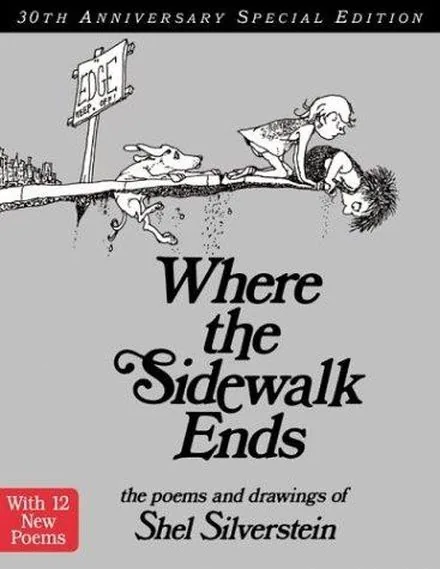
Where the Sidewalk Ends is uneven, occasionally mean, and much less wholesome than the cover of its reputation suggests. It is also inventive, direct, and very good at making a physical detail carry an entire joke. I liked the poems that treated imagination as a way to challenge rules, not as a substitute for doing the work. I liked the ones that let children be selfish, scared, gross, impatient, and right. I liked that some lessons fail. I liked it best when the book stopped trying to make happiness the point and admitted that curiosity, privacy, competence, and escape might be better reasons to keep going.
The sidewalk does not end in one clean place. Sometimes it ends at a garbage pile, a failed engine, a vanished baby, a traffic light that will not change, or a question about what comes after the thing you spent years trying to find. That tracks. I would rather read a children’s book that admits the world is strange and unfair, then gives me a flying kid and a peanut-butter sandwich, than one that tells me everything will work out if I think positively enough.