A very efficient machine for making its point

Oliver Evans, 23
16 reviews on RNKD · 8 min read
SPOILERS This review discusses the whole book, including how it ends.
The first thing Yesteryear does is put a camera in a kitchen and make the kitchen feel more dangerous than the farm outside it.
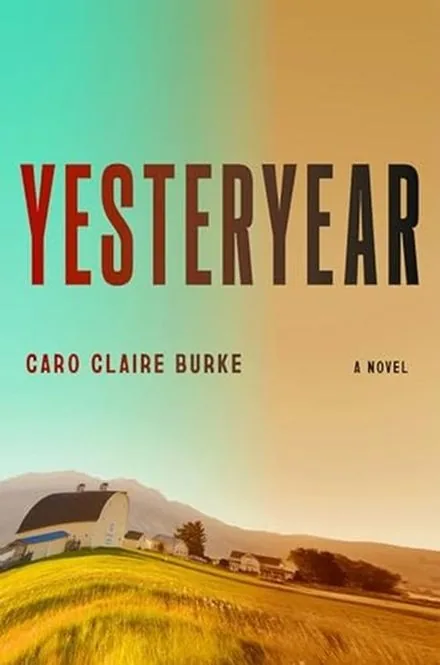
Natalie Heller Mills wakes before dawn, thanks God for her husband, her children, her pregnancy and her follower count, then starts the day’s content production. There are nannies, a producer, farmhands, a cow, a chicken coop, a hidden microwave and enough money to make the whole thing possible. Online, Natalie presents this as the natural result of discipline and Christian virtue. In private, she thinks of her children as units in a brand, her husband as a project, her employees as defective equipment and her followers as small animals that need to be fed.
That opening is funny. It is also immediately unpleasant, which is the point. Natalie’s voice is precise, nasty and frequently very funny in the way that watching someone confidently explain their own hypocrisy can be funny. She knows exactly how to arrange a kitchen so it looks lived-in without looking untidy. She knows where the camera should go. She knows how to turn domestic labour into a moral performance. She also knows, somewhere beneath the religious language and the forced smiles, that the performance is failing.
The book gets into the ending, obviously. This is not the sort of novel where protecting the twist improves the discussion.
The central device is that Natalie wakes up in a nineteenth-century version of her own ranch. The house has the same layout, but there is no electricity, no modern plumbing, no phone and no hidden appliances. Her husband is an older, harder version of Caleb. The children are not quite her children, although they look enough like them to make the distinction worse. Mary, Maeve, Noah and Abel live in a stripped-back homestead where women cook, clean, sew, wash clothes and accept that men make the important decisions. Natalie is slapped, injured in a trap and forced to live the life she has spent years selling to other people as freedom.
This is a strong premise because it does not merely punish Natalie with inconvenience. It removes the infrastructure that allowed her to pretend that she wanted the past. She wants the aesthetic of nineteenth-century life, with the labour performed by someone else and the camera placed at the flattering angle. She wants sourdough without having to understand fermentation, farm animals without learning how to keep them alive, and a large family without admitting that children are not decorative evidence of virtue. Once she loses the nannies, the electric lights, the shopping trips and the ability to outsource the ugly work, the brand becomes much easier to assess.
The novel is especially good on the difference between work and the performance of work. Natalie spends years building Yesteryear Ranch into a successful social media account. She pays for a marketing course, learns how to stage authenticity, hires Shannon to make the footage look better, and turns her exhaustion into content. Her followers do not want the actual farm. They want a controlled image of the farm. They want to believe that a woman can bake, homeschool, raise six children, run a business and look attractive without needing help. Natalie understands this, then uses it to make money. The lie is not accidental. It is the product.
The sharpest parts of the book are the ones where Natalie understands the machinery because she is part of it. She knows that her audience wants perfection and occasional failure, but only the right kind of failure. A little flour on the counter is authentic. Forgetting to feed the children until nine at night is not. She knows that the goal is not to be liked or hated but to be both at once, because resentment and admiration produce engagement. It is a sharp observation, and the book keeps finding concrete ways to put it under pressure.
The problem is that Yesteryear is not satisfied with trusting its own premise. Natalie is already a compellingly awful person. She lies about the help she employs, exploits her children’s images, manipulates Caleb, hides money from him, humiliates women she considers inferior and treats the people around her as props in a system that is both commercial and religious. The book does not need to keep proving that she is awful, but it keeps doing so. Nearly every chapter adds another grotesque thought, another cruel joke, another piece of evidence that Natalie has mistaken control for competence.
Some of this repetition is deliberate. Natalie’s mind is a loop. She uses the same phrases until they become threats: pregnancy brain, the Angry Women, the days of yesteryear, being watched, being a good wife. The repetition shows how a person can turn a slogan into a cage. It also means the novel sometimes feels like it is running the same test again after the result is already clear. Natalie sees hypocrisy, explains it, then commits a more extreme version of it. The point lands. Then it lands again.
The historical sections are more interesting than the modern ones, partly because the constraints are finally physical. Natalie can no longer change the caption or move the camera to fix a mistake. She has to wash clothes in freezing water, scrub with lye, bake bread, tend an injured animal and deal with the consequences of not knowing what she is doing. Her first attempt at bread fails, and this is treated as a genuine crisis because it is one of the few moments when the image of competence cannot be edited around the result. She is also frightened by the children’s dependence on her, even while she has spent years insisting that motherhood is her natural purpose.
The best relationship in the book is between Natalie and Mary. Mary is initially presented as one of the children in the old-fashioned household, but the later reveal shows that she is Natalie’s own sixth child, raised in the invented past after Natalie and Caleb decided to turn their family into a long-running experiment. The children are taught that they live in the nineteenth century. They are cut off from the outside world, supplied with food by older brothers who secretly use a truck and a cabin, and made to believe that modern life is dangerous and morally corrupt.
This reveal is horrible in the specific way that good horror is horrible. The supernatural or psychological mechanism matters less than the fact that Natalie has used a child’s adaptability against her. Mary does more than live in a strange house. She has been trained to make the strange house feel normal. She becomes a mother to younger siblings and an enforcer of the rules, while Natalie occasionally mistakes her competence for proof that the experiment is working. The book is strongest when it lets this arrangement sit without immediately converting it into a speech about ideology.
The ending goes further than I expected. Clementine, the first child and the one who has been watching longest, escapes with the other children. She returns years later as an adult, secures the children’s removal and confronts Natalie with the world outside. Natalie is now fifty-five, has been living in the ranch’s invented past for decades and is convinced she is pregnant, although she is menopausal. She is also intermittently drugged, legally entangled and unable to distinguish the production set from the house itself. Her daughter’s memoir, The Book of Mary, becomes the final record of what happened.
Clementine’s line about time only moving in one direction is the book’s clearest statement. Natalie has spent her life trying to reverse time, or at least package a fantasy of reversal for other people. She wants to return to an imagined world before modernity, before women had choices, before work was complicated by money and institutions and technology. But the past she wants never existed in the uncomplicated form she sells. It is assembled from money, labour, historical ignorance, hired workers, selective filming and the suffering of people she refuses to regard as full participants.
There is a good irony in Natalie finally escaping with Caleb after the children are taken away. He has been both her victim and her collaborator, an overgrown child who accepts the world she builds because it gives him permission not to choose anything. He is not secretly the mastermind, and Natalie is not the only person responsible. But the novel is careful about responsibility in a way Natalie is not. Caleb benefits from the arrangement. The boys help maintain it. Doug finances it when it suits him. The adults around the family repeatedly choose the version of events that requires the least immediate discomfort.
I did find the final television interview too neat. Reena appears as the anchor for the interview Natalie has selected, the person who once represented everything Natalie thought she had defeated. The book’s structure loops back on itself so aggressively that the ending sometimes feels assembled from thematic requirements rather than discovered through character. The memoir’s title, the producer’s questions, the prison sentence and the direct address to Natalie all work, but they also announce what they mean. There is not much room left for uncertainty.
Still, the book has earned the right to be blunt. Its real target is the conversion of private life into a product, and the way online audiences reward people for making coercion look voluntary, more than tradwife content or religious conservatism on their own. Natalie is not interesting because she is secretly good. She is interesting because she understands the lie and keeps improving it. Her tragedy is not that she wanted an impossible life. It is that she kept treating every person who objected as a technical problem.
I enjoyed Yesteryear more when it was making me uncomfortable than when it was explaining why I should be uncomfortable. The premise is strong, the voice is committed, and several scenes are difficult to forget, particularly the first encounter with the altered ranch, the failed bread, the dead chickens and Clementine’s arrival in the red Subaru. The novel is also about twice as long as it needs to be. It keeps adding proof after the verdict has already been returned.
Even so, I finished it because Natalie’s collapse remained unpredictable in its details. I wanted to know which part of the performance would fail next, and whether she would ever understand that the problem was not one bad employee, one ungrateful daughter or one hostile audience. She was the system. She was also trapped inside it.
That is what Yesteryear ultimately became for me: a novel about a woman who mistakes control of the image for control of her life, then builds a prison so convincing that she can no longer tell whether she is being watched by God, an audience, her family or herself. The answer is all of them, and none of them can give her the past back.