Roundtable 9 READERS · 1 BOOK

The Covenant of Water

by Abraham Verghese · Literary Fiction · 2023

Seven of nine readers recommend this without hesitation, though Sophie and Yael see the same over-explained scenes and convenient coincidences as reason enough to hedge.

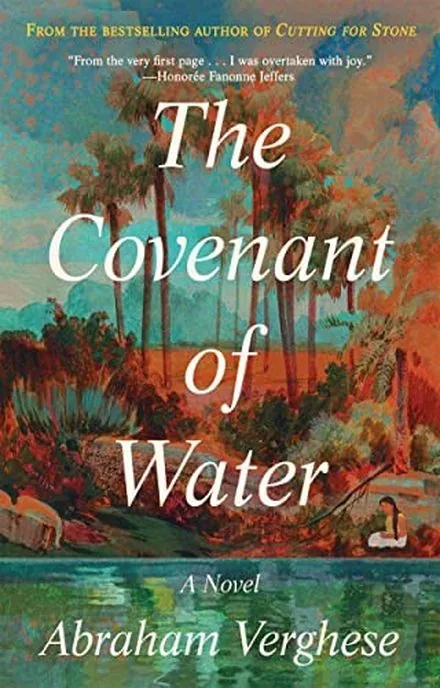
Cover of The Covenant of Water by Abraham Verghese
Genre
Literary Fiction
First published
2023
ISBN
9781804710432
RNKD readers
9

Cover artwork © its publisher, shown to identify the book under review. Rights

Verdicts at a glance

No RNKD reader scores a book out of five, so there is no average here. Just 9 people saying what they thought. Each of them wrote before reading the others.

READER 01 OF 9

A Family Tree with Water at the Root

Daniel Cohen

Daniel Cohen, 35

9 reviews on RNKD

WOULD RECOMMEND Finished the book

SPOILERS This review contains major spoilers, including the deaths of JoJo and Ninan, the fate of Elsie, the nature of the Condition, and the ending.

The Covenant of Water is a novel about inheritance, but not only in the genetic sense. It is about what families pass down because they cannot explain it, what they conceal because they think concealment is protection, and what they repeat because nobody has stopped to inspect the system. In the Parambil family, a tendency to drown, an inability to tolerate water, progressive deafness, dizziness, and facial weakness move through the generations. The family records these events in a genealogy called the Water Tree, marking deaths with a cross over waves. They know the pattern exists. They do not know what it is.

That is the central strength of Abraham Verghese’s novel. It treats a family mystery as both a medical problem and a moral one. The characters keep asking what they owe the next generation when they do not understand the danger themselves. The answer is never simple. The father who refuses to imprison his son around water is not simply brave or foolish. Big Ammachi’s husband, the first major patriarch we meet, was kept away from water by relatives who loved him and restricted his life because they were afraid. When his own son JoJo dies in a drainage ditch, he refuses to conclude that a more controlled childhood would have saved him. JoJo lived like a tiger, he says. The line is moving, but it is also a decision to accept a terrible risk rather than reproduce the prison built around him.

The novel begins in 1900 with a twelve-year-old girl being married to a forty-year-old widower. She is never given a proper name at first. She becomes Big Ammachi, a title that gradually replaces the identity she had before marriage. This opening could have been unbearable. It involves child marriage, a huge age difference, economic vulnerability, caste hierarchy, and a husband who initially flees the altar after realizing that his prospective bride is a child. Verghese makes the situation readable without pretending it is acceptable. The girl is frightened, observant, and capable of judging the adults around her. The groom’s behavior is not romanticized. He is ashamed, returns because his sister persuades him to do so, and spends years keeping a careful distance from his young wife.

Their eventual marriage is one of the book’s better examples of how care can exist inside a damaged social arrangement. He does not speak much, but he provides food, land, security, a newspaper, a church visit, jewelry, and practical protection. Big Ammachi learns to read his actions because his words are scarce. Rather than an ideal marriage, this is one in which two people gradually build trust despite a beginning neither of them chose freely. The distinction matters. The novel does not ask us to approve of the arrangement because love eventually appears. It asks us to see how people make a life inside conditions they did not design.

Big Ammachi becomes the emotional and structural center of the book. She is a householder, mother, widow, grandmother, caretaker, amateur historian, and reluctant theologian. Her relationship with God is basically an ongoing incident report. She brings evidence. She identifies failures. She asks for explanations. When JoJo drowns, she tells God that faithfulness in small things is not enough if God cannot be faithful in large ones. Later, when Baby Mol is diagnosed with congenital hypothyroidism and her mother is diagnosed with terminal stomach cancer, Big Ammachi receives more information but not more control. The novel’s medical knowledge does not remove suffering. It mostly gives suffering a name and tells the characters what cannot be done.

That is one of Verghese’s consistent ideas: diagnosis is valuable even when cure is unavailable, because ignorance creates its own cruelty. Rune Orqvist, the Swedish doctor who establishes a leprosarium, understands this. He can identify diseases that the local vaidyan treats with one tonic for everything, but he cannot cure leprosy or reverse the damage done before Baby Mol receives treatment for hypothyroidism. His knowledge is real, but it has limits. The book respects those limits more than many historical medical novels do. It does not turn the doctor into a magician. Rune’s greatest contribution is often organizational. He creates a place where people rejected by everyone else can live, work, eat, and retain some dignity.

The leprosarium is also where the book’s title makes its broadest claim. Water connects everything, physically and symbolically. It carries trade, food, disease, news, bodies, and people. It is the highway in Kerala, but for members of the Parambil family it is also a threat. Verghese repeatedly makes water beautiful and dangerous in the same paragraph. A canal can carry a bride to a new home, provide a place for bathing, flood a village, or drown a child. The contradiction is not decorative. Water is the condition of life and the mechanism of death.

The family’s caste system complicates this beauty. Parambil’s patriarch gives land to relatives and workers, shares food, establishes a school, and treats Shamuel, a Pulayan laborer, as a trusted companion. He is better than many landowners around him. He is also still a landowner whose household maintains separate dishes for Shamuel and whose workers live inside a system built on inherited inequality. Big Ammachi understands this contradiction more clearly than most. When her son Philipose tries to educate Joppan, the Pulayan boy, the village reacts as if literacy were an act of theft. The teacher beats Joppan for crossing an invisible boundary. Big Ammachi later explains the caste system to Philipose and admits that their Christian community has not escaped it.

The strongest challenge to Parambil’s self-image comes from Joppan as an adult. Philipose offers him a profitable management arrangement, including land. He thinks this is generous. Joppan explains that generosity is not the same as justice. If a relative of the same labor history and contribution had been treated as an equal, everyone would call a small plot and accumulated wages exploitation. Because Shamuel was Pulayan, the same outcome is praised as kindness. Joppan’s point lands because Philipose is not a cruel man. He loves Shamuel and would defend him physically. That love has still allowed him to mistake unequal power for benevolence. The book is at its best when it examines this kind of failure, where good intentions do not cancel the structure producing the result.

Philipose himself is an excellent character because his strengths and weaknesses are closely connected. He loves language, books, maps, radio, and the possibility of bringing the world to his doorstep. He is also limited by severe hearing loss and an inherited inability to manage water. College in Madras exposes both problems. He cannot follow lectures because he cannot hear them, and he returns home humiliated, carrying trunks of books and a radio. He becomes a writer instead, producing Unfictions for the Malayala Manorama. His stories are funny, political, and often sharper than his private behavior.

That gap matters. Philipose can identify hypocrisy in government offices and caste relations while failing to recognize how his own fear controls his marriage. He tells Elsie he will support her art, then refuses to travel because Madras has become associated with humiliation and failure. When she asks him to cut down a jackfruit tree obstructing the light in their room, he promises but delays. He wants to preserve the tree and also wants credit for accommodating her. The compromise is not a compromise at all. He leaves a dangerous remnant standing, and their son Ninan climbs it and dies on one of its amputated branches.

This is the novel’s most painful example of a problem being created by indecision. Philipose wants to be a good husband without surrendering anything important. Elsie wants room to work. Neither request is unreasonable. The failure is that he says yes without meaning yes. His internal language is full of justification, but the tree remains. After Ninan’s death, both parents blame each other because the alternative is to admit that their combined grief and fear produced a world neither can tolerate. Elsie leaves. Philipose turns to opium. The marriage becomes a case study in how love can survive and still fail to make people safe for one another.

Elsie’s later disappearance is where the novel becomes more melodramatic than I wanted, but it is also where its moral logic completes itself. She has contracted leprosy and realizes that remaining near her newborn daughter could expose the child and permanently mark her life. She stages her death by leaving her clothes near the river and enters Saint Bridget’s Leprosarium. Digby, the surgeon who fathered Mariamma, follows her there. The secret is kept for decades. Mariamma grows up believing that her mother drowned and that Philipose is her biological father.

This revelation is effective because it changes the meaning of nearly every earlier event. It also makes the adults’ concealment harder to excuse. They believe they are protecting Mariamma, and in practical terms they give her a loving home. But she loses the chance to know her mother, and her father dies without ever acknowledging what he knows. The book is clear that secrets can preserve a family and still injure the person they are meant to protect. There is no clean solution here, only competing forms of harm.

Mariamma’s path toward medicine gives the novel its forward motion. She is not simply fulfilling Big Ammachi’s dream. She chooses medicine because she has spent her life watching people suffer from diseases nobody could explain or treat. At medical school, she discovers that anatomy can be learned as a three-dimensional structure rather than merely memorized text. Her ability to imagine the body in space leads her toward neurosurgery and eventually toward the discovery that the Condition is a form of neurofibromatosis associated with bilateral acoustic neuromas. She saves Lenin by draining fluid from his brain and gets him to a hospital where the tumor is removed.

I liked the medical sections because they focus on the failing case rather than the abstract diagnosis. The doctor must decide what can be done with the equipment, staff, and time actually available. The operation on Lenin is a risky intervention that buys time, not a triumphant cure. That is the practical ethic running through the novel: do the next useful thing, with the tools available, while admitting what remains unknown.

The book is not subtle. Verghese explains many images, repeats its central ideas, and sometimes adds another historical or medical digression when the scene already has enough force. The prose often wants to make sure the reader understands that water is connected, that stories tell truths, that hands represent work, that grace can appear in small things, and that families are built from both blood and choice. I understood these points the first time. The novel keeps returning to them anyway.

The length is therefore both justified and excessive. The historical scope, medical detail, and multigenerational structure need room. But some scenes repeat a pattern: a character encounters suffering, a doctor names it, someone offers a theological interpretation, and the family continues. The book is most powerful when it trusts a specific action, such as Shamuel carrying Ninan’s body in his thorthu, Big Ammachi lighting the lamp for a newborn girl, or Mariamma placing her hands over her mother’s on the glass. It is less powerful when it explains the meaning of those actions immediately afterward.

Still, the novel earns its emotional scale. The final image of Mariamma and Elsie separated by glass is not a simple reunion. Mariamma knows her mother is alive, but she does not instantly know how to forgive the abandonment. Elsie has protected her daughter by erasing herself, and that protection has also stolen a relationship. Digby has given up his public life to stay with her. Philipose has spent his life loving a daughter who was not biologically his. Big Ammachi dies believing her family can continue without her, and the hospital she helped bring to Parambil gives Mariamma a place to pursue the work she was called toward.

For me, The Covenant of Water ultimately became a book about the difference between understanding a person and being able to save them. Medicine can identify the tumor. It can drain the pressure. It can remove what is removable. It cannot restore the dead, undo caste, repair a marriage, or give a mother back the years she missed with her child. But knowledge still matters. It changes what the next generation can do. Mariamma inherits a family full of secrets, injuries, and bad explanations. She does not get a clean history. She gets enough information to stop calling the pattern fate.

That is a meaningful achievement for a novel this large. It is also why I finished it despite the repetition. The book keeps asking who owns the responsibility for what happens next. The answer is not God, not blood, not tradition, and not good intentions. Someone has to look at the failing case, name the problem, and act before another child reaches the water.

READER 02 OF 9

A Family Novel That Knows Every Detail and Refuses to Leave Any of Them Out

Emily Johnson

Emily Johnson, 29

11 reviews on RNKD

WOULD RECOMMEND Finished the book

SPOILERS This review discusses the whole book, including how it ends.

I finished The Covenant of Water, including the drownings, the leprosy hospital, the famine, the war, the train wreck, the Naxalites, the brain tumors, the childbirth emergencies, and the final explanation of why so many people in one family are afraid of water. This is a huge novel about a Saint Thomas Christian family in Kerala from 1900 through the late twentieth century, and it contains enough plot for several ordinary novels. It also contains enough medical information for a small textbook, enough food for a very ambitious wedding, and enough grief to make every body of water in the book feel personally suspect.

The opening is excellent. A twelve-year-old girl is married to a forty-year-old widower after her mother and uncle conceal the family history of drownings. The groom sees her at the altar, realizes she is a child, and runs away. He is persuaded to return, largely because his sister Thankamma points out that abandoning the girl would leave her socially ruined. This is funny in a grim, practical way, which is exactly the kind of humor I prefer. Thankamma does not solve the moral problem of child marriage. She simply looks at the immediate consequences and says, in effect, that everyone needs to stop making this worse.

The girl becomes Big Ammachi, the center of the novel and the reason I kept reading through all 736 pages. She moves into Parambil, a large estate her new husband has built from cleared jungle, and gradually makes a household there. Her husband is nearly silent, illiterate, physically imposing, terrified of water, and much kinder than his first impression suggests. He climbs trees, works beside the people on his land, gives relatives property, and expresses affection through food, newspapers, church trips, earrings, and the practical rescue of Big Ammachi's abused mother. He does not say much because he cannot say much, but he pays attention. That distinction matters.

Big Ammachi's early life at Parambil is the strongest part of the novel. The kitchen, the fishmonger, the cellar, the elephant Damodaran, the paddy, the monsoon, the household workers, and the children all become specific rather than decorative. I could understand why this place mattered to her. It was not just a scenic setting. It was work, food, memory, weather, property, caste, and the people who showed up when something went wrong. The book is at its best when it stays with those practical details. Thankamma teaching the young bride to cook is more convincing than many pages of formal romance. A husband bringing home a newspaper because his wife wants something to read tells me more about their marriage than a declaration of devotion would have.

The family history is organized around the Condition, a hereditary disorder involving bilateral acoustic neuromas, balance problems, hearing loss, facial weakness, and a dangerous aversion to water. For generations, the family records each death by drowning with a cross over wavy lines. The secret is eventually passed to Big Ammachi after her stepson JoJo drowns in a shallow irrigation ditch. That death is brutal because it involves a child falling into a small amount of water, not a grand river disaster, and the adults do everything they can until they cannot do anything more. Big Ammachi's anger at God afterward is one of the novel's most honest religious moments. She asks how she is supposed to be faithful in small things when God has not been faithful in big ones.

I liked that the book does not treat faith as a clean answer. Big Ammachi continues praying, but she argues with God, ignores God, demands explanations, and sometimes decides that a doctor knows more than God does. The novel also understands that medicine has limits. Rune Orqvist can diagnose Baby Mol's congenital hypothyroidism and recognize Big Ammachi's mother's metastatic cancer, but he cannot cure either one. Digby Kilgour can save lives through surgery, but his own confidence and judgment fail catastrophically. Mariamma becomes a doctor because she wants to understand and treat the suffering her family could only endure. None of these people are granted control over the terms of illness.

The medical material is often fascinating. Verghese explains surgery through the physical steps of the work, and I appreciated that attention to mechanism. A huge hydrocele is a specific body problem with a specific operation, not simply a symbol of colonial neglect. A goiter extending into the chest requires positioning, tools, bleeding control, and a plan for the airway afterward. The premature infant kept alive by a homemade tracheostomy is one of the book's most memorable scenes. Philipose, who does not want to become a doctor, is forced to help Digby save the baby because Digby's hands are damaged by burns. It is an unlikely scene, but the actual details of the procedure give it weight.

The novel is also very good on caste when it stops congratulating itself for noticing caste. Parambil's patriarch gives land to pulayar families and treats Shamuel with affection, but Joppan eventually explains why affection is not equality. His father was beloved, reliable, and indispensable, yet he was still paid and rewarded within a system that assumed he deserved less because he was a pulayan. Joppan's argument to Philipose is one of the clearest passages in the book. A kind landowner can still benefit from an unjust arrangement. Being personally decent does not make the arrangement fair. That point should not be controversial, but the novel earns it by showing how difficult it is for Philipose to hear.

Philipose is an interesting character because he is both thoughtful and maddening. He loves literature, writes the Ordinary Man columns, starts a feeding center during famine, supports education, and eventually gives Joppan land and managerial authority. He is also insecure, controlling, evasive, addicted to opium, and capable of turning his fear into a command. His treatment of Elsie after their son Ninan dies is the central failure of his life. He cannot tolerate uncertainty, so he tries to control her movements and work. He tells her she cannot leave Parambil. He refuses to cut down the tree she wants removed, then compromises by amputating its branches and leaves a deadly remnant standing. Ninan climbs it and dies on one of the branches. Philipose is not solely responsible for the accident, but his indecision and his refusal to take Elsie's request seriously are part of the chain. The book is right not to let him escape that fact.

I had more trouble with Elsie. Her art is important to the novel, and her portraits reveal truths that other people refuse to see. Her portrait of Lizzi helps Lizzi recognize her own strength. Her sculptures give form to grief and desire. But the book sometimes treats Elsie's artistic talent as proof that every decision she makes must be profound. Leaving Mariamma with Big Ammachi is understandable as an attempt to protect her from leprosy and stigma, but it is still abandonment. The novel asks me to admire the sacrifice while also showing the damage it causes. I could accept that contradiction. I did not always accept the amount of mystical framing around it. Sometimes a mother who leaves her child is simply a mother who leaves her child, even when the reasons are tragic.

There is a lot of this novel that is moving because it is so direct. There is also a lot that is moving because the author keeps explaining that it is moving. Nearly every major scene receives a second emotional interpretation. A character cries, then the narration tells us what the tears mean, then a remembered Bible verse provides the meaning again. By the middle, I occasionally wanted someone to stop explaining the significance and let the scene remain difficult on its own.

The structure creates a similar problem. The book moves away from Big Ammachi and Parambil to Digby in Glasgow and Madras, then returns to the family, then moves forward through Philipose and Elsie, then into Mariamma's medical training and her relationship with Lenin. The shifts are not random. They eventually connect through medicine, family, colonial history, and the Condition. Still, the connections sometimes feel engineered. Digby happens to meet Rune. Philipose happens to meet Digby at the leprosarium. Lenin happens to arrive at Saint Bridget's with a dying child. Mariamma happens to uncover the truth about her parents through Digby. The novel is openly interested in fate, but after enough of these meetings, I started seeing the author arranging people in the hallway.

The prose can be beautiful, especially when it describes bodies, food, weather, and work. It can also become excessive. Water is a useful central image, but the book uses it so constantly that there were times when I wanted one scene to contain an ordinary puddle without also carrying the entire history of Kerala, the family, creation, baptism, death, and colonial trade. The title is justified, but the motif is not allowed to rest.

Still, the ending worked for me more than I expected. Mariamma discovers that her father was not her biological father, then finds her mother alive at Saint Bridget's. She also learns that Digby is her biological father. This could have become a cheap reunion scene. Instead, Mariamma stands with Digby at the window while Elsie approaches from the lawn. Mariamma places her hands against the glass over her mother's hands. They do not speak. The physical barrier remains, but the three of them briefly occupy the same space. That restraint is welcome after so much explanation. The scene does not erase the years they lost or turn the family into a neat arrangement. It simply allows recognition.

The Covenant of Water is too long, too crowded, too determined to make every detail meaningful, and occasionally too pleased with its own emotional conclusions. It is also generous, intelligent, funny, informed, and genuinely interested in the work of caring for people whose bodies and circumstances cannot be fixed. I did not believe every coincidence, and I did not need every page. But I believed Big Ammachi's kitchen, Shamuel's loyalty, Joppan's anger, Mariamma's purpose, and the exhausting daily labor of keeping a household alive. For me, this became a novel about how people inherit damage, kindness, silence, land, and obligations, then decide what to pass on. The answer is never clean. That is the part I trusted.

READER 03 OF 9

A Family Story That Refuses to Stay Small

James Wilson

James Wilson, 38

12 reviews on RNKD

WOULD RECOMMEND Finished the book

SPOILERS This review discusses the whole book, including how it ends.

There is a point in a long book where you stop asking whether it is good and start asking whether it has earned the next evening of your life. The Covenant of Water earned mine, although it made me work for them. At nearly 800 pages, it is a large, serious, occasionally exhausting family novel about water, illness, caste, faith, medicine, colonialism, grief and the stories people tell in order to keep living with what cannot be repaired, not a book you can carry casually from room to room unless you are ready to explain why dinner is late.

There are major spoilers throughout.

The opening is one of the strongest parts. In 1900, a twelve-year-old girl is married to a forty-year-old widower in Travancore. The groom takes one look at her and walks out of the church because she is plainly a child. He returns, largely because his sister Thankamma persuades him that the abandoned bride needs a household and that his household needs her. It is an uncomfortable beginning, and the book does not pretend otherwise. The girl, who becomes Big Ammachi, is frightened, homesick and expected to become a wife before she has finished being a child. Yet Verghese gives her intelligence, humour and practical competence from the start. She is not rescued by a man. She survives by learning the household, caring for JoJo, making food, reading newspapers and gradually making a life in a place that was never meant to belong to her.

Big Ammachi is the centre of the first part, even when the narration moves away from her. Her relationship with her husband is especially well handled in its early stages. He is a physically imposing, taciturn farmer who cannot swim, fears water and bathes in sections because of an inherited condition. He cannot read, but he understands land, trees and people. He expresses affection through practical acts: arranging for a newspaper to arrive, taking his wife to church, rescuing her mother from a cruel household and giving land to relatives. The book understands that reliability can be a form of love, even when it is not especially communicative. Big Ammachi has to interpret his silences, and she is often better at doing so than he is at explaining himself.

The central family illness is initially treated as a mystery, but it is not really a mystery in the usual novelistic sense. We know early that drownings recur across the family. We know that men are especially affected, that some cannot tolerate water and that others develop deafness, dizziness or facial weakness. Identifying the disease matters less than watching the family live around it. JoJo avoids water and dies in an irrigation ditch. Big Ammachi's husband survives into old age, then develops symptoms suggesting an acoustic neuroma. Philipose inherits the same problem, along with profound hearing loss and a fear of water that becomes entangled with shame. Later, Mariamma learns that the condition is associated with bilateral acoustic neuromas, what would now be recognised as a form of neurofibromatosis type 2.

The medical material is one of the book's great strengths, but also one of its risks. Verghese writes as a physician, and he is very good at making anatomy feel like lived experience rather than textbook decoration. Digby Kilgour's first operation in Madras, on a huge hydrocele, is funny and revolting in exactly the right proportions. His work with Ravichandran shows how competence is built: not through confidence alone, but through observation, correction and knowing when a familiar procedure is not the best possible procedure. The line that the best operation possible is not always the best possible operation is useful because it describes Digby's entire development. He is constantly learning the difference between what he wants to do and what the situation allows.

The book also understands the moral complications of medical practice. Digby arrives in India wanting surgical experience and gradually realises that the Indian Medical Service exists within an occupying system. He benefits from being white, even while recognising the injustice of that privilege. Claude Arnold, his senior, is worse than incompetent. He is protected by family connections, class and the British administrative machine until he kills Jeb by opening what is actually a carotid aneurysm. The inquiry into Jeb's death is one of the novel's clearest demonstrations of how institutions protect the wrong person. Claude does not need to be a cartoon villain because the system around him is already doing the work.

Digby's later injury and reconstruction at Saint Bridget's Leprosarium is the other major medical section. His hands are burned in a fire that kills Celeste, the woman he loves and has betrayed. Rune Orqvist saves him through a series of inventive operations, including attaching Digby's hand to his chest so that it can grow a new skin covering. The surgery is difficult to read in places, but it gives the novel a serious idea about repair. The hand does more than grip and cut. It carries identity, work and usefulness. Digby thinks he has lost the right to use his hands, and the leprosy patients show him that a damaged body can still make things, care for others and have a place in the world.

That part of the novel works because Rune does not treat the residents as symbols of suffering. He treats them as workers, patients, friends and irritating human beings. Saint Bridget's is a practical institution built by people who have been rejected elsewhere, not a sentimental refuge. The line about leprosy's real wound being exile rather than pain is direct and persuasive. It also connects to the wider novel. Almost everyone in The Covenant of Water is living with some form of exile, whether from a family, a caste, a country, a profession, a marriage or their own body.

The book's weakness is that it sometimes explains its own meaning too thoroughly. A symbol appears, works perfectly well, and then the narration explains what it means. Water connects everything. Trees preserve memory. Hands represent work and identity. Houses hold ghosts. Art reveals what people cannot say. These are all worthwhile ideas, but the novel does not always trust the reader to notice them. The prose can be so determined to make a moment significant that it reduces the reader's freedom to respond.

There is also a recurring problem with coincidence. Characters meet at exactly the moment required by the story. Digby encounters Philipose when the boy needs help saving a baby. Philipose later meets Elsie on a train, although they have already crossed paths as children. Digby finds Lenin when he needs Mariamma. The family members and medical knowledge keep colliding across enormous distances and decades. The novel knows this is melodramatic. It calls attention to fate, providence and the idea that all water is connected. Even so, after a while the coincidences begin to resemble a very efficient customer-service system. Ask for the right person and they will arrive, usually carrying a medical diagnosis.

The other issue is the scale of the tragedy. JoJo's death is devastating because the book has spent enough time showing who he is. Ninan's death is more difficult for me. It is horrifying, and the scene is written with force, but the circumstances also feel arranged to punish Philipose and Elsie for their unresolved marital conflict. The tree that Philipose refuses to cut down because of his promise to Elsie becomes the instrument of their son's death. It is dramatically neat in a way that real grief is not. The novel does understand the consequences. Philipose becomes addicted to opium, Elsie disappears and Baby Mol begins to die from heartbreak. But the mechanism is still almost too perfectly cruel.

The marriage between Philipose and Elsie is the emotional argument of the later sections. He loves her, supports her art and also repeatedly mistakes his fear for authority. His refusal to let her visit her father's estate is not a minor disagreement. It exposes his need to control the world around him whenever he feels inadequate. Elsie, meanwhile, is not simply a victim. She recognises what she wants, understands the restrictions placed on women and refuses to surrender her work. Her art gives her a language outside marriage, but it also becomes a source of distance because Philipose admires her talent while fearing what it says about his own smaller ambitions.

Their separation after Ninan's death is painful because neither of them is entirely wrong. Both are grieving. Both blame themselves and each other. Both want the other to acknowledge the damage. When they come together again, Philipose believes sex has repaired the marriage, while Elsie remains emotionally absent. It is one of the book's better observations about intimacy. Physical closeness can express love, but it cannot replace an apology or make a dead child live again.

Mariamma's story gives the book its final direction. She becomes a doctor, then a neurosurgeon, and follows the Condition into the brain. Her education is built on the work of women who were denied education, on Big Ammachi's determination, on her father's support and on the painful inheritance of a family that has hidden its illness for generations, not presented as a simple triumph over tradition. Her encounter with Brijee Sarkar is shocking, but her response is also one of the few moments in the novel where anger produces something immediate and practical. She refuses to become a passive patient in somebody else's examination.

The revelation that Philipose is not Mariamma's biological father changes the meaning of his love without diminishing it. He chooses to be her father, and that choice matters more to the novel than blood. The book has spent hundreds of pages showing families formed by marriage, adoption, service, friendship, caste and obligation. The final definition of family here is the people who decide to care for one another, often without knowing whether the care will be returned, not biological certainty.

The ending is a proper Verghese ending: another disaster, another rescue, another hospital and another chance to name the disease. Philipose boards a train to find evidence that Elsie may still be alive, then survives the derailment only to try to save a drowning child. Mariamma discovers the truth about her parents through Digby, while Digby and Elsie remain together at Saint Bridget's. The plot is undeniably engineered, but the final image of Mariamma placing her hands on the glass over her mother's hands is earned. It is quiet after all the shouting, medical emergencies, arguments and deaths. For once, nobody needs to explain what water means.

This book is too long, too determined, and occasionally too pleased with its own symbols. It is not a tidy one. It also contains characters I cared about, medical scenes I will remember, and a serious understanding of how people use competence, faith and stories to withstand loss. I liked it more than I expected to, though not always in the same way. At its best, it asks a practical question with emotional consequences: who owns the next step when the old order has failed? The answer is rarely God, despite what the characters say. Usually it is the person who stays, picks up the damaged thing, and tries to make it usable again.

READER 04 OF 9

A Family History That Refuses to Stay Underwater

Jessica Brown

Jessica Brown, 48

14 reviews on RNKD

WOULD RECOMMEND Finished the book

SPOILERS This review discusses the whole book, including how it ends.

The practical question in The Covenant of Water is not whether a family can survive tragedy. Families do that all the time, usually without a choice. The better question is what they do with the knowledge that tragedy may come again. Do they protect their children so completely that life becomes a prison? Do they keep a secret because disclosure would cause more harm? Do they accept what they cannot change, or do they spend generations looking for the person, doctor, or explanation that might finally fix it?

Abraham Verghese gives that question almost nine hundred pages, several countries, a train wreck, a famine, a leprosarium, a family tree full of drownings, and enough medical detail to stock a small teaching hospital. I finished the book, although there were stretches when I wondered whether I was reading a novel or being asked to attend an unusually beautiful seminar that had forgotten to provide a lunch break. I am glad I stayed. I am also going to say clearly that the book could have used an editor with a calendar and the authority to say, "This section is doing too much."

The opening is one of the strongest parts. A twelve-year-old girl is married to a forty-year-old widower, and the groom sees her at the altar and runs away because, quite reasonably, he realizes she is a child. The marriage still happens. That is the first example of the book's central problem with people: intentions matter, but circumstances are usually stronger. The young bride becomes Big Ammachi, the matriarch of Parambil, and the story follows her family through several generations. Her husband is afraid of water. His first son drowns in a shallow irrigation ditch. Later, the family discovers a genealogy recording similar drownings and water aversions across generations.

Big Ammachi is compelling because the novel does not present her as a saint who never makes a bad decision. She is practical, loving, proud, judgmental, funny, and sometimes wrong. She can run a household, preserve food, manage land, educate children, organize a school, and argue with God, but she cannot prevent every loss. Her response to helplessness is to become useful. That is a recognizable response, and one I trusted more than the novel's occasional speeches about destiny. She does not solve grief. She cooks through it, teaches through it, sits beside the sick, and remembers who needs to be fed.

The household scenes are where Verghese is at his best. He knows that a family is held together by repeated tasks more than by declarations of love. Food is prepared, letters are sent, children are watched, paddy is dried, wounds are dressed, and somebody is always being told to sit down before they fall over. The books have a strong sense of how practical care becomes emotional language. The silent husband who cannot read gives his wife a newspaper every week because he understands that she needs words. The gesture says more than the speeches he cannot make.

The novel is also very good at showing how knowledge changes a person before it changes a system. Big Ammachi creates a school, tries to educate Joppan, and understands that the caste system is incompatible with the Christianity her family claims to practice. She also continues to serve Shamuel separately, outside the house, using separate vessels. Her moral awareness does not automatically make her behavior consistent. That is one of the book's better choices. It does not let her generosity erase the structure that benefits her.

Joppan eventually explains the problem directly. Shamuel was beloved, dependable, and treated as family, but he was still not rewarded as an equal. A plot for a hut and accumulated wages may look generous when given to a pulayan. The same arrangement would look exploitative if it were applied to a cousin who had worked beside the family for a lifetime. Joppan's point is painful because it is correct. Kindness does not repair an unjust system. Sometimes kindness helps the people inside that system feel better about remaining inside it.

This is also where I wanted the family to put more facts in writing. The novel understands the importance of records, but its characters repeatedly rely on assumptions, family reputation, and information passed along by people who think the other person surely knows. The marriage broker knows about the Condition. The husband assumes his young bride knows. Parents conceal medical facts from children. People avoid direct conversations because the conversation would be uncomfortable, then act surprised when the consequences are worse. It is the oldest administrative failure in the world: no clear owner, no effective date, and no one willing to confirm the information in writing.

The medical material is detailed, sometimes fascinating, and sometimes too pleased with itself. Verghese writes about surgery as craft, which works because Digby Kilgour and later Mariamma understand the body through their hands. The operation scenes are not just displays of technical knowledge. They are about responsibility. Digby learns that a surgeon must care for complications rather than hide behind status. Mariamma learns that a doctor can know the name of a condition and still be unable to cure it. The book's best medical idea is that naming a disease is not the same as defeating it. A label may help organize the problem, but the patient still has to live inside the body.

Digby's story, set in Glasgow and colonial India, is effective because he is forced to confront the fact that he is both excluded and privileged. In Glasgow he is marked by class, religion, and accent. In India he becomes one of the occupiers simply by arriving. His friendship with the Indian surgeon Ravichandran and with Honorine, the Geordie matron, gives the colonial sections energy. Honorine is especially good. She can be funny, furious, competent, and morally clear without turning into a lesson with a hat on.

The long section at Saint Bridget's Leprosarium is one of the book's emotional centers. Rune Orqvist, Digby, and the residents make a community in a place intended to isolate people from the rest of society. Rune's idea that the greater wound of leprosy is exile is convincing because the novel shows the residents working, laughing, building, and caring for one another. The disease damages bodies, but social rejection does at least as much harm. This section also gives Digby a way to return to usefulness after the fire that destroys his hands and kills Celeste. His rehabilitation is not a clean redemption. He still carries guilt. He simply begins doing the next necessary thing.

I did have problems with the book's scale and tone. Verghese is capable of writing a quiet scene about a mother holding a premature baby, then immediately adding a historical aside, a medical explanation, a joke about anatomy, and a symbolic statement about water. Sometimes the layering creates richness. Sometimes it feels like every available drawer in the author's desk was opened at once. The novel does not trust a significant moment to remain significant without explaining it again.

The prose can also become overly determined to make every object meaningful. A tree is a tree, then a family symbol, then a moral test, then a sculpture, then a cause of death, then a problem in a marriage. Water is landscape, transportation, danger, baptism, disease, memory, and theology. The repetition is intentional, but intention does not always prevent exhaustion. By the time someone says that all water is connected, I understood the assignment.

Philipose and Elsie's marriage is more interesting than it is comfortable. He loves her and wants to support her art, but he also wants support to mean that she stays where he feels secure. His fear of travel, water, and public embarrassment narrows his world, and then he tries to make that narrowing a household rule. Elsie is right to resist him. He is also a grieving man whose son has died in a way connected to the compromise he made over her sculpture. The book does not offer a simple villain in that conflict. It offers two injured people who keep trying to make the other person responsible for an injury neither can survive alone.

The revelation that Mariamma is Digby and Elsie's daughter is melodramatic, but the book has earned enough emotional history by then that I accepted it. The surprise matters less than the question it raises: should biology have the final word? Philipose is not Mariamma's biological father, but he is her father in every way that counts to her. Digby is her biological father, but he has no claim on the years he missed. Elsie is her biological mother, yet she gave up her place in Mariamma's life to protect her from leprosy and stigma. Nobody gets to call that choice harmless. Nobody gets to pretend it was made without love.

That is the strongest argument in the novel: love is not always the same as presence, sacrifice, or protection. Sometimes it is an act of care. Sometimes it is control wearing a good intention. Sometimes it is leaving. Sometimes it is staying beside a person everyone else has abandoned. The book is at its best when it refuses to sort those actions neatly.

I also appreciated that the novel gives Mariamma a future beyond repairing her family's past. She becomes a doctor because she has seen what it means to be helpless in the presence of illness. She does not want medicine as a family honor or as a way to prove herself. She wants to understand the Condition, treat it earlier, and stop other families from losing children to something they were never told to watch for. That is a practical ambition, and it suits her.

The Covenant of Water is too long, too crowded, and occasionally too eager to tell me what I should feel. It is also generous, vivid, funny, angry, and deeply interested in the difference between caring for people and controlling them. The book understands that families carry both injuries and instructions forward. It understands that the past is not a stable record. People revise it to survive, and sometimes the revision protects them. Sometimes it only delays the damage.

I kept reading because the people in Parambil felt more real to me than the plot machinery surrounding them. I wanted to know what happened to Big Ammachi, to Mariamma, to Lenin, to Joppan, and even to the people who were making the wrong choice for understandable reasons. By the end, the title's covenant reads as a recognition that water connects everything, including the people who believe they have escaped one another, not a promise that water will spare anyone. That is a beautiful idea. It is also an inconvenient one, which is usually where the useful ideas are.

READER 05 OF 9

A Big Book That Earns Most of Its Space

Michael Davis

Michael Davis, 44

11 reviews on RNKD

WOULD RECOMMEND Finished the book

SPOILERS This review discusses the whole book, including how it ends.

I finished The Covenant of Water, and I am glad I did. I am also not going to pretend it needed every page it used to get there. This is a large, serious family novel about three generations of a Saint Thomas Christian family in Kerala, beginning in 1900 with a twelve-year-old girl sent to marry a forty-year-old widower and ending decades later with medicine, political violence, leprosy, art, addiction, grief, and the discovery of what has been hidden inside the family for generations. It is the kind of book that makes a person check how many pages remain and then, a few chapters later, look at the clock and realize the evening has gone somewhere without permission.

The central family condition is an aversion to water that appears alongside deafness, balance problems, facial weakness, and eventually drowning deaths. The family has preserved a private genealogy called the Water Tree, marking each death with a cross over wavy lines. That image gives the novel its structure, but the book is much better when the condition is treated as a practical problem instead of a literary symbol. A child who cannot bathe normally, a man who refuses boats, a boy who keeps trying to swim, and a family trying to protect people without turning them into prisoners are all more convincing than any explanation of what water means.

The opening section is the strongest part of the book. The young bride, later known as Big Ammachi, leaves her mother and arrives at Parambil, a huge piece of land away from the rivers that define the region. Her new husband initially runs from the altar because he realizes she is a child. He eventually returns, marries her, and brings her home. That is not a small complication. It tells you what kind of society this is, what women are expected to endure, and what kind of man he is trying to be. He is not warm in the usual way. He is quiet, illiterate, frightened of water, and more comfortable climbing trees than speaking to his wife. But he gives land to relatives, protects laborers where he can, and quietly arranges what his household needs.

Big Ammachi makes the marriage work because she refuses to wait for a personality change before beginning her life. She learns the household, raises JoJo, befriends Shamuel, handles food and money, and creates a home out of a place that initially feels like exile. The writing is at its best in these sections because every emotion has a task attached to it. Loneliness means writing a letter. Grief means making dinner anyway. Love means taking someone to church, arranging a newspaper, or walking fifty miles because a mother is being mistreated. That is a language I understand. People show what they value by what they take responsibility for when nobody is watching.

The class and caste material is also stronger when it is put into work. Shamuel is the Parambil foreman, a pulayan whose family has served the household for generations. The novel does not let the reader dismiss him as either a grateful dependent or a simple victim. He is competent, loyal, funny, and deeply constrained by the system around him. The scene in which his son Joppan is beaten for trying to enter a classroom is painful because it is not presented as one bad man having a bad day. Everyone around him understands the rules. Even the Christians who believe their faith makes them equal have built a household where Shamuel eats from a separate vessel outside the kitchen.

That contradiction matters later, when Joppan explains to Philipose that generosity is not the same as justice. His father was loved, but he was not treated as an equal. Philipose sees himself as a decent man, and he is a decent man in many ways. He also benefits from a system he has not examined closely enough. Joppan’s argument lands because he does not ask for a sentimental apology. He asks Philipose to understand the difference between being kind to a person and changing the terms that keep the person dependent. It is one of the best conversations in the novel.

The book is full of medical detail, but most of it serves the characters rather than showing off research. Digby Kilgour, a Scottish surgeon who arrives in Madras in 1933, gives the novel its second major viewpoint. His first operation involves a massive hydrocele, and the scene is both grotesque and funny. He learns surgery in a colonial hospital where European patients receive better care than Indian patients, and where a senior surgeon’s family connections protect him from consequences. Digby is an outsider in Scotland and an entitled white doctor in India. The book does not let him resolve that contradiction through one good deed.

His friendship with Honorine and Ravichandran is excellent. Honorine is funny, practical, and angry about the British Empire without becoming a speech delivery system. Ravichandran is vain, generous, brilliant, and funny in exactly the way a good surgeon can be funny when he knows he is the smartest person in the room. The operating scenes work because they include judgment, hesitation, and consequences. A surgeon has to decide with incomplete information, then live with what the decision does.

Digby’s affair with Celeste Arnold is where the book becomes less disciplined. I understood the attraction. Both are isolated, both are artists in different forms, and both have been shaped by loss. Celeste is trapped in a marriage to Claude Arnold, a cowardly and incompetent surgeon. Digby is lonely and idealizes her. The problem is not that the affair is morally complicated. The problem is that the novel sometimes treats their attraction as more inevitable and profound than their actual conversations support. Then the consequences arrive with the subtlety of a filing cabinet falling down the stairs. Jeb dies because Arnold mistakes a carotid aneurysm for an abscess, Celeste and Digby become lovers, and a fire destroys Digby’s hands and ends Celeste’s life. The plot can handle tragedy. It does not always need to announce that tragedy is approaching with a brass band.

Even so, Digby’s recovery at Saint Bridget’s is one of the sections I kept thinking about. Rune Orqvist, the Swedish doctor who establishes a leprosarium, treats patients who have been rejected by their families and communities. He also reconstructs Digby’s burned hands through difficult, almost improvised surgery. One procedure attaches Digby’s hand to his chest so new skin can grow over it. That sounds impossible until the book explains exactly what is being done. The point is not that suffering makes a person noble. The point is that the body can be damaged and still be used, and that rehabilitation means repetition, pain, patience, and somebody standing nearby when the patient would rather give up, not an abstraction.

I did have problems with the novel’s habit of explaining itself. Water, hands, trees, silence, stories, inheritance, and art all carry meaning, and the book often tells the reader what that meaning is immediately after demonstrating it. A character will experience a scene, understand its emotional significance, and then explain the significance in a paragraph that leaves no room for the reader to finish the thought. There are also stretches where coincidence does too much work. A lost person appears at exactly the right place. A doctor with the exact needed knowledge arrives. A family secret waits until the moment its revelation will cause maximum damage. The book knows this is how stories work, but knowing does not make every coincidence feel earned.

The deaths are often effective because Verghese pays attention to the physical details people usually avoid. JoJo drowns in a shallow irrigation ditch. That is the scene that changes the family permanently, and it is more disturbing because the water is not deep or dramatic. Ninan later dies on the amputated branch of the jackfruit tree, a death that grows out of Philipose’s refusal to make a clear decision. His wife wanted the tree removed because it blocked the light. Philipose wanted to preserve it because it carried family history. He compromised badly, leaving a set of sharp branches that killed their son. That is a useful depiction of guilt. No single villain causes the tragedy. A person trying to avoid disappointing anyone ends up failing everybody instead.

Philipose is difficult to like after that, which is correct. He turns to opium, becomes self-absorbed, and interprets his own suffering as the center of the household. The birth of Mariamma, who is not his biological child, becomes a second chance he does not entirely understand. He loves her completely. His journal reveals that he knew or suspected the truth, and that he chose to be her father. That is one of the book’s most moving ideas. Biology matters in this novel, especially when discussing inherited disease, but parenthood is also a decision repeated over time. Philipose makes that decision every day, and Mariamma is the person he becomes worthy of being loved by.

Mariamma’s medical career gives the novel a direction beyond family memory. She becomes a doctor because she has seen what happens when people suffer without access to care. Her first anatomy class, her work in labor and delivery, her treatment of leprosy, and her eventual pursuit of acoustic neuromas all connect the family history to a practical future. She is not simply searching for a cure because the plot needs one. She is trying to turn a private family curse into a public medical problem that can be studied, named, and treated.

Her confrontation with the predatory examiner Brijee is one of the rare moments when I wanted the book to slow down and let a scene stand on its own. He tells her to put her hand in his pocket. She does exactly what he asks, then crushes what she finds there. It is shocking, ugly, and satisfying without being presented as a clean victory. She still carries the damage afterward. That matters. Surviving an assault does not erase it, and professional consequences for the man do not return the person she was before it happened.

The ending brings the medical and family threads together when Mariamma discovers that her father had bilateral acoustic neuromas, explaining the inherited condition. She later learns that her mother is alive at Saint Bridget’s, severely disabled by leprosy and still creating art in secret. The final revelation is not tidy. Mariamma does not suddenly become grateful that her mother abandoned her, and she does not instantly forgive Digby. She can understand the choices and still be angry about them. That is the right response. Understanding is not the same as approval.

The Covenant of Water is overstuffed, melodramatic, and occasionally too eager to tell me what I should feel. It is also generous, vivid, funny, angry, and deeply interested in the work people do to keep one another alive. It understands that medicine takes more than knowledge. It takes attention, logistics, touch, and the willingness to remain present when the answer is uncertain. For all its size, the book’s central question is fairly direct: what do we owe the people whose lives are tied to ours, whether by blood, marriage, labor, faith, or simple accident? Verghese’s answer is demanding. We owe them more than good intentions. We owe them attention, honesty, and the work itself.

READER 06 OF 9

A Family History With an Actual Water Problem

Noa Levi

Noa Levi, 27

11 reviews on RNKD

WOULD RECOMMEND Finished the book

SPOILERS This review discusses the whole book, including how it ends.

The Covenant of Water is about a family in Kerala whose men are afraid of water, a fear that looks like superstition until it becomes a medical inheritance. It is also about a twelve-year-old girl who is married to a forty-year-old widower, a surgeon trying to become useful inside a colonial system, a boy who wants to read more than he wants to become a doctor, and a woman whose artistic life is treated as an inconvenience until her work becomes impossible to ignore. The book is enormous, sometimes absurdly so, but its central question is practical: what do people do with the knowledge that keeps arriving too late?

The opening is excellent. Big Ammachi is twelve, her father is dead, her mother is being pushed around by relatives, and she is about to be married to a widower who runs away when he sees how young she is. That is enough material for an entire novel. Verghese then adds the landscape, the family property, the caste system, the elephant Damodaran, the silent husband, the child JoJo, and the strange condition that has already killed people by drowning. I expected the book to lose focus immediately. Instead, those first chapters establish the pattern that holds the whole novel together: every personal crisis is connected to a system of labor, inheritance, religion, medicine, caste, or water.

Big Ammachi is the strongest reason to keep reading. She is not presented as a saint, which matters. She is observant, frightened, funny, resentful, loving, and often wrong. She begins as a child trying to understand why adults are making decisions over her body and future. She becomes the person who runs Parambil, teaches Philipose, looks after Baby Mol, protects her mother, creates a school, feeds starving people, and eventually helps deliver a baby in a dangerous breech birth while stopping a postpartum hemorrhage with a technique she heard about from another woman. Her competence comes from repetition and attention, not from a sudden transformation into a heroic figure. She knows where the rice is, who is hungry, which roof leaks, and which person is about to collapse. That is the kind of intelligence this novel respects most.

Her relationship with her husband is also unusually effective. He is huge, taciturn, illiterate, generous, and shaped by a childhood of confinement. He cannot cross water, but he clears jungle, builds roads, gives away land, rescues his mother-in-law from abuse, and refuses to keep his son on a leash even after learning that the family condition has killed previous generations. When JoJo dies by drowning in a shallow irrigation ditch, the decision not to protect the boy through permanent imprisonment becomes morally painful rather than obviously right or wrong. The husband’s argument is that JoJo lived as a tiger for the years he had. I understood why he believed that. I also understood why Big Ammachi could not forgive the logic of it.

That death is one of the places where the novel’s emotional machinery works. Another is the later death of Ninan, when Philipose leaves the jackfruit tree standing because he cannot fully choose between his wife’s request and his own attachment to the tree. The tree is a practical hazard, a family object, a source of stories, a piece of land and labor, and a monument to the past, not just a symbol. Philipose’s indecision directly contributes to his son’s death. He knows it, and the knowledge destroys him. The book is good at showing how grief turns a complicated event into a single accusation because a single accusation is easier to carry than the full list of failures, accidents, omissions, and bad timing.

I also liked the way the novel treats medicine as a practice rather than a collection of impressive procedures. Digby Kilgour’s early operation on the enormous hydrocele is memorable because he is not immediately brilliant. He is frightened, inexperienced, and saved by Matron Honorine, who tells him that the familiar operation is still there, only magnified. That sentence describes much of the novel. Digby keeps encountering ordinary diseases in extreme forms, but the deeper lesson is that technical knowledge is not enough. A surgeon must notice who is being excluded, who is being treated as disposable, and who has no alternative.

Digby’s relationship with colonial privilege is one of the better parts of the book. He arrives in India believing he is going there for surgical experience. He gradually realizes that the Indian Medical Service exists for the benefit of the empire, not for his career. He is Catholic and working class in Glasgow, then becomes white and privileged in Madras. The conversation with Banerjee on the ship makes that shift clear, and Honorine’s anger gives it a human voice. Digby does not become a perfect anti-colonial hero. He remains limited, guilty, lonely, and often self-absorbed. That is more convincing than a clean conversion.

The medical plot also exposes the limits of institutions. Digby identifies that Jeb’s neck swelling is an aneurysm, but Claude Arnold opens it anyway because Arnold’s status matters more than the patient’s life. Jeb bleeds to death while Arnold stands back. The later inquiry is important not because it restores justice completely, but because it shows how reputation, rank, family connections, and official silence protect incompetent people. Digby’s affair with Celeste is where the novel becomes harder for me. I understand why they are drawn together. Their attraction grows through art, loneliness, shared displacement, and their conversation at Mahabalipuram. But the book sometimes romanticizes their affair after Jeb’s death, even though Digby is committing adultery with his superior’s wife while she is still married. Their guilt is present, but the writing often gives their passion more space than the damage it causes.

The same problem appears in the book’s treatment of Philipose and Elsie. The marriage is compelling because both characters want to make art, but Philipose’s fear gradually becomes controlling behavior. He forbids Elsie from visiting her father, refuses to travel, and turns his dependence on Parambil into a demand that she remain inside his limits. The death of Ninan makes their mutual blame understandable, but it does not make Philipose’s behavior harmless. When he later takes advantage of Elsie while she is grieving and emotionally absent, the scene is written from inside his self-serving interpretation. He believes he is healing them. She is not consenting in any meaningful emotional sense. The prose does not fully confront that. I wanted the novel to be more exact about what he did.

Elsie’s eventual disappearance is both moving and frustrating. She leaves because she has leprosy and believes her presence will endanger Mariamma and destroy her family’s reputation. Her decision is loving, but it also repeats the novel’s pattern of adults making life-changing choices on behalf of children without giving them the truth. Mariamma grows up believing her mother drowned. When she finally finds Elsie alive at Saint Bridget’s, she is not given an easy reunion. She sees the physical damage of leprosy, the years of work and concealment, and the man who gave up his former life to stay with her mother. The scene at the window, when Mariamma places her hands over Elsie’s on the glass, is one of the book’s best moments because it does not pretend that recognition repairs twenty-six years of absence.

The medical discovery of the acoustic neuromas gives the family history a name, but not a cure. That is important. Naming the Condition explains the drowning, the deafness, the dizziness, and the facial weakness. It does not bring JoJo, Ninan, Big Appachen, or Philipose back. It does not erase the choices made in ignorance. Mariamma’s decision to become a neurosurgeon is therefore not a neat resolution. It is a direction. She can study the disease, identify families at risk, and eventually learn better surgery, but she cannot reverse the past. I preferred this to a miracle cure.

The novel is often too much. Verghese repeats the water imagery, explains emotional conclusions after scenes have already made them clear, and sometimes treats every secondary character as if they deserve a separate legend. Rune’s conversion, Uplift Master’s hospital campaign, the Maramon Convention, Philipose’s return to writing, and the repeated descriptions of food all have energy, but the accumulation can feel like a long list of things the author does not want us to miss. The prose is frequently beautiful, but it does not always trust the reader. A character will act, then think about the action, then explain what the action means. I still found myself turning pages, but I occasionally wanted someone to remove one layer of explanation and leave the actual event alone.

The caste material is more successful because the book keeps returning to the difference between individual kindness and structural equality. Big Appachen gives land to the pulayar. Big Ammachi treats Shamuel as family. They are genuinely loving relationships. Joppan still makes the necessary correction: a beloved worker can remain exploited. If a cousin of the same caste had worked for decades and received only wages and a plot for a hut, everyone would call the arrangement unfair. The fact that Shamuel is a pulayan makes generosity look like justice. Joppan’s refusal to become the next Shamuel is one of the most important decisions in the novel. He wants land and independence, not a better version of service.

By the end, I felt that the book’s real subject was not water alone. It was inheritance, including the things people inherit without understanding them. Genes, land, religion, caste, silence, guilt, skills, recipes, stories, and obligations all pass from one generation to the next. Some inheritances help. Some kill. Some can be altered only after someone is willing to look directly at what the family has hidden.

I admired The Covenant of Water more than I loved every part of it. It is sentimental, repetitive, and occasionally overconfident about its own wisdom. It is also full of characters who feel shaped by actual work, actual bodies, and actual consequences. Big Ammachi’s life remains the center of it for me. She keeps a household functioning through deaths, floods, illness, hunger, betrayal, and bad decisions. Her final night, when she asks Baby Mol whether it is her time and receives no answer, is quiet in a way the rest of the novel rarely is. The next morning they are found together, peaceful, still holding each other. It is one more form of care, not a solution.

The book asks whether a family can survive what it knows about itself. Its answer is not exactly yes. The family survives by telling stories, withholding information, adapting old roles, building new institutions, and sometimes leaving. It survives because people keep doing the next necessary thing, even when they are angry, grieving, or not sure what the right thing is. That is a practical answer. It is also the reason I stayed with this very long book.

READER 07 OF 9

A Family History That Refuses to Leave Anything Unassigned

Sarah Williams

Sarah Williams, 51

8 reviews on RNKD

WOULD RECOMMEND Finished the book

SPOILERS This review discusses the whole book, including how it ends.

I finished this book after spending a considerable amount of time thinking that somebody ought to give the Parambil family a proper household ledger. Not because the family lacks love, or land, or people willing to work until their hands give out, but because every generation inherits an unresolved problem and then calls it fate. There are drownings, illnesses, secrets, debts, marriages arranged with information missing, children sent away, children kept too close, and one very dangerous tree. Nobody writes down who knows what, who is responsible for what, or what must happen next. The result is nine hundred pages of people trying to manage disaster by intuition and prayer while withholding the one piece of information that might have helped.

I did enjoy it. I also found it exhausting. This is a large, serious, often beautiful novel that believes every life deserves to be recorded in full, including the food, the weather, the medical symptoms, the family arguments, the political history, the architecture, the caste arrangements, and the precise route a boat takes through the backwaters. Sometimes that fullness feels generous. Sometimes it feels as if the author has opened every filing cabinet in the office and expects me to admire the filing system while still standing there at half past five.

There are spoilers throughout, including the ending.

The opening is excellent. A twelve-year-old girl is married to a forty-year-old widower in 1900, and the groom runs away from the altar when he realises that his proposed bride is a child. He is persuaded to return, largely by his sister Thankamma, who understands both the shame of abandoning the girl and the practical consequences for her future. That is the kind of social pressure this book handles well. Marriage here means housing, food, status, labour, protection, and the transfer of responsibility from one household to another, not simply romance or cruelty. The young bride, later known as Big Ammachi, is not just gaining a husband. She is losing her mother, her home, her name, and the authority to decide where she goes.

Big Ammachi becomes the centre of the novel, even when the narrative moves away from her. Her strength is practical rather than theatrical. She learns to run the house, cares for JoJo, makes food from what is available, keeps her mother safe after years of neglect, establishes a school, teaches a pulayan boy who has been beaten for trying to attend lessons, and eventually helps bring a hospital to Parambil. She does not describe herself as a leader. She simply notices what is not being done and starts doing it. That felt more convincing to me than all the speeches about destiny.

Her husband is one of the more memorable characters in the book. He is nearly illiterate, largely silent, physically formidable, afraid of water, and deeply uncomfortable with his own vulnerability. He shows affection by arranging a newspaper, giving his wife earrings, escorting her to church, rescuing her mother, and making land available to relatives. This is not an excuse for his secrecy. He knows there is a hereditary condition in his family and does not tell his young wife. Their son JoJo dies in an irrigation ditch because the family has understood that he fears water but has not understood why, or what else he cannot safely do. The death is horrifying because it is such an ordinary practical failure rather than a grand plot twist, the sort that happens when people believe they have taken enough precautions.

The Water Tree, the family genealogy recording generations of drowning, deafness, dizziness, facial weakness, and aversion to water, is a strong idea. It is part family archive, part medical record, part attempt to impose order on grief. Big Ammachi takes responsibility for preserving it. That makes sense to me. If a family has observed the same pattern for generations, someone should have written down the symptoms, ages, names, and circumstances instead of leaving the next bride to discover the problem after a child dies.

The book is strongest when it connects a medical fact to an everyday consequence. Big Ammachi notices that one child enjoys water while another becomes disoriented. Digby Kilgour, a Scottish surgeon in colonial Madras, identifies diphtheria in a baby because Philipose describes a leathery membrane in the throat. Mariamma eventually discovers that the family condition is associated with bilateral acoustic neuromas, causing hearing loss, balance problems, facial weakness, and a dangerous inability to orient in water. Her father dies in a train accident because the wreck throws him into a flooded ravine, and his brain autopsy finally reveals the tumours that explain his life. The medical explanation does not undo the deaths. It does, however, replace superstition and shame with something that can be studied.

That matters to Mariamma, who becomes a doctor and then a neurosurgeon. Her vocation begins with helplessness. Big Ammachi wants her to become a doctor because she has watched too many people suffer without access to treatment. Mariamma initially thinks the request is simply another family expectation, but she eventually makes it her own. The scenes of her medical training are among the best in the book because they show work. She studies anatomy, dissects cadavers, learns the names and positions of structures, and survives the sexual harassment of an examiner who tells her to put her hand in his pocket. Her response is not dignified or restrained. She crushes him. I cannot pretend I was sorry.

Mariamma’s career also gives the novel its clearest argument. Naming a disease is not the same as treating it, but without a name it is almost impossible to organise treatment, research, prevention, or support. She tracks other families with the condition and begins building a wider record. This is the useful version of family history, not the kind that exists to prove who married well. It identifies a pattern and gives the next generation a chance to make a different decision.

The caste material is also important, especially through Shamuel and his son Joppan. The family treats Shamuel with affection, but affection does not make the arrangement equal. He works for Parambil from childhood, owns a plot and accumulated wages, and is regarded as family, but he is still expected to eat separately and remain outside the house. Joppan eventually tells Philipose that kindness can make an unjust system harder to see. That conversation is one of the book’s most useful scenes. Philipose believes his family has been generous. Joppan asks what Shamuel would have owned if he had not been born a pulayan. The answer is not comfortable, and it should not be.

Philipose himself is a difficult character to love. He is intelligent, funny, and genuinely concerned about famine, poverty, and public health. He starts a feeding centre, writes sharp newspaper pieces, supports education, and understands that charity cannot replace structural change. He also becomes possessive and frightened when Elsie wants to travel or make art. He forbids her to leave Parambil, then blames her, indirectly and directly, when their son Ninan climbs the amputated tree and is impaled. After that, he takes opium and turns his grief into another form of control. His fatherhood is real, but so is the damage he does.

The novel does not let him escape that damage. It also refuses to make Elsie entirely blameless. She leaves after Ninan’s death, gives birth to Mariamma, and eventually disappears into the leprosarium where she and Digby live under assumed separation from the world. Her choice protects Mariamma from leprosy and from the stigma attached to it, but it also means abandoning a daughter who believes her mother is dead. This is a morally complicated decision, not a noble sacrifice with no cost. Mariamma has every right to be furious when she discovers the truth.

I found the story of Digby and Elsie more affecting than their romance. Their attraction is convincing, but the important part is what they do after suffering makes ordinary life impossible. Digby loses his hands in a fire, receives remarkable reconstructive surgery from Rune Orqvist, and then stays at Saint Bridget’s to work with leprosy patients. Elsie loses sensation, sight, and eventually much of the physical ability to make art, but continues to produce sculpture with whatever remains. Their life together runs on care, injury, work, and persistence, not sentiment.

The final movement, when Mariamma meets her mother and places her hands over Elsie’s on the glass, is effective because it brings the book’s central concerns together without pretending that knowledge repairs everything. Water connects the generations, the landscapes, the diseases, and the deaths. So do hands. Hands prepare food, write letters, operate, sculpt, carry babies, strike people, offer coins, and hold a dying person in place. A hand can be an instrument of harm or care, sometimes within the same family and on the same day.

My main criticism is that the novel repeatedly explains its own meaning. A scene will carry the point clearly, then a character will think through it, then the narrator will restate it, then a historical or medical aside will confirm it. The writing is often vivid, but the emotional effect would be stronger with fewer declarations. The book also has a tendency to treat every coincidence as part of a design. People reappear across decades, objects carry exactly the right memory, and lost connections are recovered at the moment they are most useful. I accepted this as part of the novel’s storytelling method, but there were times when I wanted the family to be allowed one ordinary accident that did not reveal a pattern.

Even with those reservations, I am glad I stayed with it. The book is too long, too full, and occasionally too pleased with its own knowledge, but it has a serious interest in what families owe one another and what they owe the people whose labour supports them. It understands that love expressed through practical care is still love, but it also understands that practical care without honesty can become control. Most of all, it argues that the past should be recorded properly. Not polished into a family legend. Not hidden because the truth is embarrassing. Written down with names, dates, symptoms, responsibilities, and consequences.

By the end, I believed Big Ammachi’s view that life becomes manageable not through discovering a perfect pattern but by carrying on with the next task while knowing that the pattern may never be visible. That is less a comforting promise than simply the work.

READER 08 OF 9

A Family History That Refuses to Stay Neat

Sophie Taylor

Sophie Taylor, 26

13 reviews on RNKD

DEPENDS Finished the book

SPOILERS This review discusses the whole book, including how it ends.

The first thing I noticed about The Covenant of Water was how much practical work it contains. Not the vague sort of creative labour people describe as inspiration, but cooking, farming, ferrying, stitching, digging, teaching, operating, repairing, carrying, and making a household function after something terrible has happened. Even the book's central mystery arrives as a piece of work. The family genealogy recording generations of drowning is a document someone has preserved, updated, hidden, and finally handed on because people kept dying and the pattern mattered, not a supernatural riddle waiting for a clever person to solve.

That appealed to me. I like books that understand that survival is usually organised by somebody who is tired. Big Ammachi does not save her family through grand speeches or special destiny. She cooks, teaches, notices symptoms, keeps track of who needs food, looks after Baby Mol, comforts people, argues with God, and eventually insists on a hospital. When a baby is born feet first and then the mother haemorrhages, it is Big Ammachi and Anna Chedethi who act. There is no tidy medical infrastructure waiting to help them. They use knowledge, nerve, oil, pressure, and whatever else is available. The scene is frightening because it understands the material reality of a body in trouble. Someone has to put a hand inside and do something.

The novel is full of those moments. Digby Kilgour, the Scottish surgeon who arrives in Madras in the 1930s, is forced to operate before he feels ready. His first enormous hydrocele is not a dignified teaching case but an alarming brown mass the size of a watermelon. He makes mistakes, learns from people with more experience, and gradually becomes a better surgeon. His best lesson comes from Ravichandran: the best operation is not the same as the best operation possible. That line stayed with me because it applies far beyond surgery. Good decisions depend on the actual tools, time, bodies, money, and skill available. Not the ideal version of the situation in someone’s head.

Verghese is at his strongest when the book stays close to this kind of evidence. The description of dissection, childbirth, nerve damage, anaesthesia, burns, leprosy, and drowning can be graphic, but it is rarely decorative. The body is not used as an abstract symbol when there is a real wound that needs dressing. Digby’s hand reconstruction at Saint Bridget’s is especially memorable. His ruined hand is attached to his chest so that living skin can grow across it. That sounds impossible until the book explains the steps. Even then it remains horrible, but now it is a horrible procedure rather than a dramatic flourish. The same applies to Philipose opening the baby’s windpipe at the leprosarium. He is a schoolboy, not a doctor, and the scene does not pretend that courage makes him qualified. He is simply the person holding the baby when the qualified person cannot use his own hands.

The family story is held together by water, but the water means several different things at once. It is transport, food, danger, work, memory, baptism, escape, and a physical fact that cannot be argued away. The family members with the Condition cannot swim and often cannot tolerate water near their heads. That makes their whole world difficult, because Kerala is made of canals, rivers, flooded fields, backwaters, rain, and sea. Water is everywhere, and the family keeps trying to treat it as an enemy, a mystery, or a moral test. The book is most interesting when it refuses to choose only one explanation. The Condition is genetic, but the family’s response to it is social. Fear, secrecy, overprotection, pride, and ignorance kill as effectively as the underlying disease.

I found the secrecy more convincing than some of the book’s mystical material. The Water Tree exists because people are trying to record what happened while also protecting the family from shame. The parents do not tell their children. Marriage brokers soften or conceal the risk. Drownings become accidents, eccentricity, or God’s will. The story shows how a secret can be intended as care and still become dangerous. That is a useful distinction. The adults are not all villains for withholding information. They are frightened people making decisions inside a society where disability, caste, illness, and marriage affect the whole family. But good intentions do not make a locked door less locked.

Philipose’s struggle with water and hearing is the clearest example. He is not stupid, lazy, or insufficiently educated. He is a young man whose hearing loss is missed because people prefer to call him inattentive. At college, he is publicly marked before anyone bothers to understand what is happening. He returns to Parambil, brings home a radio and two trunks of books, and builds a life through reading and writing. That part moved me more than I expected. He does not become a heroic writer in the usual way. He writes newspaper pieces about food, famine, bureaucracy, caste, and ordinary people. His work is useful because it makes local life visible without pretending to stand above it.

He is also deeply flawed. The treatment of Elsie after Ninan’s death is not a small marital disagreement. Philipose is grieving, addicted to opium, physically disabled, frightened, and consumed by guilt, but none of that excuses his controlling behaviour. He forbids Elsie from visiting her father. He destroys the Stone Woman because he has convinced himself that the unfinished sculpture is threatening him. He interprets her artistic work as a judgement on his inadequacy and repeatedly decides that his pain gives him the right to manage hers. The novel does not make him easy to forgive. When he later discovers that Elsie has leprosy and has been living at Saint Bridget’s, his love for her is real, but it does not erase the harm he caused.

Elsie is one of the reasons the book is worth reading despite its excesses. She is an artist who refuses to accept that marriage should turn her into a household function. Her work is dismissed when it carries a woman’s name, then celebrated when she submits it under initials that allow judges to imagine a male artist. That is a good, precise piece of institutional criticism. The problem is not that nobody recognised her genius. The problem is that people were willing to recognise it only after they thought it belonged to a man.

Her relationship with Philipose is compelling because love does not make either of them generous all the time. They understand each other physically and creatively, but they also compete for room, attention, recognition, and control. The death of their son turns grief into blame. Elsie leaves, is presumed drowned, and then lives at Saint Bridget’s, where she continues to make art while leprosy takes her sight and damages her hands. That revelation is painful, but it also exposes one of the novel’s recurring problems. The book sometimes turns suffering into a machine for producing meaning. Nearly every wound becomes an occasion for a lesson about grace, art, family, or the body.

I did not always want the lesson. Verghese’s prose can be beautiful, but it often explains an emotional moment after the moment has already made itself clear. A character sees something, understands it, and then the narration tells us what it means in several more paragraphs. The same idea may return through a Bible verse, a medical explanation, a family saying, and a symbol involving water. By the middle of the book, I occasionally wanted to put a hand over the page and say, yes, I understood the first time.

The book is also far too generous to its own coincidences. Everyone is connected to everyone else through family, medicine, trains, newspapers, plantations, hospitals, and shared memories. Some connections are satisfying. Others feel arranged by an author who has become attached to every thread and refuses to cut one. The ending in particular brings the discoveries together through an accident, an autopsy, a leprosarium, a long-hidden parentage, and a delayed understanding of the Condition. It is emotionally effective, but it also makes the world feel smaller than the novel’s vast geography suggests.

Still, the ending earns more than I expected. Mariamma learns that Digby is her biological father and that Elsie is alive. She does not immediately fall into a convenient reunion. She needs time. That matters. The final image of mother and daughter touching hands through the glass is powerful because it stops before reconciliation becomes easy. The contact is real, but so is the distance. Digby has loved Elsie for decades, but he cannot make Mariamma recover twenty-six missing years. Elsie has protected her daughter, but protection has also meant abandonment. There is no clean repair available.

That is ultimately what the book became for me: a story about people trying to repair damage with the tools they have, while repeatedly making new damage through secrecy, pride, fear, and love. It is enormous, often over-explained, and more sentimental than I usually have patience for. But it is also serious about labour, disability, caste, medical care, women’s lives, and the difference between kindness and justice. Joppan’s challenge to Philipose is one of the book’s most important moments. Being a kind landowner does not make the system fair. A beloved worker can still be exploited. That distinction should have been given more space than some of the later mystical material.

I finished The Covenant of Water with a complicated response. I admired its attention to bodies and useful work. I cared about Big Ammachi, Mariamma, Elsie, Digby, Joppan, and even Philipose when he was not making everyone else carry his fear. I sometimes found the writing too determined to turn every event into a statement. But the book kept returning to practical questions that matter: Who has access to care? Who is allowed to study? Who gets believed? Who performs the invisible work? Who is protected, and who is merely managed?

The novel’s answer is not always comforting. Water connects everyone, but connection does not produce fairness by itself. Someone still has to build the bridge, open the hospital, tell the truth, or put down the cup and help. That part, at least, is worth remembering.

READER 09 OF 9

A Family History Written in Water

Yael Shapiro

Yael Shapiro, 46

11 reviews on RNKD

DEPENDS Finished the book

SPOILERS This review discusses the whole book, including how it ends.

One practical question first: who is doing the work in this novel? Big Ammachi, mostly. She cooks, raises children, manages a difficult household, cares for an aging mother, survives widowhood, teaches, grieves, organizes a village, and keeps going after the book has given her every reason to stop. Around her, men clear land, practice medicine, write newspapers, run businesses, join revolutions, and make speeches. Big Ammachi keeps the household alive while everyone else is busy becoming symbolic.

I finished The Covenant of Water, and this review discusses the entire novel. It is a huge, ambitious, frequently beautiful book about three generations of a Saint Thomas Christian family in Kerala, beginning in 1900 with a twelve-year-old girl married to a widower and continuing into the 1970s. The family carries a strange inherited condition: some members cannot swim, are terrified of water, or become dizzy and deaf, while others die by drowning. The family records these deaths in a genealogy marked by crosses over waves. The condition is eventually identified as bilateral acoustic neuromas associated with neurofibromatosis type 2, but the medical explanation is only one part of what Verghese is doing. The larger subject is inheritance: what is passed through blood, what is passed through work, what is passed through silence, and what people choose to pass on instead.

The opening is strong because the girl who will become Big Ammachi notices the practical arrangements immediately. She is being married at twelve, her father is dead, her uncle is hiding information, the groom is forty, and nobody has explained what will happen next. Then the groom sees her at the altar and runs away because he realizes she is a child. This is both alarming and, in its details, darkly funny. The marriage proceeds anyway. That is the world of the novel: cruel systems are not suspended because someone has noticed the cruelty. People have to improvise inside them.

Big Ammachi’s early life at Parambil is the best part of the book. Thankamma teaches her recipes, household routines, and the practical management of men. Shamuel teaches her what the estate depends on, while the social structure keeps reminding her that the people doing the physical work are not treated as equals. Her husband is illiterate, fearful of water, and emotionally almost impossible to read. He is also generous, hardworking, brave, and capable of seeing a new settlement where everyone else sees only jungle. Their marriage grows through actions rather than speeches. He arranges for a newspaper because he knows she wants words. He takes her to church because she asks. He rescues her mother from humiliating poverty. He gives away land. He remembers her birthday and buys her earrings. This is a convincing portrait of a man who cannot explain himself but understands that care is a form of speech.

The novel is very good at showing the labor behind a life that later looks inevitable. A house does not simply become a family estate. Somebody clears the land, carries the coconuts, cooks the food, repairs the roof, teaches the child, delivers the letter, and watches the river. Verghese keeps returning to hands, feet, tools, food, scars, and water because he understands that bodies are where history becomes real. The caste system is not presented only as an idea. It appears in who may enter the house, who eats from which vessel, who owns land, who carries a load, who is permitted to learn, and who is expected to regard dependence as good fortune.

The strongest scene in the first section is Joppan’s attempt to enter the school. He is a pulayan child who arrives with a leaf, a stone, and a wooden coin because he wants to study. The teacher beats him and calls him an upstart. Joppan responds by insulting the teacher and walking away. Big Ammachi then understands that her own household’s kindness does not cancel the caste system. This is important. She may give land, food, or schooling, but she still has a separate dish for Shamuel. Her husband may be unusually decent for a landowner, but Shamuel is still not his equal. Joppan eventually explains this directly to Philipose, and that conversation is one of the most intellectually serious passages in the book. A benevolent arrangement can still be an unjust arrangement. Who is doing the extra work, and who decides what counts as generosity? That is the right question.

The book also understands that medical knowledge can be both liberating and inadequate. Rune Orqvist can name Baby Mol’s congenital hypothyroidism, diagnose cancer in Big Ammachi’s mother, and understand the inherited drowning condition, but he cannot cure any of these things. Digby can perform extraordinary surgery and still be unable to save Jeb because his superior’s pride overrides his judgment. Mariamma can identify her father’s acoustic neuromas after his death, but diagnosis arrives too late to help him. Medicine is a way of seeing and sometimes a way of intervening, not magic. The people who benefit most are often the ones who have someone competent beside them at the right moment.

I especially liked the way the book treats doctors as people who must still do ordinary work. Digby’s best teaching comes from Matron Honorine and Ravichandran, not from a formal lecture. He learns through assisting, observing, listening, and being corrected. Mariamma’s medical education begins with the dead informing the living, then proceeds through long hours of dissection, memorization, humiliation, and practical work. Her response to the predatory examiner is violent, but I understood it. The institution has decided that a woman’s body is available for inspection, and she answers with the only language the man has made available to her. The book does not pretend that this is an admirable professional solution. It is a frightening moment in which a student refuses to be made helpless.

There is too much of this book. That is not a complaint about length alone. The novel often explains a scene after the scene has already made its point. Emotional events are repeated through dialogue, internal reflection, symbolism, and later recollection. Drowning, water, elephants, trees, hands, feet, silence, inheritance, and faith are all meaningful motifs, but Verghese does not always trust them to remain meaningful without another explanation. The book occasionally says, in effect, this is what the scene means, and then says it again in a different voice.

The coincidences also accumulate. Characters meet at exactly the right time, medical experts appear when needed, letters travel through unlikely channels, and people who have been separated for decades reappear with information that changes everything. Some of this belongs to the family saga tradition. The novel is openly mythic. But at times the machinery shows. When Digby and Mariamma meet through the history of a disease, a hospital, a dead surgeon, an artist, a train journey, and a hidden parentage, I understood the design before the characters did. The revelations are emotionally effective, but not always plausible.

The prose has a similar unevenness. Verghese can write a landscape with extraordinary precision, especially water moving through Kerala, or a hand learning to work again after a burn. He is also very good at food. Thankamma’s clay pot, the fish curry, jackfruit halwa, coffee, kappa, mangoes, and rice are not decorative details. They are how people express welcome, affection, grief, and status. But the prose sometimes becomes over-furnished. A sentence will contain a medical fact, a historical aside, a biblical reference, a joke, a metaphor, and a conclusion about human nature when two of those things would have been enough.

I had more patience for the book’s sentimentality than I expected, partly because Big Ammachi earns it. Her final night with Baby Mol is moving because the novel has shown us the repetitive, ordinary care that made their relationship what it was. The scene is powerful not merely because they die together, but because Big Ammachi has spent decades answering the same question, taking responsibility for the same child, lighting the hearth, making the food, and worrying about the next morning. The work has accumulated.

The ending with Mariamma discovering that Digby and Elsie are alive is both melodramatic and exactly right for this novel. I was not persuaded by every step that brought her there, but I believed the force of the recognition. She has spent her life trying to understand the Condition, and discovers that the family mystery is also a personal one. Her mother’s disappearance protected her and wounded her. Her father’s silence gave her a home and left her without the truth. Digby’s love is not enough to undo that history, but it is enough to make the history visible.

For me, The Covenant of Water ultimately became a book about the difference between kindness and justice. The Parambil family does many kind things. They feed people, give land, rescue relatives, educate children, and care for the sick. But kindness can leave the structure that produced the suffering untouched. Joppan understands this before Philipose does. Mariamma understands it in medicine. Big Ammachi understands it through a lifetime of watching who is allowed to speak and who is expected to be grateful.

This is a book for readers who can accept a family saga that wants to be history, medical novel, religious argument, romance, political story, and catalogue of Kerala at once. It does not always control its abundance. Still, its central questions remain clear. Who is doing the work? Who gets to leave? Who gets to be remembered? Who is allowed to have a body that is not treated as someone else’s property? And when a family survives because one person keeps doing the necessary thing, who notices?

Big Ammachi notices. So should we.

Where they agreed

Every reader names the same two things as the book's real strength: Big Ammachi, whose competence is shown through cooking, teaching and noticing rather than speeches, and the conversation where Joppan tells Philipose that a kind landlord is not the same as a just one. Daniel, Michael and Sarah all point to the same recurring flaw too, that the novel explains a scene's meaning right after showing it, then explains it again through a Bible verse or a medical aside. Several readers also flag how often people and information arrive at exactly the moment the plot needs them, though nearly everyone forgives it as part of the book's family-saga logic.

Where they split

Most readers list the same complaints: too much explaining, too many overly convenient coincidences. James, Michael and Noa raise them and still land on an unqualified yes. Sophie and Yael weigh the identical flaws and land on a more guarded verdict, with Yael writing that the book is for readers who can accept a saga trying to be history, medicine, religion and romance all at once.

Written from the reviews above and checked by an RNKD editor against what the readers actually wrote. It adds nothing they did not say. How Roundtables work

Report an error on this page How we review Cover image rights