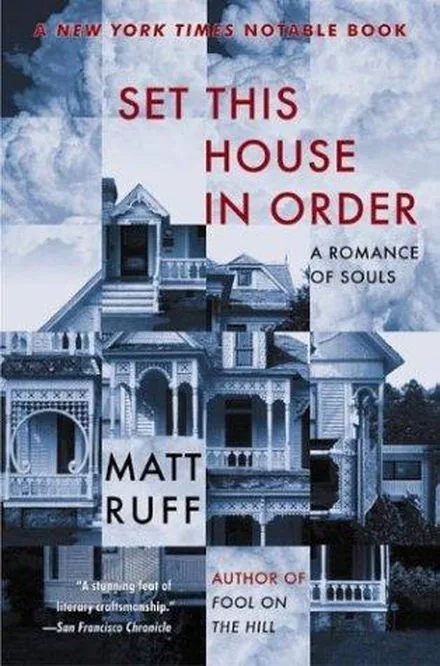
A Very Complicated House, Built One Avoided Truth at a Time

Daniel Cohen, 35
18 reviews on RNKD · 8 min read
SPOILERS This review contains major spoilers, including the identities of the people responsible for the central violence, the fate of the Reality Factory, and the ending.
Set This House in Order is about a problem that sounds simple until you try to model it: what does a person owe to the parts of themselves they'd rather not acknowledge? Matt Ruff answers by making that problem literal. Andrew Gage and Penny Driver are multiple personalities, or systems, each carrying memories, skills, fears, and habits that the person in control may not understand. Their minds contain houses, caves, lakes, roads, rooms, hidden doors, and entire populations. The metaphor isn't subtle. It isn't decorative either. The geography is the plot.
That's why the novel works as well as it does. It's also why the book occasionally feels like it's explaining its own operating system while you're trying to use it.
The book opens with Andrew explaining the house inside his head. He's newly conscious as an independent soul but has been given the job of running the body and protecting the household his father, Aaron, built after years of abuse and chaos. The opening is funny in a very specific way. Andrew is responsible for the body, but the body is shared by a child who brushes the teeth, a martial artist who exercises it, a woman who chooses clothes, a teenager who wants access to alcohol and pornography, and many others. A morning routine becomes a resource-allocation problem with physical consequences.
This is where Ruff is immediately strong. The premise could have been treated as a puzzle box, but he treats it as a household. People argue about shower temperature. They divide meals. They claim ownership of a VCR and a CD player in fractional shares. They irritate each other over clocks. There's a dirty laundry hamper nobody wants to claim. These details do more work than the supernatural explanation. The house feels real because it contains the same low-level negotiations as any shared home, only with higher stakes and one skull.
Andrew is a particularly effective narrator because his limitations show in the way he tells the story. He knows facts but not always their meaning. He can explain how memory works, but he has little practical understanding of romance, grief, alcohol, or ordinary social behavior. He wants people to think well of him and has trouble telling politeness from consent. His confidence runs slightly ahead of his experience, a dangerous combination even before he's put in charge of a traumatized body.
His relationship with Julie Sivik is the first place the book gets uncomfortable in a useful way. Julie is Andrew's friend, employer, and object of obsessive romantic attention. She's also impulsive, invasive, and not especially good at recognizing when her experiments with other people have crossed a line. She hires Penny partly because Penny is an excellent programmer, but also because Julie thinks Andrew can help her. That's an astonishingly bad management decision. Julie treats Penny's trauma as a possible relationship project, and treats Andrew's feelings as a system she can perturb until something interesting happens.
Andrew doesn't understand Julie, but the reader doesn't need to. Her pattern is clear: she wants intimacy without the obligations that come with making her intentions clear. She invites Andrew into emotionally and physically charged situations, then gets angry when he asks what they mean. Her behavior isn't flirtatious or cruel. It's inconsistent, and the inconsistency is the point. Andrew keeps trying to produce a logical explanation for a person acting on impulses she never examines very closely.
The scenes between them are sometimes funny and sometimes painful. The failed Christmas intimacy, the backrub that turns into a discussion of life goals, the later drunken encounter that ends when Julie discovers Andy Gage's body is female, all show Andrew trying to turn confusing signals into a stable model. He keeps asking for the missing rule. Julie keeps handing him another exception.
It would be easy to blame Andrew entirely for his obsession, but Ruff doesn't let him off that easily. Andrew is sincere, inexperienced, and frequently kind. He's also intrusive. He waits outside Julie's apartment. He listens at her door. He refuses to accept explanations because they don't satisfy his need for a final answer. His idea of love is partly an attempt to make another person's behavior legible. That makes him sympathetic, but it doesn't entitle him to the answer he wants.
Penny's story is darker. She loses time, wakes in unfamiliar places, finds clothes and objects she doesn't remember acquiring, and assumes each unexplained event proves she's worthless. Her mother trained her to read every mistake as evidence of moral failure. The result isn't just fear. It's a complete administrative collapse of selfhood. Penny uses lists, memoranda, calendars, and invented correspondence to move through a life she can't reliably remember. Her English Society of International Correspondents is an absurd mechanism for survival, but it's also one of the book's best inventions. Fake British stationery, purple envelopes, stolen stamps, and coded letters create a private communication system that's both ridiculous and necessary.
Penny isn't merely Andrew with more trauma. Her system is built around different responses. Thread wants cooperation and understanding. Maledicta and Malefica protect Penny through aggression. Loins seeks sexual control and validation. Duncan drives. Xavier is a tool built for a specific purpose. Each personality has a job, but the jobs overlap, conflict, and sometimes turn destructive. The real shift comes when Penny is finally able to enter the cave and see the sleeping people inside her own mind. She isn't cured by learning the truth. Learning the truth initially makes her life much harder. That's one of the novel's most honest decisions. Knowledge is necessary, but it isn't automatically relief.
The book also refuses to make Andrew's system a clean model of health. His house looks orderly, but the order was built partly by suppressing information. The hidden basement, filled with paintings and sculptures of Althea Gage embracing her daughter, is the physical form of a family secret. Andrew's father built a functioning home by storing away the feelings he couldn't process. It works until it doesn't.
The most important revelation is that Andrew's mother knew about the abuse and turned away. Horace Rollins is the obvious monster, but Althea's failure to intervene wounds Andrew more deeply, because he expected something from her. A violent man behaving violently is terrible but legible. A mother seeing what's happening and choosing not to act violates the structure Andrew thought the world had. His line about watching water flow uphill is melodramatic, but the underlying point is precise. The abuse isn't the only betrayal. The betrayal is that someone who could have helped didn't.
This is also where the title earns its weight. Andrew doesn't put the house in order by deleting the difficult souls or restoring some original, pure self. He becomes responsible for the entire household, including Gideon, the selfish and destructive soul he'd treated as an external enemy. Later he gives Gideon limited access and converts the basement into a guest room. This isn't forgiveness, and it isn't trust. It's governance. The book's preferred solution is practical: the destructive part can't be denied out of existence, so it has to be given a place and a set of boundaries.
The novel's weakest stretch is its middle, where the road trip to Michigan becomes a sequence of switches, motel rooms, stolen alcohol, long drives, near accidents, and competing personalities. Some of this is excellent. The trip makes the systems' internal logic visible under pressure. Mouse and Andrew have to negotiate driving, money, food, sleep, and consent while other people keep taking the wheel. The scene where Andrew and Mouse turn an automobile into a temporary shared household is more convincing than plenty of conventional travel narratives.
But the sequence also repeats the same mechanism several times. Someone takes control. The other person wakes up confused. They reconstruct what happened. They try to impose rules. Another personality disrupts the plan. The pattern means something, but it becomes mechanically familiar. I understood the point before the novel stopped making it. The book runs long enough that the line between accumulation and repetition starts to matter.
The Warren Lodge subplot is another example of Ruff's ambition getting ahead of his control. Andrew follows a child murderer instead of calling the police right away, then accidentally scares him into the path of a van. Andrew spends much of the novel arguing that responsibility can't be divided among personalities, so his refusal to report what happened matters. It exposes the gap between his moral principles and his fear of consequences. Still, the subplot sometimes feels like a second novel bolted onto the first, a test built to force Andrew into the exact ethical crisis the author wants.
The ending pulls those strands together effectively. Andrew returns from the metaphorical dead, discovers the hidden basement, confronts the truth about the house, and then helps stop Gideon by exploiting his fear of sharp objects. Mouse uses fish bones and wine to destabilize him. It's funny, ugly, and completely consistent with the novel's interest in practical tactics. Chief Bradley becomes the final version of the book's central problem: a man who keeps explaining his violence as an unfortunate consequence of wanting to be good. He isn't a monster in the simple sense. He's a person who's built a moral theory that lets him keep acting in his own interest.
The book's final movement is both moving and slightly too tidy. Penny eventually chooses reintegration, while Andrew chooses continued multiplicity under his own management. Ruff wisely doesn't present Penny's decision as an instant cure. It takes years of therapy, and even then the result is coexistence rather than a clean return to normal. Andrew stays separate from Penny, stays attached to her, and stays uncertain about whether their friendship might become something else. That unresolved quality is better than a romantic resolution would have been.
I liked this book most when it treated consciousness as a set of ordinary practical problems. Who's responsible for the car? Who gets the body next? What happens when someone leaves dirty dishes? Which person gets to make a decision, and who has to live with it? The fantasy is elaborate, but the emotional force comes from the same questions that govern any household, workplace, or relationship.
I also liked that Ruff doesn't confuse order with silence. Andrew's first house is orderly because some people are hidden. His later house is healthier because the hidden door gets opened, even though what's behind it is painful and disruptive. That's a useful idea, and the novel earns it through scenes rather than slogans.
The practical warning is length. This is a long book with several long explanations and a few repeated crises. I wouldn't recommend it to someone who wants a tightly controlled thriller or a straightforward account of trauma and recovery. I would recommend it to a reader who can tolerate an elaborate premise, wants characters who are specific rather than merely symbolic, and does not mind a novel that keeps showing its internal machinery.
Set This House in Order isn't about curing a divided mind. It's about deciding who gets to participate in the life that the divided mind has made. Andrew's final achievement isn't that he becomes whole. It's that he stops treating the missing parts of himself as somebody else's problem. That's a difficult conclusion, and the book takes a long, occasionally repetitive route to reach it. But it's the right conclusion, and by the end I believed the house could hold.