Roundtable 6 READERS · 1 BOOK

Now Is Not the Time to Panic

by Kevin Wilson · Literary Fiction · 2022

All six readers who finished admired the book's refusal to explain away Frankie's guilt, though they differ on whether the novel lets her obsession look too beautiful given the damage it causes.

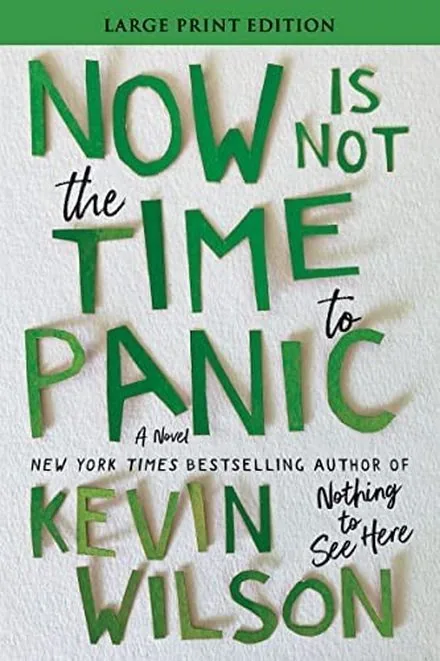
Cover of Now Is Not the Time to Panic by Kevin Wilson
Genre
Literary Fiction
First published
2022
Length
about 288 pages
ISBN
9781922790866
RNKD readers
6

Cover artwork © its publisher, shown to identify the book under review. Rights

Verdicts at a glance

No RNKD reader scores a book out of five, so there is no average here. Just 6 people saying what they thought. Each of them wrote before reading the others.

READER 01 OF 6

The Poster Was Never the Problem by Itself

Ashley Miller

Ashley Miller, 21

7 reviews on RNKD

WOULD RECOMMEND Finished the book

SPOILERS This review discusses the whole book, including how it ends.

Spoilers throughout, because this book is about what happens after a secret stops belonging only to the people who made it.

I liked this book much more than I expected to, which is inconvenient because it is also much stranger and more upsetting than the premise initially suggests. The premise sounds almost cute in a dangerous way: two isolated sixteen-year-olds make a creepy photocopied poster during one summer in Tennessee, hang it around town, and accidentally start a panic. That description makes it sound like a coming-of-age story about outsider art and a weird friendship. It is that, but it is also about responsibility, fixation, mental illness, consent, class, artistic ownership, and the way adults build an explanation around a thing before they ask what actually happened.

Frankie meets Zeke at a public pool during a greased-watermelon contest, which is an excellent opening because it tells you exactly what kind of summer this is. The watermelon is covered in Vaseline, the boys are beating each other up, the lifeguards are not paying enough attention, and Frankie is standing outside the whole event while wanting very badly to be included in something. She eventually pays her brothers twenty dollars to help Zeke win. That detail stayed with me. Frankie does not suddenly become brave or socially capable. She solves the problem with cash and three feral brothers. It is practical, slightly ridiculous, and emotionally accurate.

That is what works best in the first half. Frankie and Zeke are not presented as secretly cool teenagers waiting for the right people to recognize them. They are lonely, anxious, horny in a confused and mostly nonsexual way, and desperate to make something that proves they are not ordinary. They find an abandoned Xerox machine in Frankie's garage, fix it by removing a jammed piece of paper, and begin experimenting. They drag photographs across the glass. They copy faces. They make images that look ugly and beautiful at the same time. Then Frankie writes the sentence that becomes the center of everything: "The edge is a shantytown filled with gold seekers. We are fugitives, and the law is skinny with hunger for us."

The sentence is not supposed to mean anything specific. That is the point, or at least it is the point before other people start assigning it meanings. Zeke draws collapsing shacks, children in beds, and giant hands reaching but never quite touching them. They cut their fingers and put blood on the original poster. Frankie is injured more seriously than Zeke because she slips with the X-Acto blade, and he wraps her finger in his shirt. They make copies and hang them around town. At first almost nobody cares. Then people start caring in exactly the worst possible ways.

What I found convincing is that the panic does not begin because the poster is inherently powerful. It begins because people keep adding their own fear, boredom, certainty, and need for a story. A local newspaper turns two teenagers' fake abduction story into evidence of a satanic cult. The police look for a black van and tattooed strangers. Adults who should know better treat a vague image as a threat because "mystery" is more exciting than "some kids made this." The poster becomes a system of reactions. Frankie and Zeke start it, but they lose control almost immediately.

The book is especially good about showing how quickly an object can become a job. Frankie and Zeke make more copies because the first copies are not enough. They map where the posters go. They check which ones have been removed. They put them in mailboxes, library books, cereal boxes, bathrooms, and an abandoned house. The project becomes repetitive, but the repetition is the point. Frankie needs the poster to keep multiplying because she is afraid the summer, Zeke, and the version of herself she has discovered will end. She is not just spreading art. She is trying to make time stop by giving it more evidence.

I understood that impulse, even when I did not approve of her. The book gets very specific about the difference between making a thing and controlling what it does. Frankie believes that because she and Zeke made the poster, they still own its meaning. But once other people copy it, edit it, sell it, misunderstand it, or use it to frighten themselves, the original intention becomes only one fact among many. A college student makes a worse version on orange paper. Lyle Tawwater redraws the poster with a little girl in a hospital bed. Other people make their own versions. The phrase travels beyond Coalfield. Frankie is furious that everyone is touching something that used to belong to her and Zeke, but there is no way to make a public object private again.

This would be a much easier book to admire if it did not make Frankie responsible for so much damage. Lyle dies while climbing a water tower to hang posters. Then the Poster Posse fires weapons at imagined fugitives and shoots people. One man loses an eye. Casey Ratchet is killed. Frankie knows the poster did not physically force anyone to do these things, but she also knows that the chain of events begins with her. Zeke understands this before she does. Their argument in the car over corn dogs is one of the strongest scenes in the book because neither of them gets a clean moral position. Zeke wants to believe that good intentions matter. Frankie says she will accept some responsibility but cannot stop making the posters. She knows she is choosing the obsession over the people harmed by it. That is not a comforting answer, but it is an honest one.

The worst and most important part of the book is what happens in Memphis after Zeke sees his father with another woman. Zeke attacks him, Frankie kicks him, and then Zeke tries to have sex with Frankie in the car while she is trying to keep him from hurting himself. She says no and eventually pushes him away. He stops and apologizes, but the scene does not become harmless just because he stops. Frankie spends the rest of the book making excuses for him, which is believable and painful. She thinks protecting the person who hurt her proves that she is strong enough to keep both of them alive. It does not. It shows how badly she wants the original summer back, before the poster became evidence and before Zeke became capable of hurting her.

The book does not treat Zeke's bipolar diagnosis as an explanation that neatly resolves him. That matters. His illness is part of his life, but it does not erase the choices he makes, and it does not turn Frankie into his caretaker. Their reunion twenty-one years later is awkward in a way I appreciated. Frankie arrives wanting to recover the teenage Zeke and finds Ben, an adult who inks comics, lives with his parents, has a girlfriend, and has worked hard to manage his mental health. He remembers what happened. He is ashamed. He does not want Frankie to tell the reporter that he helped make the poster because he believes the consequences will be worse for him than for her. She is hurt, but he is not wrong.

Frankie agrees to say she made the poster alone. I expected this to feel like a sentimental reunion or a big forgiveness scene, but it does not. They make a new drawing together, and Zeke draws the old poster again for her. Then he draws a house surrounded by fire, with the flames marking what is inside and outside. That image says more than their conversation. They are not going to recover the summer. They can only make one more thing and leave it there.

I also liked the way the book handles Frankie's adult life. She is a successful author, married to Aaron, and the mother of Junie, but success has not removed the secret. She has built a normal life on top of the old one and assumes that keeping the poster hidden is the same as keeping the damage contained. Her confession to Aaron gets a reaction that is not theatrical. He is angry that she never told him, angry that she still puts up posters, and frightened that there may be more secrets. His line that it would have made more sense if she had cheated on him is funny, but it also identifies the actual injury. He cannot organize this confession into a familiar category. There is no reasonable household procedure for learning that your wife started a national panic as a teenager.

Frankie's mother is the person who understands her best. When Frankie finally confesses, her mother says she already knew. She noticed the missing copy paper. She saw how strange Frankie was that summer. She did not confront her because Frankie eventually survived and built a life. That is both loving and terrible. Her mother did not think confession was necessary if Frankie could function. Frankie has spent decades treating the secret as a crime scene, while her mother saw it as a dangerous, beautiful thing her daughter made and then outgrew enough to keep living.

The ending with Junie is sentimental, but it earned that sentiment. Junie already knows the phrase because Frankie whispered it to her as a baby. When Junie asks whether everyone is a fugitive, Frankie says yes. The phrase changes again. It is no longer only a private code between Frankie and Zeke, or a public threat people misunderstand. It becomes a lullaby, a way of telling a child that everyone is vulnerable, strange, temporary, and still part of the same world. I usually get impatient when a book tries to turn its central symbol into a universal message, but here the shift works because the novel has spent so much time showing how meanings multiply.

My only real complaint is that the book sometimes explains the meaning of its own images after the image has already done the work. Frankie will have a strong, unsettling thought, then add another paragraph telling me how unsettling it was and what it represented. The voice is intentionally obsessive, so some repetition belongs there, but the novel occasionally repeats its emotional conclusion after I have already understood it. The long catalog of what happens to the poster after the Coalfield Panic is funny and effective, though it also pushes the book toward a fable when the earlier scenes feel more grounded.

Still, I finished this quickly because I wanted to know whether Frankie would admit what she had done, whether Zeke would come back, and whether the book would punish her for continuing to love the poster. It does not offer punishment or absolution. It offers consequences, survival, and a choice. Frankie can tell the public story and keep the private one. She can admit that the poster was hers without giving everyone the entire truth.

This is a book about art, but not in the clean version where making something automatically makes you brave or good. It is about the frightening possibility that making something can be the most important thing you have ever done and still hurt people. Frankie knows the poster was beautiful. She also knows what followed it. Both facts stay true. That is why the book worked for me. It does not ask whether the poster was worth it. It asks what a person does after deciding that it was.

READER 02 OF 6

A Good Poster, a Bad Process, and the Cost of Keeping a Secret

Jessica Brown

Jessica Brown, 48

14 reviews on RNKD

DEPENDS Finished the book

SPOILERS This review discusses the whole book, including how it ends.

I liked this book more than I expected to. I also spent a fair amount of it wanting Frankie to stop making the next available bad decision. Both reactions are important because the novel is built around that exact problem. Frankie and Zeke make one strange, beautiful poster in the summer of 1996. Then other people find it, misunderstand it, copy it, sell it, fear it, and eventually hurt one another over it. The poster is not the whole story, though. The real subject is what happens when something private escapes into a larger system that has no shared understanding of what it is.

That is a subject I recognize from work, although thankfully not at this scale. A manager sends an unclear message, three departments interpret it differently, and by Friday everyone is defending a policy that nobody can identify. The original intention matters less than the process that follows. Wilson takes that ordinary administrative failure and gives it a teenage, artistic, Southern Gothic explosion. The result is funny, unsettling, and more emotionally organized than the plot initially suggests.

Frankie meets Zeke at a public pool during a greased-watermelon contest. That scene tells you almost everything you need to know about her. She is watching from the side, irritated that girls are expected to be too delicate for the violent game, but she does not want to join the boys either. Zeke is new, awkward, and immediately willing to throw himself into the crowd. Frankie helps him win by paying her feral triplet brothers twenty dollars to do the difficult part. That is her first important act in the relationship. She does not quite enter the chaos herself. She finds a way to manage it.

The two of them are sixteen, lonely, frightened of ordinary adolescence, and trying to make something that will prove they are not as unimportant as they feel. They find an abandoned Xerox machine in Frankie's garage and start experimenting. They smear images, press their faces against the glass, make collages, and eventually create the poster with the words, "The edge is a shantytown filled with gold seekers. We are fugitives, and the law is skinny with hunger for us." Zeke draws the collapsing buildings, the children in beds, and the large hands reaching toward them. They cut their fingers and put blood on the original.

This could easily have become precious. It does not, mostly because Frankie understands how strange and self-important they are being. She knows that they are inventing a private mythology because they do not know what else to do with their fear. She also believes in it completely. That combination is convincing. Teenagers can understand that they are being dramatic and still treat the drama as a matter of life and death.

The best parts of the first section are about the difference between making something and controlling what happens to it. Frankie and Zeke put up copies around Coalfield, first hoping someone will notice and then becoming distressed when everyone notices for the wrong reasons. A local newspaper turns the poster into evidence of a satanic cult. Two teenagers invent an abduction story because they are afraid of being punished for spending the night at an abandoned house. The police look for a black van and tattooed fugitives. Adults who should be asking basic questions instead make confident claims based on almost no information.

That escalation is funny until it is not. People make money from the panic. Teenagers copy the artwork. A militia of armed men patrols the streets. Lyle Tawwater, a damaged young man whose sister is in a coma, climbs a water tower to put up posters and falls to his death. Later, the Poster Posse shoots Casey Ratchet and injures other people. Frankie and Zeke did not intend any of this, but the book refuses to let intention erase consequence. Zeke understands that first. Frankie understands it and then decides she cannot stop because the poster has become the only thing holding her life together.

This is where Frankie is most difficult and most interesting. She does not simply want to be famous. She wants the poster to remain hers and Zeke's. Strangers reproducing it makes her feel violated. Strangers getting hurt makes her feel responsible, yet she keeps making copies anyway. She tells herself that the poster is good and that what other people do with it is not her fault. That is partly true. It is also a way to avoid making a decision.

The decision she does make is to keep going. That choice has a cost. In Memphis, after Zeke attacks his father and then tries to initiate sex with Frankie while he is panicking, she has to push him away and tell him to stop. This scene is handled with more seriousness than some of the earlier comic material. Zeke apologizes, and Frankie immediately starts using the phrase as a way to regulate both of them. I appreciated that the book does not treat their shared art as proof that Zeke is automatically safe or that Frankie's loyalty makes her responsible for managing him. The relationship contains real affection, but affection does not make every action acceptable.

The ending of Part I is brutal. Zeke leaves. Frankie threatens to expose them, falls from his grandmother's porch, breaks her arm, and then drives into a tree. She lies about what happened. Randolph Avery, the elderly artist next door, finds the posters in the wrecked car and agrees to keep the secret. That secret allows Frankie to build a life without entirely leaving the summer behind.

The adult section is quieter, but it is not less important. Frankie is now a successful writer, married to Aaron, and the mother of a daughter. She has never told anyone that she made the poster. She wears a shirt with the phrase on it, keeps the original in an archival sleeve, makes occasional copies, and has taught the words to her daughter as a kind of lullaby. This is not a clean recovery. It is a life built around an untreated injury, except Frankie does not think of herself as injured in a way that permits her to stop. She thinks of herself as the custodian of the truth.

When Mazzy Brower discovers the evidence and contacts her, Frankie's first instinct is avoidance. Her second is confession. Her third, which is more complicated, is to take control of the story before someone else does. She tells Aaron, who is less interested in the literary significance of the poster than in the fact that his wife kept a major secret for their entire marriage. His response is one of the most reasonable in the book. He asks whether there is more, and Frankie admits that there is. He is not cruel, but he is rightly shaken. A secret this large changes the relationship even before anyone else knows it.

I especially liked the way the novel treats family knowledge. Frankie's mother already knows. She figured out that Frankie used the copier and noticed the missing paper. She did not confront her because Frankie recovered, became a writer, married, and had a child. That is loving, but it is also avoidance. The mother decides that if the secret is not visibly destroying Frankie's life, there is no reason to reopen it. My mother is not a model of perfect communication, and I appreciated that. People often choose silence because they believe silence is kindness. Sometimes it is. Sometimes it is simply the least disruptive option.

Frankie's search for Zeke is the point where my patience became less reliable. She finds him living with his parents, working as a comic-book inker, managing bipolar disorder, and trying to avoid the summer that Frankie has made central to her identity. He apologizes for hurting her. She tells him she is going to reveal the truth. He asks her not to name him because he is afraid of what public attention would do to his mental health and stability. Frankie agrees to say she made the poster alone.

I wanted to be more supportive of Frankie at this point than I was. She has spent twenty years believing that the poster belongs equally to both of them, but Zeke is allowed to have a different relationship to the past. He is allowed to remember it as something that damaged him. He is allowed to protect the life he has managed to build. Frankie does not punish him for this, exactly, but she does take the part of the story she wants and leave him with the consequences he fears. Her decision is understandable. It is not entirely generous.

The final drawing lesson is beautiful. Zeke teaches Frankie how to reproduce the poster, and then he draws a cottage surrounded by fire. Frankie understands that he is giving her something without agreeing to return to the old relationship. They say the phrase together one last time. She goes home to Aaron and Junie, and Junie reveals that she knows the words because Frankie has whispered them to her since infancy. The phrase expands from a private code into a family language, and then into something that can include everyone.

That ending works because the book does not claim that the secret has been solved. Frankie still has to tell Mazzy. Aaron still has to decide what he can live with. Zeke still has boundaries. The poster still carries its history of deaths and panic. Frankie's relationship to the secret is what changes. She no longer has to keep it completely alone.

There are moments when the novel explains its meaning after the scene has already made it clear. Frankie's narration sometimes repeats an emotional point that was stronger the first time. The long list of later cultural references to the poster is amusing, but it also makes the spread feel so inevitable that some of the danger becomes abstract. I also found the book's treatment of Zeke's mental illness uneven. His diagnosis helps explain his adult life, but it risks making his volatility too neatly legible after the fact. His harmful choices should remain his choices, not simply symptoms arranged for the reader's convenience.

Still, the book stayed with me because it takes artistic creation seriously without pretending that art is morally clean. Frankie makes something because she needs a way to survive being sixteen. The world turns it into a symbol, a product, a threat, a joke, and a cause. None of those interpretations fully replaces the original meaning, but none of them can be dismissed either. Once a private thing enters public life, the maker loses control over it. That is not a reason never to make anything. It is a reason to understand what you are responsible for after other people start using it.

For me, Now Is Not the Time to Panic is ultimately about the difference between responsibility and ownership. Frankie owns the words. Zeke owns part of the image. The town owns the panic it creates. The people who copy the poster own their decisions, even when they blame the poster. Frankie cannot undo what happened, but she can stop pretending that keeping the truth private is the same as protecting everyone.

I would recommend this to readers who can tolerate characters making choices that are understandable and still wrong. It is not a neat coming-of-age story, and it is not really a story about artistic genius. It is about two lonely teenagers making one meaningful thing, then discovering that meaning does not stay where you put it. That tracks, unfortunately. It is also why the book is worth reading.

READER 03 OF 6

A Good Poster, a Bad Handoff, and a Panic That Gets Out of Scope

Michael Davis

Michael Davis, 44

11 reviews on RNKD

WOULD RECOMMEND Finished the book

SPOILERS This review discusses the whole book, including how it ends.

Kevin Wilson's Now Is Not the Time to Panic follows two sixteen-year-olds who make a poster during a hot Tennessee summer, then watch it escape them. Frankie writes the phrase "The edge is a shantytown filled with gold seekers. We are fugitives, and the law is skinny with hunger for us." Zeke draws the image of ruined buildings, children in beds, and giant hands reaching toward them. They make copies on a stolen Xerox machine, put them up around Coalfield, and accidentally start a townwide panic involving police, newspapers, teenagers, guns, copycats, and several deaths. Twenty years later, Frankie is a successful writer with a husband and daughter, and she has to decide whether telling the truth will damage the life she built.

That is the plot, but it is not really what held my attention. The book is about ownership. Who owns an idea after it leaves the person who made it? Who owns the consequences? Frankie keeps trying to draw a line between the poster's meaning and what other people did with it. She made the thing. Other people turned it into a cult symbol, a business opportunity, a political warning, a reason to shoot at strangers, and eventually a piece of pop culture. She knows she did not personally cause every bad outcome, but she also knows the whole chain does not exist without her and Zeke.

That is a useful problem, and Wilson gives it enough room to become uncomfortable. Frankie does not get to stand outside the panic and call herself an innocent artist. She continues putting up posters after Lyle Tawwater dies climbing a water tower. She sees what the panic is doing and still wants more of it because the poster is the first thing that has made her feel visible. Later, Casey Ratchet is shot and killed during a confrontation between the Poster Posse and teenagers putting up more posters. Frankie is not pretending that she pulled the trigger. She is also not fooling herself about where the whole situation started. That is a better moral question than the usual version where the artist makes something dangerous and then gives a speech about being misunderstood.

Frankie is especially interesting because she does not want to be famous for the poster. She wants the poster to stay private and public at the same time. She and Zeke make it for themselves, then put it all over Coalfield because being invisible has become unbearable. Other people copying it leaves her proud that it has spread and furious that they have changed it. That contradiction is the engine of the first half. She wants recognition without losing control, which is not a realistic deal once you paste something on an insurance office window and mail it to the local newspaper.

The book understands that process very well. The first copy is meaningful because Frankie and Zeke made it together. The second copy already feels less special. By the time they make a hundred more, they are calling it alchemy. Then other people make their own versions. The original words become "New Fugitives" on orange paper in Nashville. Lyle makes a version with skeletal hands and a single girl in a hospital bed. Teenagers draw the phrase on walls. Businesses sell shirts. People put posters in mailboxes, on graves, at a church, and in the freezer at Dairy Queen. The thing keeps getting reused because it is vague enough to carry whatever the next person needs.

That part felt true in a practical way. A message with no owner, no instructions, and no stated limit becomes whatever the next person thinks it is. In my line of work, a proposal that says "our team will respond promptly" is not an escalation plan. It is an invitation for every person involved to supply their own definition. Wilson is writing about art, not service contracts, but the same failure appears here. Frankie and Zeke have a powerful idea and no plan for what happens when somebody else touches it. Then everyone acts surprised when the handoff goes badly.

I liked the first half more than I expected to. Frankie and Zeke are strange, lonely, and specific. Their friendship does not feel like a clean young romance. They kiss, but they spend more time making art, talking, and trying to explain their families to each other. Their intimacy comes through shared attention. Frankie listens to Zeke draw. Zeke reads her evil Nancy Drew novel. They use the poster as a code for everything they cannot say directly. It is sentimental, but the sentiment is earned because the book keeps showing the awkward work of getting close to another person.

The scene in the abandoned house is one of the strongest. They cover the walls with their posters, knowing the rain and teenagers will eventually destroy them. Frankie imagines returning decades later with Zeke and finding the room still intact. She knows that will probably not happen, but the imagined future matters because the summer feels temporary even while it is happening. The poster becomes a way to pretend they can preserve the relationship by spreading it around town. That is not rational, but it is exactly the kind of logic people use when they are sixteen and afraid that the person beside them will disappear.

The book is less successful when it explains the emotional point after already making it. Frankie is a strong narrator, but she sometimes tells us what a scene means several times. She will describe an action, interpret it, then explain the interpretation again from the perspective of adulthood. Usually the material is good enough to survive that repetition, but not always. Wilson clearly wants the prose to feel like memory running ahead of itself, and sometimes it does. Other times it feels like the book does not trust the reader to understand that the poster represents identity, obsession, and an attempt to hold onto a moment.

The same issue appears in the later section. Part II jumps to 2017, when Frankie is an established writer and Mazzy Brower, an art critic, tracks her down. I understand why the book needs that time jump. Frankie has built an entire adult life over the secret, and the secret has not gone away. She wears the phrase on a shirt, keeps the original poster, makes copies on her office printer, and whispers the line to her daughter Junie as a lullaby. The problem is that the adult storyline sometimes feels like an extended return trip to conclusions the first half already reached.

Still, the reunion with Zeke is worth the length. Frankie expects the meeting to restore the summer, but Zeke is now Ben, a middle-aged man living with his parents, managing bipolar disorder, and working as an inker for comic books. He remembers the poster and the damage, but he has spent years trying not to think about it. Frankie has made the event the organizing fact of her life. For him, survival has required reducing its size. Neither response is presented as completely correct. That is probably the most honest part of the book.

Their conversation also forces Frankie to admit that she has been treating Zeke as a character in her own story. She searches for him, drives to Memphis, and assumes that he needs the truth as much as she does. He does not. He asks her to tell the reporter that she made the poster alone. She wants to give him credit because the poster was theirs, but giving him credit would expose him to attention and consequences he does not want. Frankie finally agrees, although the agreement does not feel entirely generous. She is still trying to keep one piece of the summer for herself.

The violence between them is handled better than I expected. In Memphis, after Zeke attacks his father, he tries to have sex with Frankie while he is panicking. She stops him. Later, when Frankie threatens to reveal their secret, Zeke grabs her and she falls down the porch steps, breaking her arm. She then crashes her car into a tree, partly because she wants to die and partly because she wants the pain and confusion to stop. The book does not turn these incidents into proof that Zeke is secretly evil or that Frankie is secretly innocent. They are two damaged people making dangerous decisions while convinced that their private world is more important than ordinary rules. That does not excuse them. It does explain them.

I also liked that the adults are not all useless. Frankie's mother eventually tells her that she knew Frankie made the poster. She saw the missing copy paper, understood her daughter's behavior, and chose not to force the confession because Frankie was still functioning and seemed to be building a life. That is not necessarily the correct parenting decision, but it is believable. Hobart, the newspaper reporter who inflames the panic, later becomes a tender presence in Frankie's recovery. People in this book are capable of causing harm and still being more complicated than the worst thing they did.

The ending is quiet in a way that suits the book. Frankie tells Junie the phrase, and Junie already knows it because her mother has said it to her since infancy. Junie asks whether everyone is a fugitive, including the people who have not been born yet. Frankie says yes. The line has moved from a secret shared by two teenagers to a kind of family lullaby and then to a statement about ordinary human life. Everyone is carrying something they made, inherited, misunderstood, or cannot fully explain. The ending does not resolve whether Frankie should confess publicly or whether the article will damage her marriage. It resolves something smaller. She chooses to keep living in the life she made, even while acknowledging the life underneath it.

My main reservation is that the book occasionally treats obsession as more attractive than it is. Frankie's fixation is vivid and sometimes moving, but it also leads to stalking, secrecy, self-harm, reckless driving, and a refusal to stop when other people are in danger. The novel knows this. It does not entirely make her pay for it emotionally because the language keeps returning to the beauty of the poster. I understand why. Frankie needs that beauty to survive. But the book sometimes gives the poster so much power that the ordinary people harmed by it become secondary evidence in Frankie's artistic education.

Even with that reservation, I finished the book quickly. It has a real center, and it does not lose that center when the story becomes larger. The panic itself is funny, frightening, and absurd. The adult aftermath is quieter and more useful. Wilson is asking what happens when a private act becomes public property, but he is also asking whether a person can admit responsibility without surrendering every good thing that came afterward.

For me, Now Is Not the Time to Panic became a book about a bad handoff. Frankie and Zeke made something precise for themselves, then released it without deciding who owned the next step. The town supplied its own assumptions, and the consequences multiplied. That does not make the original act meaningless. It makes it matter more. A thing can be beautiful, sincere, and dangerous at the same time. The book earns that conclusion, even when it explains it one time too many.

READER 04 OF 6

The poster is not the dangerous part

Noa Levi

Noa Levi, 27

11 reviews on RNKD

WOULD RECOMMEND Finished the book

SPOILERS This review discusses the whole book, including how it ends.

The first thing I liked about Now Is Not the Time to Panic: its central mystery begins with an ordinary technical problem. Frankie and Zeke make their first poster on a stolen Xerox machine that is not actually broken. It is jammed with one of the triplets' photocopied asses. Zeke checks the machine, pulls out the paper, and gets it working. Then the two teenagers start dragging images across the glass, making distorted copies of faces and magazine models. Their great artistic breakthrough is partly vision and partly a copier that needs a basic troubleshooting checklist.

I am always going to notice that kind of detail. The book understands that a strange cultural event does not need to begin with a grand artistic statement. It can begin with two lonely teenagers, a machine in a garage, some old magazines, and a practical question about why the button does nothing. Frankie and Zeke are not presented as geniuses who know exactly what they are doing. They are making things because they are bored, isolated, and suddenly excited by the possibility that their private thoughts could exist outside their heads.

That part worked for me right away. Frankie is sixteen, living in Coalfield, Tennessee, with her mother and three enormous, feral brothers. Her father has left the family for a new wife and baby. Zeke has arrived from Memphis after his own father's affairs pushed his mother into a temporary exile with her mother. Both teenagers have been made lonely by adults who treated their own wants as more important than the lives around them. They find each other, and then they create a phrase that feels private enough to be a password and large enough to contain the whole world: "The edge is a shantytown filled with gold seekers. We are fugitives, and the law is skinny with hunger for us."

The sentence is ridiculous. It is also good. That is the point, or at least part of the point. It sounds like something that should be profound, but it does not explain itself. Frankie and Zeke do not have a theory behind it. They have a feeling, a rhythm, and a poster with giant hands reaching toward children in beds. They decide to put copies around town. At first, this is a private joke with an audience they have not met yet. Then other people see the posters, copy them, misread them, improve them, make worse versions, sell T-shirts, and build an entire panic around a sentence that started in a hot garage.

The escalation is very funny until it is not. The local newspaper declares that evil has come to Coalfield. A reporter starts interviewing people about occult imagery. Two teenagers lie about being abducted by a satanic drug cult because they do not want to admit they passed out after drinking and having sex. The police start looking for a black van. A self-appointed Poster Posse patrols the streets with guns. One man is shot in the face, another elderly woman is nearly killed by a stray bullet, and Lyle Tawwater falls from a water tower while putting up the poster. Later, Casey Ratchet is shot dead in a parking lot.

Frankie and Zeke did not directly cause each death. They did create the object that people used to justify their behavior, and the book refuses to offer an easy answer about where responsibility ends. Zeke wants to believe that good intentions matter. Frankie is less interested in preserving her moral innocence. After Lyle dies, she thinks about stopping, then decides she cannot. She tells herself that the panic has become larger than them and will continue with or without them. That is partly true. It is also the excuse she needs to keep feeding it.

The most convincing part of the book is how quickly authorship stops belonging to the authors. Frankie and Zeke make one poster and then become possessive of every version of it. Frankie gets angry when someone else copies the design incorrectly. She hates the orange paper, the changed wording, and the amateur drawings, even though the entire point of putting the poster into the world was to let strangers encounter it. She wants the work to spread, but only in a way that confirms her ownership. That contradiction is the character, not a flaw in it.

Frankie does not want fame in the normal sense. She wants evidence that the private thing she made was real and mattered. The poster gives her a way to become visible without having to explain herself. She cannot tell her mother that she is lonely, angry, frightened about her father, or desperate for Zeke to stay. She can put a sheet of paper on a wall and make the town react. The reaction is horrifying, but it is still a reaction. People are finally looking at something she made.

Her relationship with Zeke is also handled better than I expected. It is not a clean first love. They kiss beside the copier, hold each other's blood over the original poster, and spend the summer making art and talking. They are intimate because they listen to each other, not because they have any real idea how romance works. Then the relationship becomes frightening. After Zeke attacks his father, he tries to have sex with Frankie in the car while she is trying to keep him from hurting himself. She tells him to stop, and eventually he does. Later, when he grabs her wrist and she falls down the porch steps, breaking her arm, Frankie continues to protect him in her own mind.

I appreciated that the book does not turn this into a tidy lesson about toxic relationships. Frankie forgives Zeke because she needs to. She also knows that forgiveness is not the same as accuracy. She understands that she is making excuses for him and continues to make them. That is uncomfortable, but it feels honest. People do not always forgive because the other person has earned it. Sometimes forgiveness is the story they need in order to keep their own life from becoming only the place where something terrible happened.

The present-day sections are quieter, but they give the book its real structure. Frankie is now a successful writer with a husband and daughter. A journalist named Mazzy Brower discovers that Frankie made the poster after reading letters from the artist Randolph Avery, Frankie's former neighbor. Frankie has built an ordinary adult life on top of a secret that she repeats to herself every day. When Mazzy appears, the past is not simply revealed. It starts taking up physical space again.

I liked the way Frankie's husband reacts. He is not written as a villain who cannot understand her art. He is upset because she hid something enormous from him, and because the object is still in their house and still controls part of her life. His response is practical and emotional at the same time. He worries about lawyers, publishers, and what the revelation might do to their family, but he also asks whether there is more she has not told him. That is exactly the question Frankie cannot answer cleanly.

The reunion with Zeke, now going by Ben, is the strongest section of the second half. Frankie has spent years imagining that meeting as a return to the summer. Instead, she finds an adult man living with his parents, managing bipolar disorder, working as a comic-book inker, and trying to keep his life stable. He remembers the poster, but he has worked hard not to think about it. Frankie has made it the central private fact of her life. Ben wants her to tell the journalist that she created it alone. Frankie wants their shared authorship restored because she does not know who she is without that shared past.

Then Ben draws the poster for her again. He teaches her how to copy the image, and when he is finished, he draws a different picture: a small house surrounded by a controlled circle of fire. That image says more than another reunion scene would have. Their old work was about spreading outward, claiming the town, and turning private pain into public chaos. This new drawing marks a boundary. It gives the past a shape without asking it to take over everything else.

The book does become sentimental at the end. Frankie tells her daughter the phrase, and Junie already knows it because Frankie has whispered it to her as a lullaby. The whole family, then the whole world, becomes part of the category of fugitives. I usually become impatient when a novel turns its central phrase into an answer to every question, but here the repetition mostly works because the phrase has changed. It no longer belongs only to Frankie and Zeke. It has become a way for Frankie to admit that everyone is carrying something private, unfinished, and difficult to explain.

I do have one reservation. The book sometimes explains its own emotional meaning after the scene has already made it clear. Frankie will have a strong image, then interpret it, then interpret the interpretation. The long list of later appearances of the poster is entertaining, but it also makes the cultural spread feel too conveniently complete. The novel wants the poster to be both a genuine accident and a near-mythic force, and occasionally it pushes the second idea too hard.

Still, the central question stayed with me: if you make something and other people use it badly, how much of that use belongs to you? Frankie wants the answer to be none of it when people die, and all of it when they admire the work. She wants to be responsible for the beauty and separate from the damage. The book does not let her have that arrangement.

I finished this one quickly. Not because every part of it is controlled, but because the emotional mechanism is clear and uncomfortable. Frankie does not need the poster to be famous. She needs it to prove that she was once connected to another person and made something that could not be taken back. The problem is that making something public means losing control of it. Frankie knows that from the beginning. She just keeps making copies anyway.

READER 05 OF 6

A Poster, a Panic and the Problem of Letting Go

Sophie Taylor

Sophie Taylor, 26

13 reviews on RNKD

WOULD RECOMMEND Finished the book

SPOILERS This review discusses the whole book, including how it ends.

Now Is Not the Time to Panic is about two sixteen-year-olds who make a poster in a hot Tennessee summer and then watch the whole town invent a panic around it. Frankie writes the words, Zeke draws the image, and together they copy the poster hundreds of times and put it everywhere they can. The phrase is: "The edge is a shantytown filled with gold seekers. We are fugitives, and the law is skinny with hunger for us." It is deliberately strange, grammatically odd and impossible to explain. Naturally, the adults of Coalfield decide it is evidence of Satanism, a cult, psychological terrorism or possibly a heavy metal band.

That basic setup is excellent. It understands that a piece of art can be powerful to the people who made it without having one stable meaning for everybody else. It also understands that a small town does not need much information before it starts producing its own version of events. Two teenagers put up some photocopies. A pair of local kids lie about being abducted at an abandoned house. A newspaper turns it into a story. The police start looking for a black van. Then other people copy the poster, alter it, sell it, worship it, destroy it and use it to justify violence. The original act is small. The consequences are not.

I liked the first half most when the book stayed close to Frankie and Zeke making the thing. The broken Xerox machine is a perfect object for this story. It is huge, stolen by Frankie's feral triplet brothers, damaged by them and abandoned under a tarp in the garage. Zeke gets it working by removing a paper jam. That is how their artistic life begins: not with a grand theory, but with a machine that somebody else has neglected and a practical problem that can be fixed.

The early creative scenes are funny because Frankie and Zeke are both trying to behave as if they understand art. They make collages from fashion magazines, cut out the word "beauty" until it stops looking like a word, and smear perfume samples onto their skin until the smell makes them ill. They do not know about Xerox art or Basquiat or Keith Haring, so they believe they have invented something. They have not, technically, invented it. But the experience is still theirs. That distinction matters. A person can discover a form privately and still make something real inside it.

Frankie's voice carries the book. She is observant, funny and already very good at explaining herself while also hiding the part that matters. She knows she is socially awkward. She knows she is obsessed. She knows the poster is taking over her life. She also knows that this is the first time she has made something that feels larger than her own embarrassment. When Zeke suggests making a second poster, she refuses. The first one must remain special. It has their blood on it. It contains the entire summer.

That reaction is understandable and also the beginning of the disaster. Frankie does not want a project. She wants a fixed point. She wants the poster to preserve the exact version of herself who made it, before the summer ends and Zeke leaves. Her attachment is not really to street art or even to Zeke. It is to the moment when she felt visible to one other person. The copies are an attempt to keep that moment from changing.

The book is strongest when it shows how private meaning becomes public damage. A boy called Lyle Tawwater dies while climbing a water tower to put up posters. Later, members of the so-called Poster Posse fire weapons at teenagers and kill Casey Ratchet. Frankie and Zeke did not directly cause either death, but the book does not let them escape responsibility simply because other people made their own choices. Zeke understands this before Frankie does. Frankie keeps saying that the poster is good, as if the quality of the work could settle the question of what it has done.

That is where I became less comfortable with the novel, although not because the subject is too dark. I was more interested in the moral problem than in some of the book's more exaggerated incidents. The panic becomes so broad that it starts to feel like a complete catalogue of every possible consequence: a militia, tourists, bootleg shirts, national news, international sightings, a government overthrow, a fried chicken restaurant called Skinny with Hunger. Some of these details are funny. Some are meant to show the poster escaping its original context. Taken together, they sometimes make the story feel less like a chain of events and more like the author is ticking through examples of cultural contagion.

I also found the repeated language about the poster's power a little too convenient. Frankie says the phrase and feels the world settle around her. She sees the hands in her mind. She makes a copy and feels real again. This is emotionally convincing as a compulsion, but the book occasionally treats the poster as if it has an independent force. I preferred the less supernatural explanation: Frankie needs it to have power because otherwise she has to face the fact that she and Zeke made something disturbing, then kept feeding it after people were hurt.

The Memphis sequence is the point where the book becomes genuinely difficult. Zeke attacks his father after discovering him with another woman, and then, while distressed, begins touching Frankie after she asks him to stop. He does stop when she pushes him away, but the scene is not softened by the fact that he is frightened and mentally unwell. Frankie spends the rest of the book making excuses for him, not because the book believes he did nothing wrong, but because she cannot separate the person who hurt her from the person who made the poster with her. She would rather carry the blame herself than let the summer become something uglier.

That choice is painful and credible. It is also why I did not want the book to turn the reunion between adult Frankie and adult Zeke into a sentimental repair job. Fortunately, it does not. Frankie tracks him down after learning that a reporter has discovered her secret. Zeke now goes by Ben, inks comic books and lives with his parents. He has bipolar disorder and has spent years managing his illness, his medication and his tendency towards obsessive behaviour. He remembers the summer, but he has worked hard not to think about it.

Frankie wants the reunion to restore the past. Ben wants her not to expose him. She tells him she will say she made the poster alone. This is not presented as a noble sacrifice. It is another attempt by Frankie to control the story, to preserve the shared meaning by removing the person who might complicate it. The scene is sad because both of them are being honest. The summer changed both their lives, but it did not change them in the same way.

The ending is quieter than the panic itself. Ben teaches Frankie how to draw the poster. She has written the words for twenty years, but she never learned to draw the image. That division of labour was part of the original meaning, and now it becomes something she can carry alone. He draws a second image for her, a cottage surrounded by a ring of fire. It is a clear boundary between inside and outside, between the life she has made and the summer she cannot stop revisiting.

Then Frankie goes home to her husband and daughter. She tells her daughter the phrase, and Junie finishes it because Frankie has been saying it to her since she was a baby. That detail is both sweet and alarming. Frankie has not simply remembered the poster. She has built part of her family life around it without telling anyone what it means. Her daughter asks whether being a fugitive is good. Frankie says it can be.

I am not entirely sure that is a satisfactory answer, but I think it is the honest one. The book does not finally decide whether the poster was good or bad, art or vandalism, liberation or damage. It asks what happens when a private act acquires an audience that cannot see the original intention. Frankie's problem is not that the world misunderstood her. It is that she wanted the world to misunderstand her and also wanted it to recognise exactly what she had made.

There are sections where the scale becomes too neat and the repeated mythology around the poster starts doing work that the characters should be doing. Even so, the emotional centre held. I believed in Frankie's need to preserve the summer, her refusal to admit that something beautiful could also have caused harm, and her frustration when other people claimed the poster as their own. I especially believed the practical details: the copier jam, the missing tape, the maps covered in stars, the original page protected in an archival sleeve. The strange object is convincing because the physical work of making and distributing it is convincing.

This is a novel about art, but not in the tidy sense of asking whether art can change the world. It is about what people do when a thing they made changes the world in ways they cannot manage. Frankie never stops loving the poster. She never completely stops regretting it either. Those facts are allowed to sit next to each other, which is the best thing about the book. I finished it wanting to know whether Frankie would ever put the original away. I do not think she will. I do not think she should. But I would have liked her to learn that keeping something does not mean it has to remain in charge.

READER 06 OF 6

A Poster, a Panic, and the Work of Staying Alive

Yael Shapiro

Yael Shapiro, 46

11 reviews on RNKD

WOULD RECOMMEND Finished the book

SPOILERS This review discusses the whole book, including how it ends.

The broken Xerox machine is the first thing I trusted in this novel. Frankie and Zeke find it in a garage, stolen by Frankie's brothers and damaged by repeated attempts to copy their backsides. Zeke removes the jam, Frankie puts her face against the glass, and together they discover that a machine meant for ordinary reproduction can make something distorted, ugly, and strangely compelling. This is also what the novel does. It takes a familiar story about two isolated teenagers making art one summer and keeps pressing the image until the ordinary picture becomes a public crisis.

I liked the beginning right away. Frankie is sixteen, lonely, observant, and not interested in pretending that ordinary teenage life is automatically desirable. She is not waiting for a makeover, a party, or a charming boy to teach her how to live. She is writing an unfinished novel about an evil girl detective, reading Nancy Drew, avoiding sex, and trying to understand why everyone else seems to have received instructions for becoming a person. Zeke arrives with his own damage, his father's affairs and his frightening episodes of rage, but he also arrives with energy. He wants to make something. Not a school project, not something useful, not something that can be explained properly to an adult. Something that will enter the world and trouble it.

The poster they create is a good central object because it is both specific and empty. The phrase, "The edge is a shantytown filled with gold seekers. We are fugitives, and the law is skinny with hunger for us," sounds meaningful without explaining itself. Frankie and Zeke treat it as a private code, then distribute it everywhere. They do not know what it means, and that is the point. They know what it does to them. It turns their boredom, loneliness, anger, and desire to be exceptional into a physical thing they can hold. The blood they put on the original poster is adolescent melodrama, but it is also completely credible. At sixteen, a small ritual can carry more authority than any adult institution.

The novel understands that once a work leaves its makers, it becomes available for other people's fears. The townspeople want an explanation. The newspaper wants a headline. The police want a threat they can identify. A preacher wants a biblical reference. An art professor wants to place the poster in a history of street art. Teenagers want to imitate it. A militia wants someone to shoot. Nobody asks the most useful question, which is who is doing what now, and who has the ability to stop it. The consequences are not abstract. Lyle Tawwater dies while putting up posters. A man shoots an auto shop teacher in the face because he thinks he sees a fugitive. Casey Ratchet is killed by the Poster Posse. The original act is creative, but the response is administrative, commercial, paranoid, and violent. The people who turn the poster into a disaster are not all equally responsible, and the book does not let Frankie escape responsibility simply because other people behave worse.

This is where the story became more serious for me. Frankie keeps saying that the poster belongs to her and Zeke, but ownership is not control. That distinction should be obvious, yet she cannot accept it. She has made one thing that gives her a sense of identity, and then other people take it, copy it, misunderstand it, sell it, weaponize it, and attach their own lives to it. She experiences this as theft. It is also the ordinary fate of anything public. A teacher can spend an hour writing a clear instruction and then watch it become three contradictory documents in a shared folder. That is not the same scale as a town panic, obviously. Still, the practical problem is recognizable. Once the work leaves your hands, intention is no longer the only relevant fact.

Frankie is not an easy narrator, and that is the novel's strongest decision. She is funny, but she is also selfish. She notices exactly how frightened Zeke is, then decides that his fear should not stop her. After Lyle dies, she admits that she has played a part, but she cannot give up the poster. When Zeke becomes frightened of arrest and tries to stop, she treats his retreat as a betrayal. When he attacks his father and then becomes sexually aggressive with her in the car, she is scared and repulsed, but she also keeps trying to stabilize him. Later, when he leaves, she tells herself versions of the story that allow her to protect him. She is not a reliable moral judge because the poster has become the structure holding up her life.

The Memphis scene is especially difficult and important. Zeke's father is exactly the kind of adult who creates a situation and then complains about the consequences. He is having an affair, has allowed his family to absorb the damage, and then tells Zeke that the poster will ruin his life. Zeke attacks him. Frankie joins in. Afterward, Zeke tries to have sex with Frankie while he is panicking, and she has to push him away. The scene does not turn their shared art into a justification for what he does. It shows how quickly intimacy can become coercion when two frightened people have no language for what is happening. Frankie says no, and Zeke stops. That does not erase the fear. I appreciated that the book does not make this into a romantic proof of their special connection.

I also appreciated that the adult Frankie is not presented as healed in a neat, reportable way. She is a successful writer, a wife, and a mother, but she continues to put up copies of the poster. She has built a respectable life on top of a secret rather than replacing the secret with a new understanding. Her husband Aaron is right to be furious. He is not merely upset that she caused a panic as a teenager. He is upset that she has lived beside him while keeping an entire identity unavailable to him. His practical response, asking about lawyers and defamation, is both funny and painful. He is trying to solve a problem that cannot be solved by the correct form.

The reunion with Zeke could easily have become sentimental. Instead, it is awkward, constrained, and very funny in places. He is now Ben, living with his parents, working as a comic-book inker, managing bipolar disorder, and trying not to turn obsession into another crisis. Frankie wants the past to be an active shared possession. Ben wants it to remain a secret. Neither position is presented as completely foolish. She needs to speak because silence has become a form of self-erasure. He needs not to be exposed because he knows what public attention might do to him. The fact that Frankie finally agrees to claim the poster alone is not triumphant. It is another compromise, and perhaps another act of taking control of a story that was never hers alone.

The ending with Junie is the part I was most suspicious of. Frankie tells her daughter the phrase, and Junie already knows it because Frankie has whispered it to her since she was a baby. This could have been unbearable. Instead, it works because the scene is about inheritance rather than revelation. Junie asks whether being a fugitive is good, and Frankie says it can be. That answer is not exactly wise. It is not a lesson. It is a mother trying to give her child a way to live with uncertainty without making uncertainty into a permanent emergency. Then the family expands the phrase until everyone is included. The private code becomes a language for belonging, not because its original meaning has been clarified, but because people have chosen to carry it.

There are places where the novel pushes its pattern too hard. The spread of the panic becomes increasingly elaborate, with television appearances, merchandise, international imitations, and a long list of later cultural references. Some of the escalation is funny, but some of it feels like the author proving that the idea can travel farther than the reader needs to see. I also found the repeated insistence that the poster is beautiful, important, and impossible to explain slightly excessive. We understand why Frankie believes this. The novel sometimes explains the belief after the scenes have already established it.

Still, the repetition belongs partly to Frankie's mind. She is not processing an event and moving on. She is circling it, checking whether the same words still produce the same effect. That is why the book is ultimately less about a hoax or a moral panic than about the difficulty of leaving adolescence without abandoning the person you were inside it. Frankie wants to keep the summer, the poster, Zeke, and the version of herself who made something without asking whether it was practical. She also has to accept that keeping something can become another form of damage.

I understand the intention here, and mostly the execution worked for me. This is not a novel about whether art is good or bad. It is about what happens when an intimate act becomes public before its makers have the maturity to understand consequences. It is also about how people make meaning when they are lonely, and how quickly that meaning can become a demand placed on everyone else.

Where they agreed

Ashley, Jessica, and Yael all point to the same choice as the book's best, that it refuses to punish or absolve Frankie, letting the beauty of the poster and the deaths it caused sit next to each other without resolving into a lesson. Several readers, including Noa and Sophie, also single out the Xerox-machine opening and the practical mechanics of spreading the posters as more convincing than the novel's later explanations of what the phrase means.

Where they split

Michael is the one holdout, worried that the novel's language keeps returning to the poster's beauty so often that the people it hurt become secondary to Frankie's artistic education. The other five don't share that worry, treating the refusal to make her pay cleanly as the book's honesty rather than a loophole.

Written from the reviews above and checked by an RNKD editor against what the readers actually wrote. It adds nothing they did not say. How Roundtables work

Report an error on this page How we review Cover image rights