Roundtable 10 READERS · 1 BOOK

Zen and the Art of Motorcycle Maintenance

by Robert M. Pirsig · Nonfiction · 1974

All ten readers who finished landed on the same verdict: the mechanic-and-father material earns its keep, but the metaphysics of Quality gets stretched past what it can support.

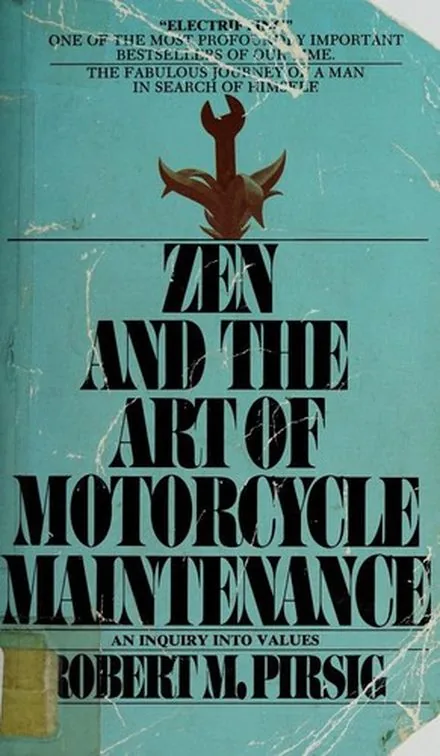
Cover of Zen and the Art of Motorcycle Maintenance by Robert M. Pirsig
Genre
Nonfiction
First published
1974
Length
about 421 pages
ISBN
9780552993784
RNKD readers
10

Cover artwork © its publisher, shown to identify the book under review. Rights

Verdicts at a glance

No RNKD reader scores a book out of five, so there is no average here. Just 10 people saying what they thought. Each of them wrote before reading the others.

READER 01 OF 10

A Good Book That Does Not Know When to Stop

Avi Mizrahi

Avi Mizrahi, 61

7 reviews on RNKD

DEPENDS Finished the book

SPOILERS This review discusses the whole book, including how it ends.

I finished this book, including the ending, and I am glad I did. I am also glad there was no one standing beside me with a stopwatch asking whether I was enjoying the middle chapters. There are long sections where Pirsig explains the same idea again, gives it a new name, connects it to Plato, Kant, Zen, or a motorcycle, and then explains the connection once more. I nearly put it down more than once. But the book kept returning to one practical question that I understand very well: what does it mean to do a job properly when the instructions are incomplete, the machine is fighting you, and nobody else is going to notice the work unless you get it wrong?

That question is stronger than the book's title suggests. The motorcycle is the place where Pirsig's ideas become useful, not decoration and not an excuse for an American road trip. He looks at a machine, sees a system of parts and functions, and then asks what the system leaves out. A manual can tell you how to adjust a valve. It cannot tell you to stop when your hand is applying too much force, or to pay attention to a sound that is not yet a failure, or to admit that your first diagnosis is wrong. Those things come from experience, attention, patience, and care. In my work, a delivery does not become correct because the screen says it is correct. The address, the loading order, the receiving contact, the driver, the time, and the signed document all have to agree. Pirsig understands that kind of reality.

The strongest parts are the mechanical ones. His account of the motorcycle's repeated seizures, the incompetent repair shop, the missing oil passage part, the damaged valve covers, and the engine hanging from one remaining bolt is more convincing than many pages of abstract philosophy. He does not treat maintenance as low work. He treats it as thinking with consequences. A careless mechanic damages metal, wastes money, delays a trip, and puts people at risk; he does not merely hold the wrong opinion, and that is a useful standard for almost everything.

The most important word in the book is Quality, although Pirsig spends much of the book trying to explain why it cannot be properly defined. At first this sounds like a trick. If a manager told me a process could not be defined but everybody knew it when they saw it, I would ask for a sample, a quantity, and the name of the person responsible. Pirsig knows this problem. He admits that his classroom method for teaching Quality is logically weak. He asks students to rank essays, then says that their shared judgment proves Quality exists. It is not proof. It is a demonstration that people can recognize a difference before they can explain it.

That distinction is real. On a warehouse floor, an experienced worker sees that a pallet is wrong before he can give a lecture about why. The wrapping is tight but the cartons are leaning. The labels are correct but the weight is badly placed. The order is technically complete but will be impossible to unload at the customer's ramp. You can write procedures for some of this. You cannot write every judgment into a checklist. A checklist is useful, but a checklist without attention is paper with boxes on it.

Pirsig is persuasive when he connects Quality to this attention. He is less persuasive when he turns it into a complete metaphysical system. The book moves from adjusting motorcycle valves to claiming that Quality creates both subject and object, then to the Tao, the Buddha, the ancient Greeks, and the structure of reality. Sometimes the movement feels earned. Sometimes it feels like a man who found one good route through a difficult warehouse and is now drawing that route across the entire country.

The personal story gives the philosophy its weight. The narrator is the surviving personality of a man called Fedro, the former self destroyed through psychiatric treatment and electroshock, not simply a thoughtful father on holiday. The early chapters keep Fedro at the edge of the story, as a ghost glimpsed in weather, roads, memories, and strange reactions. By the time the narrator explains that he and Fedro are the same person, the reveal is not exactly a surprise, but it still changes the meaning of the trip. The road is an attempt to approach a past that has been cut away without pretending it never existed, not only a road.

The book is much better when Pirsig lets that history appear through scenes. The visit to the old college is especially effective. The narrator enters the classroom where Fedro taught, remembers the chalk, the broken pieces in the tray, the view of the mountains, and then meets a former student who recognizes him but cannot say what she means. The scene has no mechanical problem to solve, yet it is more precise than many of the philosophical explanations. The narrator is a ghost there, and he knows it. The room remembers him more clearly than the people do.

The relationship with Chris is harder to read. I did not always like the father. He is impatient, controlling, and often more interested in his own thoughts than in the boy sitting behind him. When Chris complains, the father explains the complaint instead of answering it. When Chris is exhausted on the mountain, the father initially interprets the problem as ego, weakness, or the bad habits of the YMCA camp. He sees a theory before he sees his son. That is not a small character flaw. It is the central failure of the trip.

The mountain section makes this clear. Chris wants the adventure he was promised, but he is pushed into an endurance test that mostly serves the father's ideas. The father's lectures about living in the present do not prevent him from treating the summit as a target and Chris as a student who must learn a lesson. Only when Chris breaks down does the father begin to understand that his method of parenting has become another system separating him from the person in front of him.

The later revelation makes the earlier scenes painful. He had been hospitalized and separated from his family after a severe mental collapse; the narrator was not merely absent-minded or eccentric. Chris remembers the father before that collapse, remembers him playing and telling stories, and understands that the man on the motorcycle is not fully the same person. The scene where Chris says, in effect, that he knew his father was mad is difficult because the boy has been carrying knowledge that the father refused to share. The father thinks he is protecting Chris. He is also asking Chris to live inside a lie.

The ending of the main narrative is cautious rather than triumphant. The father does not cure himself through one mountain climb or one philosophical insight. He recognizes that Chris is carrying a burden, that the separation between them is real, and that he must stop pretending to be a normal father by force of performance. When Chris asks about learning motorcycle maintenance, the answer is modest: he can learn, but doing it correctly is difficult, which is better than another speech about the nature of reality.

Then the postscript changes the book again. We learn that Chris was later murdered in San Francisco, and that the journey we have just read is being remembered after his death. This is a major emotional blow because the earlier scenes were already about recovering a lost father and son relationship. Now the son is actually gone. Pirsig explains grief through the idea of a larger pattern rather than through religious certainty. Chris's body is gone, but the pattern connecting him to his father remains. I found the explanation less convincing than the grief itself, but the grief is unmistakable. The final arrival at San Francisco is no longer only the end of a trip. It is the last stretch before a future the narrator could not see.

I have more patience for the book's practical philosophy than for its historical claims. Pirsig's treatment of Plato, Aristotle, the Sophists, Zen, science, and technology is energetic, but it is also selective and sometimes too confident. He wants Aristotle to carry responsibility for a large portion of modern ugliness. That is a satisfying story, but satisfying is not the same as demonstrated. He also writes about women in ways that belong to the period and should not be excused merely because the rest of the argument is ambitious. The division of mechanical work into masculine classical intelligence and artistic feeling into feminine romantic intelligence is narrow and unnecessary. A woman can understand a machine. A man can fail to understand one. The machine does not care about the stereotype, and neither should the analysis.

The book also has a recurring problem with superiority. The narrator understands the motorcycle, while John and Sylvia do not. He recognizes the deeper meaning of the landscape, while the people in cars appear dead or lost. He diagnoses the West Coast as a funeral procession of selfish modern life. Sometimes he is making a sharp observation about alienation. Sometimes he is only pleased to be the person who noticed it first. This matters because the book argues that Quality requires humility, while its narrator repeatedly treats other people's failure to understand him as evidence of their shallowness.

Still, the book earned its length more often than it wasted it. The descriptions of roads, weather, worn gloves, cold hands, luggage, tools, oil, fuel, chain tension, and the feel of a machine under strain are excellent. They give the philosophy a place to stand. Without them, Quality would be a slogan. With them, it becomes attention applied to ordinary work. The chapter on traps for enthusiasm is particularly useful. Bad parts, wrong assembly, impatience, anxiety, boredom, ego, poor tools, uncomfortable working conditions, and rigid assumptions can all turn a repair into a defeat. That is true in a workshop, a warehouse, a marriage, and probably in a book review.

My final judgment is practical. This is not a clean book. It repeats itself, overstates its historical argument, and sometimes mistakes a forceful personal theory for a proven explanation. But it understands something important: the quality of attention brought to work matters as much as the result itself. A person who cares notices more, checks again, changes the plan when the facts require it, and does not blame the machine for an error made by the mechanic.

I would recommend the book to anyone who can tolerate long philosophical detours and who has some respect for repairing, building, writing, teaching, or maintaining anything. I would not recommend it to someone looking for a simple motorcycle travel story. The travel is the route. The real subject is what happens when a person discovers that his method for understanding the world has become another obstacle between him and the people he is supposed to love. Pirsig does not solve that problem neatly. He does something more honest. He keeps working on it.

READER 02 OF 10

A Good Repair Buried Under Too Much Philosophy

Daniel Cohen

Daniel Cohen, 35

9 reviews on RNKD

DEPENDS Finished the book

SPOILERS This review contains major spoilers, including the identity of Fedro, Chris's death, and the ending.

The useful way to describe Zen and the Art of Motorcycle Maintenance is not as a book about Zen, motorcycles, or maintenance. It is a book about a man trying to build a theory large enough to explain why he failed to remain present in his own life. The motorcycle is the practical test case. The long ride is the delivery mechanism. The real subject is a father who has come back from psychiatric treatment under a new name and is trying to determine whether the person who was destroyed is still inside him.

That is a strong premise. Parts of the book are excellent. I liked the sections where Pirsig stops trying to explain the entire structure of Western thought and shows someone working on a machine. The first chapter gets this right. The narrator notices the road surface, the weather, the temperature of the engine, the loose chain, the failed mechanics, and the difference between seeing a machine as an object and understanding what it is doing. These are not decorative details. They establish a practical argument: attention is not the opposite of thought. Attention is how thought becomes useful.

The story of the motorcycle that repeatedly overheats because a small oil passage has been blocked is better than most of the book's formal philosophical explanations. The narrator takes the bike to mechanics who work quickly, noisily, and without caring whether the job is done properly. They damage the engine, lose bolts, fail to connect the spark plugs, and then blame the owner. The important point is not that professionals can make mistakes. Everyone makes mistakes. The point is that the mechanics have separated themselves from the work. They hold the tools, but they are spectators. The narrator's phrase about lacking care is more convincing than the later claim that Quality is the source of all reality. I understood the first claim immediately. The second one kept asking for a larger budget.

I also liked the book's practical account of troubleshooting. State the problem without pretending to know the cause. List possible hypotheses. Test one thing at a time. Record what happened, including results that do not fit the expectation. Do not turn one successful test into a conclusion about the whole system. This is good advice for repairing a motorcycle, investigating a product failure, writing a technical document, or making any decision where people are tempted to explain the evidence before collecting it. Pirsig understands something that many books about rationality do not: a method is not valuable because it sounds rigorous. It is valuable because it prevents you from fooling yourself.

The chapter about a stuck screw is also useful. The narrator argues that the correct response to being blocked is not panic or brute force but a change in the question. What is the screw doing? What is holding it? What facts have not yet been noticed? That is a practical description of how expertise develops. A beginner sees a category, such as “stuck screw.” A better mechanic sees a particular arrangement of material, pressure, corrosion, access, and risk. The difference is not mystical talent. It is accumulated attention, plus enough humility not to strip the screw head while pretending to be in control.

I wanted more of that book. Unfortunately, Pirsig keeps taking a useful observation and expanding it until it becomes a total theory of civilization. The movement is repetitive. A problem in motorcycle maintenance becomes an argument about technology. Technology becomes an argument about classical and romantic intelligence. That becomes an argument about science, then metaphysics, then Plato, Aristotle, the Sophists, Zen, Taoism, Kant, Hume, Poincare, and the nature of reality. Many of these discussions are interesting in isolation. Together they produce the feeling of being trapped in a meeting where every agenda item has generated three new agenda items and nobody has written down a decision.

The book's central term, Quality, is both its most useful idea and its main structural weakness. In the practical sections, Quality means something recognizable: a standard of work, an attention to consequences, a willingness to revise an approach when the result is poor, and a relationship to the task that is more serious than merely completing it. Fine. I have no objection to that. But whenever the book is challenged to define Quality, it says that Quality cannot be defined, then treats the inability to define it as evidence of its fundamental importance. This is not a solution to a hard problem. It is a way of moving the problem to a place where objections sound less relevant.

Pirsig knows this. He admits that his first definition is logically weak. He knows that saying people recognize Quality does not prove that they agree about it, or that their agreement has the metaphysical status he wants. He even shows the mechanism by which he persuades his students: he puts several essays in front of them, asks them to rank them, and then declares that the shared ranking demonstrates their prior knowledge of Quality. This works as a classroom exercise. It does not establish that Quality is the pre-intellectual source of subjects and objects. The book often confuses a useful working concept with a universal explanation.

The philosophical history is more readable when it is attached to Fedro's psychological collapse. The narrator's reconstruction of Fedro gives the argument emotional stakes. We see a student who is exceptionally intelligent, hostile to vague claims, and increasingly convinced that the academic system has mistaken its categories for reality. His discovery of the word Quality in a writing class becomes an intellectual event because he has already spent years looking for the missing principle behind scientific reasoning. His later attack on Aristotle is an attempt to identify the source of everything that has made the world feel divided and spiritually empty, not just an academic disagreement.

But the book is too willing to accept Fedro's self-description as a heroic outsider. He is also arrogant, aggressive, and often cruel. The episode in which a professor humiliates a student is presented as part of the moral atmosphere that Fedro resists, but Fedro's response is not consistently more humane. He enjoys exposing weakness. He treats disagreement as evidence that other people are trapped inside a defective system. The book understands that his intelligence is dangerous, but it still gives him a great deal of authority because he is the one holding the knife.

The classical and romantic division is particularly weak when it becomes a theory of gender. Pirsig claims that motorcycle maintenance is classical while riding is romantic, then suggests that women avoid mechanical work because it conflicts with a feminine sensibility. This is not a subtle historical observation. It is a stereotype placed inside a book that is otherwise trying to show how inherited categories distort perception. The narrator sometimes criticizes the culture that separates art from technology, then reproduces another separation between masculine technical competence and feminine emotional response. The argument cannot repair a split while casually building a new one.

The treatment of John and Sylvia has a similar problem. They are used as examples of people who hate technology without understanding it. Their reluctance to fix a motorcycle or a dripping tap becomes evidence of a broad social disease. There is something real here. People can become alienated from systems they depend on, especially when the systems are opaque and failure is expensive. But the narrator is irritated that they do not value the same things he values, not merely diagnosing them from a distance. He wants their resistance to be interpreted as a philosophical position so that he does not have to admit that part of the conflict is personal.

The relationship with Chris is where the book becomes hardest to dismiss. The narrator repeatedly fails him while explaining the importance of care. He takes Chris on a punishing trip, treats his distress as a problem of ego, and keeps converting ordinary parental decisions into evidence for a theory about selfhood. The mountain scenes are about a father discovering that he has been trying to make his son fit a story about growth, toughness, and Quality, more than about overcoming difficulty. When Chris breaks down, the narrator does not respond with a clean insight. He responds with irritation, guilt, and fear, which is much more believable than most of the book's metaphysics.

The revelation that Chris is the narrator's former personality, Fedro's son, is effective because the book has prepared it through repetition rather than a conventional twist. The hospital, the glass door, the missing years, and Chris's recognition of the narrator's old behavior gradually make the separation impossible to maintain. The later confession that Chris was murdered after the trip is devastating. So is the narrator's attempt to understand what has survived. He rejects the idea that Chris was merely a body, then describes him as a larger pattern of relationships. This is one of the rare places where the philosophical language earns its place. Grief does not preserve a person as an object. It changes the structure of the lives around the person.

The postface is both moving and unsettling. The birth of Nell is presented as Chris's pattern continuing through another child. I understand why this matters to the narrator, but the idea also risks turning a dead son into a metaphysical explanation for a new pregnancy. The book wants transcendence, but it also knows that transcendence can become another way of avoiding the material fact of loss. I trusted the grief more than I trusted the conclusion.

I finished the book, but not because every philosophical section worked. I finished because the practical argument kept returning, even after the book had buried it under several hundred pages of theory. The best version of Pirsig's claim is simple: good work requires attention, humility, patience, and a willingness to let the thing in front of you change your understanding of the problem. That applies to machines, writing, parenting, and probably institutions. It does not require proving that Quality created the universe.

There is a very good book inside Zen and the Art of Motorcycle Maintenance. It is about repair as a form of attention, about the damage caused by separating technical work from human value, and about a father trying to become present before he loses the chance. I would recommend that book without hesitation. The book that surrounds it is often intelligent, sometimes beautiful, and far too certain that its private vocabulary has solved the oldest problems in philosophy. Pirsig tells us to notice when a system is not working. The honest response is to say that this one works intermittently.

READER 03 OF 10

A Very Long Way to Find the Useful Point

David Thompson

David Thompson, 63

7 reviews on RNKD

DEPENDS Finished the book

SPOILERS This review gets into the ending.

I finished Zen and the Art of Motorcycle Maintenance, although there were several points at which I thought the sensible thing would be to put it down and go and check whether the bathroom leak had stayed fixed. The book is a motorcycle journey from Minnesota to California, with a father, his son Chris, and two friends called John and Sylvia. It is also a long argument about technology, reason, art, value, education, mental illness, Plato, Aristotle, Zen, and the proper way to remove a damaged screw. That last subject is the one I trusted most.

The book eventually tells us that the narrator is the reconstructed personality of Fedro, a man subjected to electroshock treatment after a mental collapse, not simply a thoughtful man with an unusual interest in motorcycle maintenance. Chris is Fedro's son, not merely a difficult eleven-year-old travelling behind his father, and the narrator is trying to recover or suppress the relationship between them. At the end, the narrator accepts that he is Fedro, or at least that Fedro is part of him, and the two reach San Francisco with the promise that things may improve. The postscript then tells us that the real Chris was later murdered, and that Pirsig's later daughter, Nell, somehow completes the larger pattern left by his death. This is not a book that hides its cards. It leaves them on the table, then explains the table.

The good news is that the motorcycle sections are frequently excellent. Pirsig understands that maintenance is a way of attending to reality, not just the unpleasant work required before the interesting work can begin. He describes a mechanic checking temperatures, listening for an unfamiliar noise, testing one possibility, rejecting another, and refusing to claim more than the evidence supports, sound practice in any technical job. The strongest passages are about care, patience, sequence, and the difference between a repair carried out properly and one rushed by somebody who wants to be elsewhere at five o'clock, not really about Zen at all.

His account of the incompetent motorcycle workshop is particularly effective. The mechanics damage the machine, fail to find the actual fault, blame the owner, and then damage it again. Eventually the narrator finds the small broken part responsible for the engine trouble. It is a good example because the failure is not caused by lack of cleverness. The mechanics have tools and training. What they lack is attention. They treat the work as a set of movements rather than something for which they are responsible. That distinction is immediately clear to anyone who has watched a job go wrong because the person doing it wanted to finish rather than understand.

Pirsig is also persuasive when he discusses what he calls the traps for enthusiasm. Bad tools, poor lighting, impatience, anxiety, boredom, ego, and premature diagnosis can all turn a manageable job into a miserable one. His advice to write things down, arrange removed parts in order, allow more time than expected, and stop before tiredness turns into damage is practical and occasionally excellent. The chapter on the blocked screw is the book in miniature. When the usual method fails, do not apply more force. Stop, examine the situation, widen the question, and let the problem tell you what it is.

That is where I began to think the book had a proper centre. Quality, in practical work, is not a mystical substance hiding behind the machine. It is the standard you apply while choosing what to notice and what to do next. A good mechanic sees more because experience has taught him which facts matter. He selects, tests, adjusts, and remains willing to be wrong, rather than merely staring at the object in a supposedly neutral fashion. Pirsig's argument that technical competence includes an element of judgement, feeling, and involvement is right. The person and the work are not as separate as a manual sometimes implies.

The trouble is that Pirsig does not trust this good practical argument to stand on its own. He keeps enlarging it until it has to explain the whole of Western civilisation. Quality becomes the source of subject and object, the bridge between mind and matter, the Buddha, the Tao, the foundation of science, the basis of art, the cure for technological ugliness, and the principle that might renew American life. A useful idea is taken apart, rebuilt, and then asked to carry a very large roof.

There are stretches where the book reads like a technical manual written by someone who has decided that every loose bolt in the world is evidence against Aristotle. Pirsig's hostility to formal classification is especially odd because he himself classifies everything. He divides intelligence into classical and romantic types, builds hierarchies of concepts, identifies categories of traps, separates kinds of logic, and then objects when other people use categories. He is not wrong that classifications can become substitutes for thought. He is less convincing when he presents his own classifications as the escape route.

The attacks on Aristotle are not rigorous enough for the confidence with which they are delivered. Aristotle is presented as the founding mechanic of a culture that values forms and substances while neglecting Quality. This is a powerful story, but it is also a story Pirsig needs to make his own theory look like a rescue operation. He reads Aristotle as if the old Greek has personally designed every bad university department and every badly written instruction sheet. The book's historical argument is at its weakest when it turns complex traditions into two teams, the people who value truth and the people who value goodness, with Pirsig appointed referee.

His treatment of John and Sylvia has a similar problem. They are intelligent people who dislike mechanical work and feel alienated from technology. Pirsig interprets this as a cultural and spiritual conflict. Sometimes that is fair. Sometimes John does not want to repair his BMW, which is a perfectly defensible consumer choice if he can find somebody competent to do it. The narrator cannot leave the matter there. He needs John's reluctance to represent the romantic half of modern civilisation, while his own enthusiasm represents the classical half. This makes John and Sylvia less like friends than components in an argument.

The personal material is more troubling and more powerful. Pirsig describes a father who cannot reach his son directly, then gradually reveals that the distance is bound up with the narrator's own breakdown. Chris's repeated questions, his need for reassurance, his anger on the mountain, and his eventual collapse are the emotional cost of a father who keeps turning experience into an explanation, not simply examples in a discussion about ego. The narrator can identify the temperature of an engine, the likely cause of a misfire, and the structure of a philosophical argument. He is much less capable of answering a frightened child who asks what will happen to him.

The mountain journey makes this clear. Chris wants adventure, then becomes exhausted and miserable. The father keeps interpreting his distress as ego, competition, or a failure to accept the present moment. He eventually tells Chris that he may have to send him away because he is becoming mentally ill. It is an awful scene, not because the book tells us what to think, but because the narrator sees too late that his theory has become another way of withholding ordinary care. The later reunion is moving, though the postscript complicates it by telling us that Chris was eventually murdered. The book's metaphysical consolation, involving a continuing pattern and the birth of Nell, did not entirely persuade me. Grief does not become orderly because a theory gives it a shape.

I also found the book much too pleased with its own importance. It repeatedly announces that it is approaching a central problem, then adds another layer of terminology. A paragraph about checking the oil can become a paragraph about the nature of reality, which becomes a paragraph about ancient Greece, which becomes a paragraph about the future of civilisation. There are good insights in this method, but there is also a lot of intellectual overrun. The book would be stronger if it trusted the ordinary examples more and the grand conclusions less.

Still, I cannot dismiss it. It understands something that many books about work miss: doing a job properly changes the person doing it. Attention is not decorative. It is a form of responsibility. The narrator's best idea is that the place to improve the world is in your own head and hands before you start issuing programmes for everybody else. That is not a complete philosophy, but it is a sound maintenance instruction.

My final view is therefore mixed, but not evenly mixed. The motorcycle, the workshop, the tools, the weather, the road, the broken parts, and the practical account of getting unstuck are convincing and often memorable. The metaphysics is energetic, sometimes illuminating, and frequently overextended. The history of philosophy is too selective to bear the weight placed on it. The father and son story is the reason the book matters, although it is also the reason some of its confident theories become difficult to accept.

Pirsig wanted to unite art and technology by showing that both depend on care, judgement, and Quality. He succeeded when he stayed beside the motorcycle with the tools open and the problem still uncertain. He was less successful when he tried to rebuild the whole of Western thought before breakfast. Even so, after more than four hundred pages, I came away with one useful instruction: do not confuse a clean theory with a proper job. Check what is in front of you, admit when the first explanation has failed, and take the time to do it right.

READER 04 OF 10

The Useful Bits Are Buried Under the Philosophy

James Wilson

James Wilson, 38

12 reviews on RNKD

DEPENDS Finished the book

SPOILERS This review discusses the whole book, including how it ends.

I did not expect this book to be about a father trying to work out whether he was still himself. I expected motorcycles, American roads, some Zen, and a long argument about whether it is better to repair your own machine or hand it to a specialist. It contains all of those things, but the motorcycle is the book's working example. The subject is the difference between doing something properly and merely producing the appearance of having done it.

That part landed with me immediately. The narrator understands that a machine is not maintained by following instructions in a vacant, mechanical way. You inspect it, listen to it, notice what has changed, and resist deciding too early what the fault must be. He describes mechanics who rush, guess, and then blame the customer when the repair fails. He describes manuals that tell you to remove a cover without explaining what to do when the screw will not move. He describes the small but important difference between a person who is present in their work and a person who is only waiting for the shift to end.

There is a good practical argument here about competence. A formal method matters. So do tools, measurements, records, and checking your assumptions. But none of those replaces attention. The narrator's best point is that a person can have the correct procedure and still do poor work because they are not looking at the thing in front of them. That is true of a motorcycle, a technical manual, a university course, and most office processes I have ever encountered. A system can be perfectly documented and still fail because nobody is taking responsibility for the next step.

The early road sections are often excellent. The father, his son Chris, and their friends John and Sylvia travel from Minnesota towards Montana, choosing secondary roads over the quickest route. The narrator likes the slower roads because they put him inside the place instead of viewing it through a car window. That idea is clearly tied to the book's argument, but it is also pleasant to read. There are thunderstorms, overheating engines, bad food, cold mornings, difficult camping, wrong turns, mosquitoes, and long stretches of prairie. The physical discomfort gives the philosophical material something solid to push against.

The motorcycle maintenance itself is also more interesting than I expected. The narrator explains how he investigates a fault, beginning with a broad question and narrowing it only when the evidence allows. He stresses the danger of premature diagnosis. If you decide that the problem is electrical before testing that assumption, you can spend a week proving yourself right about the wrong thing. That is a useful lesson, although Pirsig repeats it in several different forms until the lesson starts asking for a rest.

The central division is between what he calls the classical and romantic ways of seeing. The romantic person sees the immediate appearance of a thing, the feeling it creates, the whole impression. The classical person sees systems, parts, relationships, causes, and functions. The narrator is strongly classical. John and Sylvia are more romantic, suspicious of technology and uncomfortable with mechanical work. The narrator thinks both positions are incomplete. Technology can be ugly when the people who make it have no connection with what they are doing, but rejecting technology does not solve anything. Someone still has to fix the dripping tap, check the engine, or work out why the thing has stopped.

This is the book's strongest idea, and it did not need the several hundred pages of metaphysical scaffolding eventually built around it. A mechanic who cares about the job is doing something close to art. A technical worker does not have to choose between precision and feeling. The best work joins them, and it is convincing because the book shows it in action. The narrator is checking the oil, adjusting the chain, testing the engine, keeping notes, and noticing when the machine sounds different, not merely claiming that care matters. The theory grows from the work, which is exactly how it should be.

Then the book starts explaining its own explanation.

Pirsig calls the thing that comes before the split between subject and object Quality. Quality cannot be defined, he says, because defining it would place it inside the intellectual system that it comes before. It is the immediate recognition that something is better, worse, right, wrong, elegant, clumsy, alive, or dead. It is also the source of the world as we understand it. Eventually Quality becomes connected to the Buddha, the Tao, Greek arete, scientific creativity, the origin of consciousness, and nearly everything else that Pirsig finds important.

I understand the appeal. There is a real problem with pretending that value appears only after the facts have been collected. Scientists choose which facts to investigate. Mechanics choose what to inspect first. Writers choose which sentence sounds right before they can fully explain why. A person deciding whether a repair has worked is not using measurements alone. They are also making a judgement about whether the result is satisfactory. Pirsig is right that this judgement is not a useless extra added to the serious work. It is part of the work.

But he keeps trying to turn a useful observation into a complete theory of reality. The moment he starts saying that Quality creates both subject and object, I stop following him with any confidence. The argument becomes circular in a way the book seems determined not to notice. Quality is what lets us recognise what is good, and what is good is evidence of Quality. The answer is presented as a way out of the old categories, but often it feels like a new category with a capital letter.

The sections about Poincare, Kant, Plato, Aristotle, the sophists, rhetoric, and scientific method are sometimes stimulating and sometimes a complete faff. Pirsig has clearly thought hard about these subjects, but the reader is expected to accept his reconstruction of the history of philosophy while he moves from one major claim to another. He is at his most persuasive when discussing a blocked screw or a poorly written manual. He is less persuasive when announcing that Western thought went wrong in ancient Greece and that he has found the missing principle.

The book also has an awkward relationship with the people around its narrator. John and Sylvia are treated as examples of romantic anti-technology, and Chris is often treated as a problem to be interpreted. The narrator notices a great deal, but noticing is not the same as understanding. He is capable of patience with a motorcycle and startling impatience with his son. When Chris struggles on the mountain, the narrator initially reads the problem as ego, weakness, or a camping-induced crisis. He eventually realises that his own conduct is part of the problem, but the realisation comes after some ugly exchanges.

That is where the book becomes more honest than its theory. The narrator is a man who has been absent in a more complicated way than physical absence, not simply a wise father passing on a philosophy. He is beside Chris, feeding him, carrying his equipment, telling stories, and still failing to be available. The recurring image of the glass door works because it is not explained away by the motorcycle material. Chris wants his father to come through to him. The father keeps trying to solve the situation as if it were a problem with a cause that can be isolated and corrected.

The revelation that the narrator is the surviving identity of Fedro gives the earlier arguments a different weight. Fedro, the former self, was a brilliant and difficult teacher who became obsessed with Quality, attacked the foundations of his own intellectual system, and was eventually subjected to electroshock treatment after losing his grip on ordinary life. The narrator has been trying to reconstruct him while also insisting that Fedro is dead. That is not a puzzle I found completely convincing as a medical or psychological account, but it works as a representation of a person trying to live after an internal collapse.

The ending is moving, although it is also uncomfortable. Chris has been murdered in San Francisco, something the main narrative does not reveal until the postface. The father has spent the journey with a living child who is also, in a sense, the person he lost. The later birth of Nell is presented as the larger pattern closing around the loss. I found some of that spiritual explanation too neat, especially when the book suggests that Chris has returned in another form. But the grief underneath it is not neat at all. The father is trying to find a shape that can hold the fact that his son is gone. I can understand why he needs one, even if I do not accept the metaphysics used to construct it.

What I took from the book is less grand than what it wants to give me. I do not think it has solved the relationship between mind and matter, or between Eastern and Western thought, or between Quality and reality. I do think it makes a strong case for taking care with ordinary work. It understands that a job becomes degrading when the person doing it is separated from its purpose, its standards, and its consequences. It also understands that expertise is not the same as authority. The man with the official role can still be the one who has not looked properly.

The book is too long, too repetitive, and too pleased with its own system. It occasionally mistakes persistence for proof. Still, I kept reading because the practical material kept bringing the abstract material back down to earth. Whenever Pirsig started talking about a screw, a chain, a manual, a road, a cold morning, or the exact sound of an engine, the book became clear again. Its best argument is simple: do not stand outside your work pretending to be an observer. Pay attention, accept that you may be wrong, and care enough to find out what the thing in front of you requires.

That is not the whole of Zen, and it is not a complete philosophy of life. It is nevertheless a decent way to approach a motorcycle, a job, or a child. The book would have been better if it had trusted that more often.

READER 05 OF 10

A Long Argument About What We Owe the Things We Do

Jessica Brown

Jessica Brown, 48

14 reviews on RNKD

DEPENDS Finished the book

SPOILERS This review discusses the whole book, including how it ends.

The practical question is whether a person can care about a job without reducing it to a task, and whether a system can be improved by changing the way one person pays attention to it. Robert Pirsig starts with a father, his son Chris, two friends, three motorcycles, and a long route from Minnesota to California. He then turns the trip into an extended argument about technology, reason, art, education, mental illness, parenting, and the meaning of Quality. I expected a book about motorcycle repair with some philosophy attached. It is a book about how a man tries to repair his relationship with his son while also trying to explain why repair matters.

I liked the opening more than I expected to. The secondary roads, the weather, the old gloves, the tools, the roadside conversations, and the ordinary discomfort of traveling by motorcycle all felt observed rather than arranged for effect. The narrator understands that a trip is made up of small practical decisions. Which road is safer? Is the engine too hot? Where is the missing flashlight? Did anyone remember the water bottle? That part of the book has the kind of competence I trust. It notices that a machine does not need to be glamorous to have a personality, and that a worn object can matter because it has been used, repaired, and carried through time.

The motorcycle work is also where Pirsig's central idea is clearest. A good mechanic does not merely follow instructions. A good mechanic watches, tests, listens, and notices what does not fit. The narrator's disastrous experience with the repair shop is a strong example. The mechanics have tools and technical knowledge, but they rush, fail to inspect their work, damage the motorcycle further, and treat the job as something separate from themselves. Their problem is not that they use technology. Their problem is that they do not care enough to do the work properly.

That argument made sense to me because it is not limited to motorcycles. In human resources, I see the same distinction between having a policy and having a process that works. An organization can have a six-page attendance policy and still fail to answer the ordinary question of who changed the schedule and when. A manager can use all the correct vocabulary and still avoid the actual problem. Pirsig is good on this point. Work is not improved by adding more impressive language to it. It is improved by paying attention, checking the result, and being willing to revise the first explanation.

The book is strongest when it treats Quality as a practice of attention. The discussion of a stuck screw is more useful than many of the later pages of metaphysics. When the screw will not move, the answer is not to become angry at the screw or to keep repeating the same method with greater force. You stop, examine what you know, question your assumptions, and look for a better approach. You may need a penetrating solvent, a different tool, a reference book, or another person. You may discover that the question itself was too narrow. Pirsig calls this kind of pause a block, but he does not treat it as failure. It can be the point where learning begins.

That is a useful idea in ordinary life. A workplace investigation can become stuck because the interviewer decided too early that the issue was retaliation, poor performance, or a personality conflict. Once that label takes hold, every new fact gets forced into it. The better response is to slow down and ask what is known. Pirsig's distinction between a fact and an assumption is sound. His warning about ego is sound too. People protect a wrong diagnosis because admitting it feels like admitting that they are incompetent. The machine does not care about their pride. It continues not to work.

I also appreciated the book's suspicion of false expertise. The narrator does not believe that every problem should be handed to a specialist simply because the specialist has a title. He has seen specialists damage the motorcycle, write useless manuals, and hide uncertainty behind confident language. I am not as enthusiastic as he is about amateur repair in every situation. Some jobs require a qualified person, and electrical work is not improved by confidence. Still, his larger point holds. Expertise should make the work more reliable, not make ordinary people afraid to ask what is being done and why.

The problem is that the book keeps finding a useful practical idea and then burying it under an enormous philosophical structure. The sections on Quality become increasingly difficult to evaluate because the word is asked to do too much. It means excellence, value, immediate recognition, harmony, reality before intellectual categories, the source of subject and object, and eventually something very close to God or the Tao. Pirsig keeps insisting that Quality cannot be defined, while defining it through several hundred pages of argument. That is not automatically a contradiction, but the book does not always earn the confidence with which it moves between meanings.

His account of classical and romantic intelligence is interesting at first. It gives him a way to discuss the person who sees the motorcycle as an appearance and the person who sees its components, systems, and functions. The problem is that he presents the distinction too neatly. John and Sylvia become representatives of romantic resistance to technology, while the narrator becomes the classical person who understands how things work. The categories are useful as a starting point, but the book spends so much time sorting people into them that the sorting begins to resemble the very rigid system he criticizes.

I was also uncomfortable with the gendered parts of the argument. The claim that motorcycle maintenance is classically masculine and that women avoid it because of a romantic sensitivity is not a deep insight. It is a dated generalization. The book sometimes notices that a cultural division is artificial, then repeats the division as if it were natural. Someone who has spent a career watching assumptions about people become workplace decisions will notice this. If a person is not given access to tools, training, or encouragement, that person may not develop the skill. The absence of participation is not proof of an innate preference.

The discussion of education is more complicated. Pirsig's experiment with eliminating grades is interesting because it exposes the difference between learning and performing. Some students become more engaged when they are no longer working only for a score. Others become frightened because the teacher has removed the measure without explaining what good work looks like. That detail is important. Removing a system does not automatically create freedom. If people have been trained to wait for an external judgment, taking away the judgment can leave them stranded. A process still needs a purpose, an owner, and some way to know whether the work is improving. Pirsig sees the problem, although he sometimes treats the students' confusion as evidence of their limitations rather than a predictable consequence of his own experiment.

The book's treatment of mental illness is the part I found hardest to read. The narrator eventually reveals that the man called Fedro was his former identity, erased through electroshock treatment after a psychiatric collapse. The revelation explains the ghost imagery, the fear of the mountains, and the narrator's unstable relationship with Chris. It also changes the earlier philosophical sections. They are no longer simply a man's intellectual history. They are the record of a mind trying to reconstruct itself while refusing to admit how much it has lost.

The disclosure of Chris's death in the postscript is devastating, but it is not used in a simple way. Chris is murdered in San Francisco after the events of the journey. The narrator then tries to understand what remains of a person after the body is gone. His eventual idea that Chris was part of a larger pattern is emotionally understandable, even if the metaphysical explanation is not something I can accept just because the book presents it with conviction. The later birth of Nell, and the suggestion that the larger pattern has repaired itself, moved me less than the earlier scenes between father and son. Grief does not become less real because another child is born. A family can continue, but continuation is not replacement.

What I did believe was the narrator's recognition that he had failed Chris in practical ways. He talks about Quality, care, and being present while repeatedly treating his son as an interruption to the Chautauqua. He explains the dangers of ego to Chris while becoming irritated when Chris wants attention. He tells himself that the mountain climb will teach the boy something, but he has not asked whether Chris wants the lesson. When Chris says that the trip is not fun, the narrator initially responds as though the child has failed a test of character. Later, when Chris breaks down, the narrator finally understands that his philosophical project has been competing with his responsibility as a father.

That is where the title becomes more convincing. Motorcycle maintenance is not a metaphor pasted on top of the story. It is the book's test case for a way of living. To maintain something is to observe it regularly, recognize small changes, accept that conditions matter, and take responsibility before a minor problem becomes a crisis. The narrator can do this for a motorcycle. He is less consistent with his son, his marriage, and his own mind. The contrast is not flattering, but it is honest.

I finished the book with mixed feelings. I admired its patience, its willingness to stay with an idea after the first convenient answer, and its insistence that quality comes from care rather than presentation. I also found it repetitive, self-important, and at times too pleased with its own vocabulary. The narrator says that a person should not ask others to define what is good, but the book often sounds as if it expects the reader to accept his definitions because he has worked so hard to construct them. There are stretches where I wanted someone to say, reasonably, that the meeting had gone on long enough and that we needed to decide what happens next.

Still, the book stayed with me because its best argument is modest even when its language is not. The work in front of us matters. The person affected by a decision matters. A system that cannot explain itself is not automatically wise. Expertise without attention is dangerous. Pride makes it harder to learn. And sometimes the right response to a complicated problem is to stop insisting that the first question was the right one.

I would not recommend this book to someone looking for a quick motorcycle travel story, or to someone who has no patience for long philosophical detours. I would recommend it to readers who are willing to argue with a book while reading it, especially readers interested in work, craftsmanship, parenting, or the gap between a stated value and a lived one. Pirsig does not always make his case cleanly, and he often takes three hundred pages to reach a point that could have been made in ten. But he understands something important: care is not a mood, and it is not a slogan. It is what you do when the machine is still broken, the child is still upset, and the correct answer is not yet available.

READER 06 OF 10

A Good Manual Buried Under a Lot of Philosophy

Michael Davis

Michael Davis, 44

11 reviews on RNKD

DEPENDS Finished the book

SPOILERS This review discusses the whole book, including how it ends.

I expected Zen and the Art of Motorcycle Maintenance to be a book about fixing a motorcycle while thinking about life. It is that, but it is also a road narrative, a memoir, a philosophical argument, a reconstruction of a man's mental collapse, and a long attempt to prove that all of those things are one subject. Sometimes it works. More often, it asks the motorcycle to carry a load it was never designed to carry.

The practical material is the reason I kept reading. The narrator checks oil, chain tension, tire wear, carburetion, valve clearances, engine temperature, tools, spare parts, and the order in which parts should be removed. He explains why a mechanic should keep notes, how to avoid losing small components, why impatience creates damage, and why a problem that seems minor can stop the whole repair. The story about the incompetent shop that rebuilds his engine badly is especially effective. The mechanics leave spark plugs disconnected, damage valve covers, break cooling fins, and return the motorcycle with missing engine bolts. This is not presented as a simple complaint about poor service. The narrator notices that the mechanics are not mentally present in their own work. They are moving tools around without taking responsibility for the result.

That point made sense to me immediately. A scope is not a contract just because the page has a price on it. A handoff is not complete because somebody sent an email. The person doing the work has to understand what the work requires and what happens when the plan meets an actual building, an actual customer, or an actual problem. Pirsig is strongest when he stays close to that kind of fact. His description of troubleshooting has the same basic discipline. State the problem narrowly. List possible causes. Test one thing at a time. Do not claim the test proved more than it proved. Keep track of what you know and what you are assuming.

That is useful advice, and it does not require a motorcycle. It applies to a repair bench, a proposal, a staffing plan, or almost any job where people are tempted to substitute confidence for attention. The book's best idea is also its simplest: quality begins with caring about the work in front of you. Not with a slogan about excellence, but with noticing the part that is failing and staying with it until you understand what happened.

Pirsig calls this Quality, then spends most of the book trying to define something he insists cannot be defined. The early distinction between classical and romantic understanding is clear enough. The romantic view notices appearance, feeling, immediacy, and the whole experience. The classical view looks for structure, function, causes, and relationships between parts. The narrator argues that neither view is sufficient by itself. A mechanic needs both the feel of the machine and the technical understanding of its systems. A person who hates technology misses the human intelligence built into a machine. A technician who treats the machine as a pile of parts misses the experience of using and caring for it.

I buy that argument. In fact, I buy it more readily than the book seems to expect me to. Anyone who has fixed something knows that the work is not divided as neatly as the people doing the work want to pretend. You use measurements, manuals, memory, judgment, and physical feel. You also notice when a part looks wrong before you can explain why. That is not mystical. It is experience stored in the hands and eyes.

The problem is that Pirsig cannot leave this useful point alone. He builds a metaphysical system around it, then keeps adding floors. Quality becomes an event before subject and object. It becomes the source of mind and matter. It becomes the Buddha, the Tao, the basis of science, the purpose of art, and the missing connection between religion and technology. He brings in Hume, Kant, Poincare, Plato, Aristotle, Einstein, Zen, rhetoric, Greek history, the Sophists, and the Greek word arete. Some of those sections are interesting. The discussion of how scientific facts are selected, rather than simply found lying around waiting to be observed, gives the practical argument more depth. The account of Poincare's mathematical intuition also supports Pirsig's larger point that discovery involves judgment and aesthetic recognition, not just procedure.

But the book repeatedly treats a promising analogy as if it were a completed theory. Pirsig moves from "a good mechanic notices things that a manual does not tell him to notice" to "Quality is the source of all reality" without showing enough of the road between those claims. He knows that the argument is difficult, so he keeps returning to it from another direction. That is honest in one sense. It is also exhausting. The book circles an idea, renames it, connects it to another idea, and then announces that the whole structure has finally become clear, rather than merely explaining it.

The repetition is not always accidental. Pirsig is showing a mind trying to rebuild itself after a collapse, and the circular movement is part of the subject. The narrator is trying to decide whether Fedro was wrong, whether he himself is only a replacement personality, and whether the ideas he is presenting belong to either of them, not just investigating Fedro, his former identity. That gives the philosophical sections a real emotional pressure. The book is not a calm academic paper pretending to be a motorcycle trip. It is a man trying to make sense of what happened to his own mind.

Still, understanding the reason for the repetition does not make all of it work. Pirsig's treatment of other people is often a warning sign. John and Sylvia are introduced as people who dislike technology and avoid motorcycle maintenance. The narrator interprets their irritation, their discomfort, and even a dripping faucet as evidence of a broad spiritual position. Sometimes that is perceptive. Sometimes it is intrusive. He keeps turning friends into examples in an argument they did not agree to join. When Sylvia says she does not like being treated as an object, she is right. The book knows this and continues doing it anyway.

The same issue appears in his relationship with Chris. At first, the boy is a difficult but recognizable child. He asks endless questions, becomes upset when plans change, complains of stomach pain, and wants reassurance without knowing how to request it. The narrator responds by becoming more analytical and more controlling. He treats Chris's distress as an expression of ego, a reaction to camp, or evidence of a philosophical problem. He notices the boy's behavior in detail but does not reliably respond to the need underneath it.

That failure becomes harder to ignore as the journey continues. The mountain trip is presented as a lesson about moving at the right pace and not making the destination more important than the current step. In practice, the narrator pushes Chris until the boy collapses, then interprets the collapse through the book's vocabulary of ego, Quality, and self-image. He eventually admits that he has brought Chris into an environment the boy cannot manage and that his own resentment is part of the problem. That admission comes late, but it matters.

The final revelation is that Fedro is not an abstract former self. He is the narrator's original personality, destroyed by forced electroshock treatment after a breakdown. The narrator has spent the book treating him as a ghost because that is the only way he can approach the memory. The later revelation that Chris is eventually murdered, which appears in the postscript, changes the earlier road trip. The trip is the last period before another loss, and the narrator's careful theories about identity, memory, and continuity become a way of surviving grief, not merely a father and son looking for closeness.

The postscript is both moving and troubling. Chris's death is described plainly enough to hurt, but Pirsig then interprets the birth of a daughter as Chris's larger pattern continuing into another child. I understand why he reaches for that explanation. Grief makes people search for continuity. I did not find the spiritual conclusion convincing. It is emotionally understandable, but it also feels like the same habit that caused trouble throughout the book: turning a human event into evidence for a theory. Chris deserves to remain a person who died, not only a piece of a metaphysical design.

There is also a difficult contradiction at the center of Pirsig's position. He argues that Quality should be grounded in ordinary work, in the specific act of repairing a machine, writing a sentence, or building something properly, and that is the part I trust. But he also describes Fedro's pursuit of philosophical truth as if his willingness to sacrifice family, health, stability, and responsibility were evidence of a higher commitment. The book criticizes the academic system for rewarding formal performance over real understanding, then gives its most intense thinker permission to neglect the people closest to him. Pirsig sees the damage, but he never fully settles the account.

That unresolved quality is probably why the book has lasted. It is not a clean system, despite the narrator's desire to make it one. It contains good advice, overextended philosophy, real insight, and a disturbing amount of self-justification. I liked the sections where Pirsig describes careful work. I respected the insistence that the person using a machine should not treat it as somebody else's problem. I was interested in the history of the Quality argument and in the conflict between the Sophists, Plato, and Aristotle. I also became impatient with the repeated claim that everything had finally come together when the next forty pages were still needed to explain it.

My practical conclusion is simple. Read this if you are interested in the relationship between work, attention, technology, and identity, and if you can tolerate a narrator who keeps turning a useful observation into a complete philosophy of the universe. The motorcycle material is worth the trip. The account of mental illness and the damaged relationship with Chris is more important than the metaphysics, even though Pirsig sometimes seems to think the order is reversed.

The book's central question is whether a person can care about something properly without reducing it to a formula, not really what Quality is. Pirsig gets close to an answer when he is adjusting a chain, checking a measurement, or warning against a rushed repair. He loses it when he tries to turn that answer into a system that explains everything. The best parts are the ones where he stops explaining and pays attention.

READER 07 OF 10

A Very Long Argument About Doing the Boring Bit Properly

Oliver Evans

Oliver Evans, 23

7 reviews on RNKD

DEPENDS Finished the book

SPOILERS This review discusses the whole book, including how it ends.

I finished Zen and the Art of Motorcycle Maintenance, although there were several points where I considered stopping and doing something more useful, such as cleaning a keyboard that did not need cleaning. The book is a motorcycle journey across America, a philosophical history of one man's breakdown, a discussion of rhetoric and ancient Greece, and a long argument for caring about the work in front of you. It is also much more repetitive than it needs to be. These things are all true at once.

The part that worked for me was the basic idea, which is much more practical than the title makes it sound. Pirsig keeps returning to the difference between looking at a machine and being involved with it. John and Sylvia want the motorcycle to take them away from technology, while the narrator thinks this is a fairly fragile arrangement because the machine can still stop working whether or not you have philosophical objections to carburettors. When his own motorcycle breaks down in the past because he has assumed the rain caused the problem, only to discover that he had simply run out of petrol, the lesson is clear enough. Do not decide what has happened before you have checked the obvious thing.

That is a good lesson. It is also one I recognised from software work, which is probably why the maintenance sections kept me reading when the philosophical sections started walking in circles. The narrator's description of diagnosing a fault is essentially a long-form version of writing a reproducible issue. State the problem without adding assumptions. List possible causes. Test them one at a time. Record what happened. Do not claim more than the experiment showed. He gives the example of a motorcycle that loses power on bumps, then uses the repeated pattern to form a hypothesis about the cause. Later he describes the blocked screw that turns a straightforward repair into a crisis because the person working on it is mentally somewhere else, already imagining the next stage.

That bit is very good. A blocked screw is the point where your plan stops matching the object, not merely a blocked screw. If you respond by forcing the same plan harder, you damage the screw and then blame the day. Pirsig calls this a block, and his advice is to stop treating it as an insult. The blockage may be information. The method that got you there may be the problem. This is the most convincing version of his argument because it stays close to things people do. It also explains why experienced repairers often look slow. They are not necessarily moving slowly because they lack urgency. They are trying not to create a second fault while fixing the first one.

The book's central term is Quality, capitalised and deliberately left undefined. At first this seems sensible. We all recognise that one repair, paragraph, meal, interface or conversation can be better than another before we can explain the complete reason. The narrator's classroom experiment makes the point effectively. He asks students to write about the United States, then Bozeman, then a single street, then one brick on a building. The student who could not write about a whole country produces thousands of words about the brick because the smaller subject forces her to look rather than repeat things she has already heard. That is a useful teaching idea, and it connects neatly to the book's insistence that attention is not the same as having a grand theory.

Unfortunately, Pirsig does not stop there. He spends the rest of the book trying to build a grand theory anyway.

The autobiographical structure is initially compelling. The narrator is travelling with his son Chris and two friends, John and Sylvia, while fragments of an earlier identity called Fedro keep appearing. Fedro was a brilliant, isolated teacher and philosopher who became obsessed with the question of Quality, lost his grip on ordinary life, and received electroconvulsive treatment that the narrator describes as the destruction of a personality. The narrator claims not to have known Fedro, then gradually realises that Fedro is his former self. The motorcycle trip becomes an attempt to reconstruct the path that led to the breakdown and to complete the thinking that was interrupted.

I liked the uncertainty of this for a while. The narrator's memory is not presented as a neat file that can be opened and searched. It arrives through places, smells, old classrooms, a print on a wall, the sound of wind, and the experience of seeing a road he knows without knowing how he knows it. When he enters the old classroom and a former student recognises him, the scene is uncomfortable in a way the book's theories rarely are. He has become a ghost to her, but he is also the person who does not remember her. The distinction between being physically present and being the same person is made through an awkward conversation rather than a definition, which is exactly right for this book.

The relationship with Chris is the strongest emotional thread. It is also where the book's intelligence becomes least reliable. The narrator spends much of the trip analysing his son as an example of ego, anxiety and the need for approval. Chris wants to reach the top of the mountain and prove that he can do it. He becomes exhausted, cries, complains of stomach pain and eventually injures his ankle. The narrator often responds with irritation before responding with care. He knows this about himself, which does not make it less unpleasant to watch.

The mountain sections are effective because the theory becomes a practical problem. The father wants to explain that the summit is not the point, then keeps using the summit as a test of Chris's character. He tells himself that Chris should not be climbing for the sake of ego, while quietly trying to make Chris understand that he should climb in the correct way. When he finally carries the heavier pack and accepts that they will arrive later, the book's ideas become less like a lecture and more like a strained attempt at parenting. The narrator's claim that the person who needs to change is not only the machine but also the person working on it has real force here.

The ending is devastating, although the book prepares for it so thoroughly that the reveal is not a surprise. Fedro is the damaged, driven part of the narrator that Chris has been trying to reach, not only the narrator's former personality. The final confrontation on the coast, where the narrator tells Chris that he has been mentally ill and may no longer be able to care for him, is difficult to read because the narrator understands the harm he is doing while still doing it. Chris's breakdown, followed by the recognition that he knew the truth about his father all along, finally breaks through the intellectual apparatus surrounding the journey. The conversation about motorcycles after this is simple and affecting. Chris asks whether he will be able to maintain one when he is older. His father says that it is not difficult if you do it properly, although doing it properly is the difficult bit.

Then the postscript changes the meaning of the ending again. Chris is later murdered, and the author's account of his death is blunt and horrifying. The narrator's eventual understanding of Chris as part of a larger pattern, rather than simply a body that has disappeared, is emotionally understandable but philosophically much less convincing to me. His wife becomes pregnant, they decide to keep the child, and the new daughter is presented as a continuation of the pattern. I understand why this gives the narrator a way to live with grief. I did not find the metaphysical explanation persuasive. The book is strongest when it says that a person exists within relationships, memories and habits that remain after death. It is weaker when it treats that insight as proof that the dead have returned in another form.

There are also some choices that have aged badly. The division between classical and romantic intelligence is useful as a rough description of two habits of attention, but Pirsig turns it into a system and then attaches broad claims about gender to it. The suggestion that women avoid mechanical work because they have a romantic temperament is not an insight. It is a stereotype fitted into a theory. The discussions of technology and counterculture are similarly uneven. Pirsig understands why John and Sylvia feel alienated from machines, but he often treats people who reject technology as if they are merely refusing to learn how the world works, which is not always fair. There are reasons to distrust technology that have nothing to do with being too delicate to change a spark plug, including who controls it, who benefits from it, and who is expected to absorb its failures.

His politics are also more confident than his analysis. The book sees the value of individual competence and local responsibility, which I broadly share. It is less good at explaining how individual competence relates to institutions, money and power. Telling people to improve the world through their own hands can be useful when the task is repairing a motorcycle. It is not a replacement for collective action when the task is housing, healthcare or working conditions. The narrator says political programmes begin with the wrong end, but that conclusion is partly produced by the book's preference for what he can personally inspect. A person who likes an identifiable task can start believing that anything without a screwdriver is vague.

The prose has the same problem as the argument. There are excellent concrete passages, especially about tools, heat, worn parts, rain, fatigue and the feeling of finding a fault after several wrong assumptions. Then the book repeats its concepts in slightly altered language until the repetition becomes part of the subject. The narrator says he wants to proceed slowly and carefully, but he also keeps returning to the same distinction between subject and object, classical and romantic, Quality and form, as if one more diagram will finally make the reader experience enlightenment. The diagrams are not printed as diagrams in this book, but the categories still pile up.

I was more persuaded by the ordinary advice than by the metaphysics. Keep notes. Do not trust your first diagnosis. Use the correct tool. Give yourself more time than you think you need. Stop when you are tired or angry. Notice the small fact that does not fit your explanation. Treat the work as something you are responsible for, not as a performance you are trying to finish before anyone notices you are unsure. These are not minor points. They are probably the book's real achievement. The elaborate theory gives them a vocabulary, but it also makes them harder to use.

There is a particularly revealing contradiction in Pirsig's treatment of expertise. He attacks specialists who perform tasks without caring about the result, and he is right to do so. The incompetent mechanics who damage the motorcycle while acting cheerful and detached are memorable because they are absent from their own work, not merely technically wrong. But Pirsig sometimes replaces that bad professional with an ideal craftsman who is almost morally purified by attention. Real people are messier. A careful mechanic can still be arrogant, a hurried developer can still fix the important fault, and a person can care about a job while being underpaid, exhausted or badly managed. Quality is not a substitute for decent conditions.

So I am glad I read it, but I would not describe the experience as consistently enjoyable. The book contains a useful argument about attention, maintenance and the danger of forcing a solution after the evidence has changed. It also contains several hundred pages of a man trying to turn that argument into a total explanation of reality, with results that are sometimes illuminating and sometimes a bit much. The best version of the book is not the one that identifies Quality with the Buddha or explains the history of Western thought through a quarrel between Plato, Aristotle and the sophists. It is the one where a tired person notices that the engine is too hot, slows down, checks the chain and admits that the plan may need changing.

That is enough of a philosophy for most days. The rest can wait until the motorcycle is cold.

READER 08 OF 10

A Good Manual Buried Under Too Much Philosophy

Omer Friedman

Omer Friedman, 22

8 reviews on RNKD

DEPENDS Finished the book

SPOILERS This review gets into the ending because the ending changes what the earlier road trip means.

I finished this book, which is not the same as saying it was always easy to continue. I liked the parts where Pirsig looks closely at a machine, a road, a badly written instruction manual, or a person who is pretending not to care. I became much less patient when every practical observation had to grow into a theory about Western civilization, Plato, Buddhism, the structure of reality, and the meaning of everything. The book is strongest when it stays near the workbench. It gets weaker when it starts announcing that the workbench explains the universe.

The basic journey is simple enough. A father and his son Chris travel by motorcycle from Minnesota toward Montana and eventually down to the Pacific coast, with John and Sylvia Sutherland joining them for part of the trip. The narrator rides, maintains the motorcycle, watches the landscape, and gives a long series of philosophical talks, the Chautauqua of the title. Alongside the trip, he reconstructs the life of Fedro, the earlier identity that was destroyed through psychiatric treatment after a period of mental collapse. By the end, the reader learns that Fedro is the narrator's former self and that Chris is not merely an irritating, damaged child but the son who had been separated from him during his hospitalization. The postscript then reveals that Chris is later murdered, and that a new daughter, Nell, makes the family feel that the larger pattern has closed again.

Before that point, I was mostly deciding whether I believed the narrator's ideas. After it, I had to decide whether I believed the narrator's way of telling his own history. I am not sure I did, but I understood more clearly what the book was trying to repair.

The repair and maintenance sections worked for me immediately. Pirsig understands that a machine is not just a collection of parts. A motorcycle has a history. It has been overheated, neglected, adjusted badly, repaired by people who did not care, and changed by every decision made around it. That is a practical idea, not just a poetic one. A product's quality depends partly on whether the person using it can reach the filter, understand the warning, find the replacement part, and fix the problem without destroying the housing. The book repeatedly values this kind of attention. It asks the reader to notice what is in front of them instead of relying on a category or a confident explanation.

The story about the motorcycle that stopped in the rain is one of the best examples. The narrator assumes the engine has failed, checks the obvious things, becomes frustrated, and only later discovers that the fuel tank was empty because he had been looking at the reserve supply. The important failure was a failure of attention, not just mechanical. He had decided what the problem was before he had properly observed it. That idea survives all the book's philosophical complications. In a shop, it is the difference between listening to a customer's actual complaint and selling the first expensive replacement that fits the general category.

The same is true of the mechanics who damage the narrator's motorcycle. They are not presented as villains. They are worse in a more ordinary way. They work quickly, play around, ignore details, fail to notice what they are touching, and leave the machine in a worse state. The radio is loud, the work is treated as a sequence of motions, and nobody seems personally connected to the result. Pirsig's phrase for the missing quality is sometimes vague, but the example is clear. Care is not an extra decoration added after competence. Care changes the quality of the work itself.

I also liked the discussion of technical instructions, especially when Pirsig examines the barbecue manual at the DeWeeses' house. He notices that the text and diagrams are separated so that the user has to keep moving back and forth between them. Chris solves the problem by arranging the pages differently. That is funny, but it is also the kind of small design decision that matters more than a lot of grand statements about innovation. The user is not a robot receiving instructions from above. The user is part of the system. If the instructions make the work harder, the instructions have failed, even if every sentence is technically correct.

This is where the book feels written for someone like me. I am more interested in whether an object can be opened without breaking a tab than in whether its manufacturer calls it elegant. Pirsig understands that the boring latch can be the most important part. He also understands that a bad repair can turn a small problem into a large one. The book's best claim is not that motorcycles contain Buddha. It is that attention, patience, and responsibility are forms of intelligence that modern systems often fail to recognize.

The idea of Quality begins well because Pirsig starts with something readers already know. We can usually tell that one piece of writing, one repair, one meal, or one tool is better than another before we can give a perfect definition. Students in Fedro's class can rank essays even when they cannot explain the ranking. The exercise with the student who cannot write about the United States, then can write thousands of words about one brick on a building, is especially good. Limiting the subject forces her to look. She stops trying to repeat an approved idea and starts noticing what she can see.

That is useful for education, and it is useful for ordinary work. A student with a 58 on a methods exam does not necessarily need a motivational speech about intelligence. He may need to identify which step he skipped, which definition he used incorrectly, and which part of the problem he never read. The same is true of a mechanic. You do not solve a fault by having better feelings about the motorcycle. You observe, test, revise, and keep your ego from deciding that the first hypothesis must be correct.

Unfortunately, Pirsig often treats this modest and convincing idea as if it requires a complete replacement for Western philosophy. He spends a very long time arguing that Quality is neither subjective nor objective, but the event that creates the distinction between subject and object. Sometimes this is interesting. Often it feels like he has found a useful practical point and then buried it under a large pile of terminology. The book says not to confuse the map with the territory, then keeps drawing maps of the map.

His treatment of science is also uneven. He is right that scientific work involves choosing questions, selecting relevant facts, forming hypotheses, and using intuition. A method is not a magic machine that removes every human judgment. His explanation of a mechanic's notebook, with the problem, possible causes, tests, expected results, actual results, and conclusions, is excellent. It is careful and honest. But the book sometimes moves from the true statement that observation is selective to the much larger claim that Quality is the foundation of all reality. That jump is not demonstrated. It is a philosophical preference presented with the confidence of a repair diagnosis.

The book's treatment of John and Sylvia has a similar problem. Their dislike of technology is a recognizable reaction to systems that make people feel excluded from their own lives. I understand that reaction. A locked appliance with no replacement parts can make a person feel that the object belongs to its manufacturer, not to the person who paid for it. But Pirsig is too eager to divide people into romantic and classical types, then too eager to explain them from the outside. John is not only a musician who does not understand motorcycles, and Sylvia is not only an anxious person who sees technology as a monster; both are also people being observed by a narrator who keeps using them as evidence for his argument.

The gender claims are especially bad. Pirsig says that maintenance is classically masculine and that women avoid it because they are more romantic. This is not a deep insight. It is an old stereotype wearing philosophical clothing. Plenty of men do not want to maintain machines, and plenty of women are better at careful practical work than the men around them. The book is at its most careless when it turns a personal preference into a theory of culture.

The Fedro sections are more compelling because they show the cost of refusing to accept a ready-made explanation. His search for Quality begins as an attempt to teach writing honestly. He sees that students are trained to imitate, chase grades, and ask what the teacher wants. He tries to create a classroom where students can judge their own work. That experiment partly succeeds, but it also creates a vacuum. Without grades, some students become more engaged while others become frightened because nobody has told them what counts. This is one of the book's most intelligent points. Freedom does not automatically create learning. People need a real goal, useful feedback, and enough structure to understand what they are doing.

Then Fedro turns the search into a total system, and the system consumes him. I appreciated that the narrator eventually admits this. Fedro's metaphysics is not simply presented as a triumphant discovery; it becomes part of his collapse. He constructs a theory meant to unite reason and experience, then becomes trapped inside it. The book knows that a person can be destroyed by the need to explain everything correctly.

Chris is where the book becomes emotionally difficult. Early on, I was often irritated by him. He asks questions at the wrong time, refuses food, complains about the trip, and seems to turn every inconvenience into a conflict. But the narrator's irritation is not neutral. He is impatient with a child who needs reassurance while also using that child as a witness to his philosophical performance. The mountain section makes this clear. Chris is exhausted and frightened, and the father keeps interpreting his distress as ego, competition, or evidence of a larger theory. He is sometimes caring, but he is also frighteningly absent while standing right beside his son.

The revelation that Chris had seen the father before the hospital and that the trip is partly an attempt to recover their relationship gives the earlier scenes more weight. The father's final decision to tell Chris about his mental illness is painful and badly managed, but it breaks through the false performance. Chris says he knew. That moment is powerful because it does not solve anything by argument. The child has already noticed the truth that the father kept trying to organize into a system.

The postface is both moving and manipulative. Chris's murder gives the earlier journey a tragic afterimage, and the description of grief as a pattern with a hole in it is one of the book's clearest uses of its central idea. A person is not only flesh and documents. A person is also the network of expectations, memories, habits, and relationships that remains after the body is gone. That is a meaningful way to describe grief without pretending to settle the metaphysics of death.

But the sudden pregnancy and the claim that Chris has returned as Nell pushed me away. It is emotionally understandable, but it turns grief into a neat cosmic repair. The book spends hundreds of pages warning against premature certainty, then ends by offering a spiritual explanation because it feels consoling. Maybe the narrator needs that explanation. I do not need to accept it. The final joke about Nell typing on the keyboard is sweet, but it also lowers the pressure of what came before too quickly.

I finished the book because its practical intelligence kept pulling me back. I would not recommend it without conditions. If you want a motorcycle travel story, there is one here, but it repeatedly stops for lectures. If you want a philosophy book, there is one here, but it often relies on personal conviction where an argument should be. If you care about repair, education, writing, and the difference between following instructions and understanding a task, the book has much to offer. Read the sections about the motorcycle, the classroom, the stuck screw, the bad mechanics, and the technical manual. Be more skeptical when Pirsig starts explaining women, science, the Greeks, or the whole future of civilization.

The central idea survives the grand theory. Do the work carefully. Look at the actual problem. Admit when your first explanation is wrong. Do not let a category replace observation. Do not confuse speed with competence. And if a machine, an assignment, or a person is not working, ask what you have failed to notice. That is enough of a philosophy for me. The rest is sometimes interesting, sometimes brilliant, and sometimes a very long way of avoiding the direct answer.

READER 09 OF 10

A Good Motorcycle, an Unreliable Map of the Mind

Robert Martinez

Robert Martinez, 67

7 reviews on RNKD

DEPENDS Finished the book

SPOILERS This review discusses the whole book, including how it ends.

The first thing I noticed about this book is that the motorcycle is better behaved than the man riding it. It has worn parts, a damaged history, overheating problems, a bad rear tire, a loose chain, and more than one reason to be left at a repair shop. Still, when the rider pays attention, it gets him across the country. The narrator is less dependable. He is carrying a dead man in his head, a son he does not understand, and a philosophical project that keeps getting larger every time the motorcycle needs an adjustment.

I finished the whole book, including the postscript, so this review gets into the major turns and the ending. I also spent enough time with the repair sections to say this plainly: those are the parts I trusted most. When Pirsig talks about a cold engine, an overrich mixture, a loose valve, a failed thread, a bad mechanic, or the need to write down the order in which parts come off, he is talking about work as something that requires attention instead of performance. That part is right. I have spent enough years around tools and people who should have used them better to recognize the difference between somebody who knows a machine and somebody who has memorized the names of its parts.

The trip begins with the narrator, his son Chris, and the married couple John and Sylvia riding from Minnesota toward Montana. The road matters to him more than the destination. He prefers old roads, little towns, long stretches of prairie, and places where people still have time to answer a question without checking the clock. That sounded familiar to me, although the narrator has more room in his head than most people could safely occupy. He notices the weather, the road surface, the temperature of the engine, the state of the chain, and the way a motorcycle changes with use. He also notices the people around him, but not always in a way that helps them.

His argument starts with John and Sylvia. They dislike motorcycle maintenance and, more broadly, anything that reminds them of technology. The narrator thinks they are trying to escape the machine without understanding the machine. He is correct that this creates practical trouble. John owns a BMW but does not know how to deal with a flooded engine, does not carry the right spare parts, and prefers to trust the machine and a mechanic. It is not independence. It is delegation with a romantic story attached to it.

The narrator's own past with mechanics gives the book its strongest evidence. He once had an engine repeatedly rebuilt by an incompetent shop. The mechanics forgot to connect spark plugs, damaged valve covers, left bolts out, and failed to find a cheap broken pin in the oil system. That story would be enough to make the point. A person who works on a machine without caring about the work can do more damage than a person who admits he needs help. The narrator's phrase for this is that the mechanics were spectators. They held the tools but were not involved in the result.

That is a useful distinction, and Pirsig returns to it again and again. The problem is that he does not know when to stop returning. The book takes a practical observation and keeps putting it through philosophy, psychology, religion, Greek history, Zen, Kant, Hume, Poincare, Plato, Aristotle, and a private theory called Quality. Sometimes this expansion produces a real insight. Often it produces another page explaining the insight we already had.

Quality is the center of the book. At first it means something ordinary and recognizable: the difference between work done carefully and work done carelessly. A good mechanic notices what matters, changes approach when the facts change, and refuses to let a manual replace judgment. A good writer does something similar. A good teacher does not merely hand students rules. A good person does not separate his work from his character and then claim the result has nothing to do with him.

I have no quarrel with that. In fact, I like the argument that the best work combines practical knowledge with feeling. A mechanic needs measurements, specifications, tools, and sequence. He also needs a sense of what the material is telling him. You can call that intuition if you want, but much of it comes from having seen the same problem in several forms. The hand learns. The eye learns. The person learns where not to force a part. That is not mystical. It is experience organized by attention.

Pirsig wants Quality to do more than explain good work. He wants it to become the thing that creates subject and object, mind and matter, art and science, religion and technology. He keeps moving the claim upward until Quality is described as the source of reality itself. This is where my patience started to wear thin. If the point is that values influence what we notice, how we investigate, and what we build, I am with him. If the point is that Quality is an event before subject and object exist, and that it is the same thing as the Buddha or the Tao or the ancient Greek arete, then I am no longer standing on firm ground.

Pirsig knows this argument is difficult. He even admits that Fedro, the earlier identity of the narrator, became trapped in the attempt to build a rational system around something he had declared indefinable. That is the most honest criticism in the book, because it applies directly to the book itself. The narrator keeps warning against systems while constructing one. He criticizes people who reduce life to categories, then divides the world into classical and romantic intelligence, subject and object, Quality and squareness, truth and value, mythos and logos. He says the knife of analysis can damage what it cuts, then sharpens the knife for several hundred pages.

The historical and philosophical sections are uneven. Some of the discussion of scientific method is practical and clear. The advice to state the problem without pretending to know its cause is sound. On a job, “What is wrong with the machine?” is often a better beginning than “Why has the electrical system failed?” when nobody has tested the electrical system. The book's idea of mu, the answer that says the question itself is too narrow, also has practical value. A failed test may mean the machine is wrong, but it may also mean the test was badly designed.

Other sections feel like a man arguing with an institution that is no longer in the room. Pirsig's attack on Aristotle is especially personal and repetitive. He treats Aristotle as the origin of a long mistake, the point where living excellence became fixed categories and formal systems. Maybe there is a case to make there, but this book does not always make it carefully. Aristotle becomes a name attached to everything the narrator dislikes about academic reasoning. That is not much different from blaming a bad installation on the last person who touched the panel.

The personal story is more serious than the philosophy, and it is also where the book asks the reader to do the most work. The narrator is the damaged continuation of Fedro, a man whose identity was destroyed through forced electroshock treatment and whose memories return as fragments, not simply remembering him. Chris is tied to the earlier life, the abandoned father, and the question of whether the narrator is truly himself, not merely a difficult son on a difficult trip. The motorcycle journey becomes a way to approach a buried history without naming it directly.

This structure gives the book tension, but it also exposes the narrator's failures. He spends much of the trip treating Chris as a problem to diagnose. When Chris is tired, frightened, angry, or bored, the narrator explains him through ego, competition, childhood psychology, or Fedro's shadow. He does not listen well. He tells himself he is studying his son when he is often avoiding the plain work of being his father.

The mountain section makes this obvious. Chris is exhausted, frightened, and physically failing, but the narrator keeps treating the climb as a lesson about ego and Quality. He eventually carries the boy's pack and adjusts his approach, but his first response is resentment. He wants Chris to become a better version of the idea he has in his head, and that is not a small flaw. It is the same failure he criticizes in bad mechanics, where the person sees a category instead of the actual thing in front of him.

The ending is both moving and troubling. The narrator finally tells Chris about the hospital, the lost identity, and the danger of the old mental illness returning. Chris recognizes that his father has been different for years. The two of them do not solve everything, but they begin speaking honestly. Chris asks about motorcycles and maintenance. The narrator answers him directly. The conversation is modest, which is why it works. After so much philosophy, the best repair in the book is a father telling his son that he can learn to do difficult things if he does them correctly.

The postscript changes the weight of what came before. Chris is later murdered, and the book explains that the trip was reconstructed before that death. The child on the motorcycle was already carrying the future that the narrator could not see. The grief section is sincere, although the idea that a later child somehow restores the larger pattern will not work for every reader. It did not fully work for me. A new child cannot replace a dead one. Pirsig partly avoids that mistake by saying the pattern is larger than any single body, but the spiritual explanation still feels too neat for the loss he describes.

This is a long, difficult, valuable, and self-important book. It contains practical wisdom that should have been left closer to the workbench, along with philosophical arguments that would have benefited from a shorter wrench. I admired its seriousness and its insistence that care is not decoration. Work has a moral dimension because the way a person handles a real thing reveals whether he is paying attention. That idea is strong enough without being turned into a complete theory of reality.

Read it if you want a book that treats repair, teaching, writing, fatherhood, and thought as related forms of responsibility. Read it if you can tolerate repetition and a narrator who sometimes mistakes intensity for proof. Do not read it expecting a clean manual for living. The book spends too much time explaining the road and not enough time admitting when the driver is lost. Still, it gets somewhere. By the end, the motorcycle is running, the boy is speaking, and the narrator has finally understood that no amount of theory can replace attention to the person sitting behind you.

READER 10 OF 10

A good argument buried under too many of them

Sophie Taylor

Sophie Taylor, 26

13 reviews on RNKD

DEPENDS Finished the book

SPOILERS This review discusses the whole book, including how it ends.

Zen and the Art of Motorcycle Maintenance is about a father, his son Chris, two friends, a motorcycle journey across the American West, and a long argument about why people separate practical work from art, feeling from reason, and the person doing a job from the job itself. It is also about a man trying to understand a former version of himself, Fedro, who was subjected to electroshock treatment after a mental breakdown. The motorcycle is the route through which he discusses all this, but it is not the subject. The subject is Quality, written with a capital letter, and whether it is possible to recognise something as good before reducing it to a definition.

I liked the practical question at the centre of the book. I did not like the amount of book required to arrive at it.

The strongest parts are the ones in which the narrator does something. He checks the temperature of the engine, listens for an unfamiliar sound, notices a worn tyre, adjusts the chain, changes the oil and works out why a mixture is too rich at altitude. The early account of the motorcycle being repeatedly damaged by incompetent mechanics is particularly good. The workshop has a radio playing loudly, the mechanics rush, fail to notice obvious problems and return the bike with missing bolts, disconnected spark plugs and damaged cooling fins. The narrator's anger is about people handling work as if the work has no connection to them, more than about machines.

That is a point I understood immediately. In my work, a document can look fine in a meeting and still fall apart when it reaches the actual file. A table can be technically present but unusable. A heading can look attractive while failing to repeat on the next page. Someone can say a PDF is finished because it exports, when nobody has checked the links, reading order, images or missing text. Pirsig is very good on the difference between completing a task and paying attention to what the task requires. He understands that quality is visible in the small decisions nobody applauds.

The best example is his account of the stuck screw. When a person damages the head of a screw, the immediate problem is mechanical, but the mental problem is worse. They feel incompetent, become angry, rush, and make another mistake. His answer is not to panic or pretend to know more than he does. It is to stay with the object until it becomes specific. What is this screw doing? What forces are holding it? What facts have been observed? Which assumptions were imported from the last repair?

That is useful. It is also the point where the book begins to repeat itself. The narrator keeps returning to the claim that Quality comes before the subject and object, before the facts we organise and the categories we use. He gives the idea different routes through Zen, Plato, Aristotle, Kant, Poincaré, rhetoric, science, technology and motorcycle maintenance. Some repetition is deliberate. He is showing how a thought develops by circling it. Eventually, though, circling becomes the main activity.

The sections about Poincaré and scientific discovery are among the more convincing philosophical passages. The idea that scientists select what is worth observing according to some prior sense of relevance, order, or beauty, rather than simply collecting neutral facts, fits some prior sense of relevance, order or beauty, fits the book's larger argument. Even a technical process requires judgement. You need a hypothesis before you know which test to run, and you need some sense of what matters before you can identify a useful result. The discussion of “mu”, the answer that means the question itself is too narrow, also stayed with me. Sometimes a failed test is not a yes or no. It is evidence that the question was badly set up.

That is a much better practical idea than the book's grander claims about the Buddha being the source of every subject and object. Pirsig is most persuasive when he describes how attention works. He is much less persuasive when he announces that he has solved the split between Eastern and Western thought. The argument moves from “a mechanic needs to notice what the machine is telling them” to “the metaphysical foundation of modern civilisation is wrong” with very little sense of scale. He can make a useful observation sound as if it has been carved into the side of a mountain.

The book is also much more interested in the narrator's intellectual journey than in the people travelling with him. John and Sylvia are introduced as people who hate technology, although their hatred is mostly inferred from their reluctance to maintain a motorcycle and their irritation with a dripping tap. Chris is initially lively and difficult, then increasingly distressed, and the narrator repeatedly interprets his behaviour as an expression of ego. The father sees himself as the person who understands what is happening. This becomes harder to tolerate as the journey continues.

The camping and mountain sections are where I started to distrust him. Chris is exhausted, frightened, in pain and trying to meet a standard of toughness that has been imposed on him by the narrator, the YMCA camp and possibly the whole surrounding culture of male competence. The narrator recognises some of this, but he also keeps treating Chris's distress as a philosophical problem. When Chris cries, the response is often an explanation of ego, identity or Quality rather than comfort. The narrator notices that his own voice contains disgust and resentment, but noticing it does not stop him using those feelings against his son.

That matters because the book later reveals that Chris is the son of Fedro, not simply an awkward child on a difficult trip, and the narrator is the post-hospital personality who has inherited Fedro's memories without fully knowing how to live with them. The final parts make clear that Chris has been trying to reach the father he remembers before the breakdown. The recurring glass door is the barrier between Chris and the person he believes is still behind his father's new identity, not just a symbol of mental illness.

The scene in which the narrator tells Chris that he is sending him away is horrible in a way the book earns. He tells the boy that his problems are in his head and that he is afraid of continuing to be responsible for him. Chris collapses, drowses into a repetitive movement and asks why his father left him in hospital. It is a devastating reversal of the earlier journeys through philosophy. The narrator has spent hundreds of pages insisting that we must not split the world into subject and object, yet he has treated his own son as a problem to diagnose. He has been analysing the relationship instead of being present in it.

Then Chris says, “I knew it.” That line changes the emotional meaning of the book. The narrator is not the only one who has been carrying a version of Fedro. Chris has known, in the limited and confused way a child can know such a thing, that his father was not always this distant. When the narrator finally tells him that he was mentally ill, Chris does not need a philosophical solution. He needs an explanation and the possibility that the relationship can continue. The subsequent conversation about motorcycles is the closest the two of them come to ordinary intimacy. Chris asks whether he will be able to maintain a motorcycle one day, and his father says that doing things correctly is not impossible, but it is difficult, a better inheritance than any of the metaphysics.

The postface is emotionally effective, although I am not sure it is entirely fair to the argument that comes before it. We learn that Chris was murdered in San Francisco, and that his death leads the narrator to rethink what a person is after the body is gone. He describes Chris as part of a larger pattern that survives the physical object. Then his wife becomes pregnant, and the narrator interprets the child, Nell, as part of that pattern continuing. I understand why this gives the book a form of closure. I also found it uncomfortable. The death of Chris is transformed into evidence for the narrator's philosophy, and his new daughter is presented partly as a repair to the tear left by Chris. That is moving, but it risks making grief serve the theory.

There are other things that have not aged well. The book's categories of “classical” and “romantic” intelligence become gendered in ways Pirsig seems to notice only after making them. He associates mechanical work with masculinity and says women avoid it, then builds a whole theory from examples in which men think and women react. Sylvia and Gennie are not given the same intellectual space as the men. The discussion of Black artists and “square” culture is also filtered through the narrator's confident retelling and carries the racial assumptions of its period. I did not need a modern author to use modern language, but I did need the book to understand when it was making a historical claim and when it was using other people as material for its own argument.

I also got tired of Pirsig's confidence that his intellectual opponents were not merely mistaken but spiritually deficient. The university teachers are frightened functionaries. Aristotle is an “eternal mechanic” who names parts instead of understanding life. The unnamed director is a bully whose authority collapses when Fedro catches him on an interpretation of Plato. There is some satisfaction in watching the director lose control, but the scene also exposes the narrator's appetite for intellectual victory. He says he wants dialogue, then describes disagreement as combat and treats humiliation as proof that he has found the truth.

This is why the book's central claim is stronger than its narrator. Quality does not need to be a mystical substance, or the source of all reality, to be useful. It can mean the standard that appears when somebody cares about the result, checks the actual conditions, notices what is not working and changes course without protecting their ego. It can mean making a document that someone can use, repairing a machine without pretending the manual is enough, or admitting that the question is wrong. The practical meaning is large enough. Pirsig keeps trying to make it larger until it becomes difficult to hold.

I finished the book, but I did not read it with equal patience. I flew through the motorcycle failures, the mountain weather, the workshop scenes, the stuck screw, the badly repaired engine and the conversations that revealed the narrator's relationships. I slowed down through the extended metaphysics and sometimes lost track of which distinction was being redrawn. The book is not difficult because every idea is obscure. It is difficult because Pirsig keeps explaining the same idea as if the next version will finally make it undeniable.

For me, this became a book about the difference between caring and performing care. The narrator says that a person who takes care of their work develops peace of mind, but the book shows that technical competence does not automatically make someone gentle. He can listen to an engine more carefully than he listens to Chris. He can notice a damaged thread in a motorcycle frame while missing what his son is asking for. The final repair is not the motorcycle. It is the relationship, and it only begins when he stops treating Chris as an example in the Chautauqua.

I would recommend the book to people who enjoy long philosophical detours, technical detail and an unreliable narrator who gradually becomes the subject of his own argument. I would not recommend it to anyone looking for a neat guide to Zen, motorcycle maintenance or mental health. It offers useful ways to think about craft, attention and creative work, but it buries those ideas under enough grand theory to make the reader earn them. There is real value here. There is also a lot of unnecessary scaffolding around it.

Where they agreed

Every one of the ten readers who finished rated it depends, and they converge on the same shape of complaint. Daniel, Michael, and Sophie all point to the same fault line, that the workshop scenes, where the narrator diagnoses a stuck screw or a bad diagnosis, are the parts they trust, while the claim that Quality created the universe is what several call circular or unproven. Nearly everyone also singles out the father-son material, especially the scenes where the narrator analyzes Chris's distress instead of comforting him, as more honest than the philosophy built around it.

Where they split

They do not really split on this one.

Written from the reviews above and checked by an RNKD editor against what the readers actually wrote. It adds nothing they did not say. How Roundtables work

Report an error on this page How we review Cover image rights