The Mountain Does Not Sign the Delivery Note

Avi Mizrahi, 61
16 reviews on RNKD · 8 min read
SPOILERS This review discusses the whole book, including how it ends.
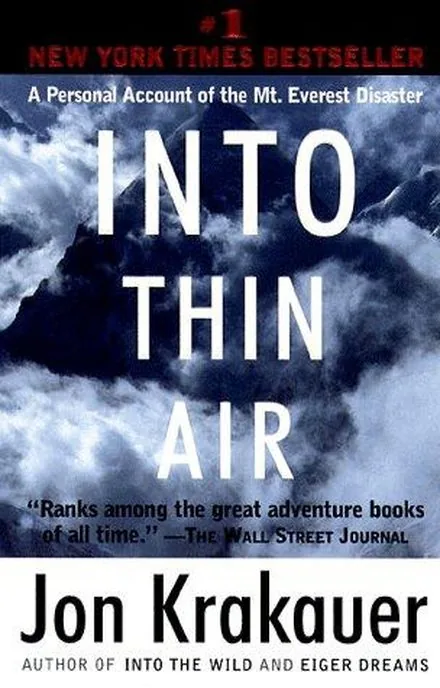
The first thing I check in a disaster story is not the size of the disaster. It is the handoff before it. Who is responsible? What was agreed? What changed? Who noticed the problem and who decided it could wait? Into Thin Air is a book about Mount Everest, but the part that stayed with me was not the height. It was the failure of a system under pressure, with everybody still trying to act as if the system was working.
Jon Krakauer goes to Everest in 1996 as a journalist and client on Rob Hall's guided expedition. He is not a beginner in the mountains, but he is not an experienced high altitude climber either. He has technical climbing experience, which is not the same thing. Everest requires a different kind of competence. It requires walking slowly while the body is failing, making decisions when the brain is starved of oxygen, and turning around after spending weeks and a large amount of money to get close to the summit. The book makes this distinction very clear. A person can be strong, brave, experienced, and still be badly prepared for the particular problem in front of him.
Krakauer begins at the summit, already exhausted, almost without oxygen, and unable to feel the triumph that should have arrived. That is an excellent decision. He does not present the summit as a clean reward. He reaches the highest point on earth and is mostly thinking about the descent, the empty oxygen bottle, the traffic jam at the Hillary Step, and whether he can get down alive. From there the book goes backward through the history of Everest, the commercialization of climbing, the people on the expedition, and the long approach up the mountain. This structure works because the reader knows the mountain will not forgive the people on it. Every delay acquires a cost.
The historical material is not filler. Krakauer explains how Everest became a symbol, first of exploration and national prestige, then of personal achievement and commercial opportunity. Edmund Hillary and Tenzing Norgay reached the summit in 1953 after an enormous expedition supported by many people. By 1996, companies were selling guided ascents to clients who could pay tens of thousands of dollars. Hall charged $65,000. The price bought logistics, oxygen, fixed ropes, Sherpa support, food, camps, and the knowledge of a famous guide. It did not buy a safe arrival at the summit. That distinction is obvious when written in a brochure. It became much less obvious at 28,000 feet.
This is where my own work habits made the book especially uncomfortable. In a warehouse, if one person changes a delivery address by telephone and nobody records it, the problem does not disappear. It moves to the next handoff. The driver finds it, the customer finds it, or the wrong goods arrive. On Everest, an undocumented change or a delayed decision can become a body on the mountain.
Rob Hall understands systems. Krakauer describes him as methodical, organized, and deeply concerned with logistics. He plans the acclimatization schedule, stocks camps, manages oxygen, and gives clear instructions. He also tells the clients that there will be a strict turnaround time on summit day. This is the correct rule. A summit is not the job. A summit followed by a return to camp is the job.
Then the rule starts moving.
The fixed ropes are not installed when they should be. Climbers wait in queues near the top, wasting oxygen and daylight. The two expeditions do not coordinate properly. Hall does not announce one firm turnaround time in a way that everyone understands. Some clients turn around at the right moment, but others continue. Doug Hansen reaches the summit after 4:00 in the afternoon, far past the sensible deadline. Hall helps him get there, even though the descent is now the more dangerous part of the day. This is not one dramatic mistake. It is a series of exceptions, each one understandable in isolation, which together remove the margin for survival.
Krakauer is strongest when he shows how these decisions feel from inside the process. People are not standing around announcing that they have become reckless. They are tired. They have invested money and effort. The summit is close. A guide wants to help a determined client. A Sherpa is carrying equipment for a paying customer. A climber thinks another ten minutes will make the difference. The problem is that above 26,000 feet, ten minutes is not a small amount of time. It is oxygen, heat, visibility, and the ability to think.
The book also refuses to make every person simple. Beck Weathers first appears to Krakauer as a loud, politically conservative doctor who seems to have purchased his place on the mountain. Later, after watching Beck climb through pain and uncertainty, Krakauer respects him and even likes him. This change matters. A person can say things I dislike and still be disciplined, generous, funny, and brave. I noticed this because Krakauer does not force the reader to choose one label and keep it forever.
Scott Fischer receives similar treatment. He is charismatic, ambitious, generous, and reckless. He has impressive climbing ability and a history of surviving incidents that should have killed him. He wants respect and wants Mountain Madness to compete with Hall's company. He also allows clients too much independence during acclimatization, becomes exhausted rescuing people, and appears to rely on his energy and reputation after his reserves are already gone. Fischer is not presented as a villain. That would be easier and less useful. He is a capable man whose strengths become liabilities when the conditions require restraint.
The treatment of the Sherpas is one of the most important parts of the book. Western clients speak about their dreams, their careers, and the price of the expedition. The Sherpas carry loads, establish routes, rescue injured people, erect camps, and accept far greater physical danger for much less money. Krakauer does not reduce them to noble background figures. He describes their skills, rivalries, religious beliefs, ambitions, and the economic pressures that bring them onto the mountain. The death of Ngawang Topche is particularly difficult because his illness is recognized, but his treatment is delayed and confused. The book makes clear that the mountain is commercial in a way that is not equal for everyone. The clients buy an opportunity. The Sherpas often sell their bodies to provide it.
I also appreciated Krakauer's honesty about his own position. He is not outside the story, calmly measuring the mistakes of other people. He is part of the same expedition, accepts the same support, wants the same summit, and makes his own bad decisions. He fails to recognize that Andy Harris is in serious trouble. He leaves Beck Weathers on the Balcony because Mike Groom is coming and because he is exhausted and relieved not to take responsibility for another person. He later learns that his mistaken account of seeing Harris at the South Col caused additional pain to Harris's family. Krakauer does not hide this. He keeps returning to his own guilt, sometimes so often that the repetition becomes uncomfortable, but that discomfort is part of the book's value.
There are moments when the detail becomes too much. The names, times, altitudes, teams, radios, oxygen bottles, and conflicting accounts can be difficult to track. The book has a long middle section explaining the background and personal history of nearly everyone involved. I usually want a tighter handoff between events. Here, however, the excess detail serves a purpose. The disaster cannot be explained by one sentence saying that the weather changed. The reader has to understand who was above whom, which guide had a radio, where the oxygen was stored, and why a message did or did not reach the person who needed it. The confusion is not a defect in the story. It is the story.
The most disturbing episode is not the summit itself. It is the night on the South Col, when several climbers are lost in the storm only a short distance from their tents. The group has reached the same elevation as camp but cannot find it. People are too exhausted to walk. Some are left behind because a rescue attempt could kill the rescuers. Anatoli Boukreev goes out alone and brings back several people, including Sandy Pittman and Charlotte Fox. Beck, who has been assumed dead, later walks into camp by himself. These scenes show both the usefulness and the limits of individual courage. Boukreev's rescue is extraordinary, but the fact that one strong climber can save several people does not mean the system was safe. It means the system had already failed and a person was spending his remaining strength to reduce the damage.
Krakauer is also fair about Boukreev, although this fairness is not soft. Boukreev descends ahead of his clients because he believes he will be more useful from camp, where he can rest and go back up if needed. That decision looks terrible if a guide is understood as a person who stays with the clients. It looks more defensible if the guide is understood as an emergency resource who must preserve his strength. The book does not settle the argument by pretending there is no argument. It shows the cost of both interpretations.
The ending does not offer a clean lesson. Krakauer discusses regulations, oxygen, guide-to-client ratios, and the commercial pressure that brought so many people onto Everest. Then he says, correctly, that people will keep trying. They will believe that better preparation will protect them from the particular mistakes made in 1996. They will look at the deaths and see a checklist, when the deeper problem is that Everest rewards the kind of desire that makes people ignore the checklist.
That is what the book ultimately became for me: an account of a process that kept giving people reasons to continue after the conditions had made continuing unreasonable. Every person had a quantity, a time, and a responsibility. The quantity of oxygen was limited. The time was running out. The responsibility was shared and therefore easily passed from one person to the next. Nobody needed to be evil for the result to be catastrophic. They only needed to accept one exception after another.
Into Thin Air is not an adventure story in the comfortable sense. It is not a celebration of conquering nature, because nobody conquers anything on Everest. It is a record of people trying to manage a situation that is larger, colder, and more indifferent than their plans. Krakauer's greatest achievement is that he makes the disaster understandable without making it feel inevitable. The deaths came from weather, altitude, commercial pressure, bad communication, exhausted judgment, personal ambition, and ordinary human loyalty. That is more frightening than a single villain. It means the signed handoff can look correct right up until the moment the whole load falls.