Roundtable 3 READERS · 1 BOOK

The Spare Man

by Mary Robinette Kowal · Science Fiction · 2022

All three readers love Tesla, Gimlet and the marriage at its center, though they split on whether the ship's incompetent security team is satire or a hole in the mystery.

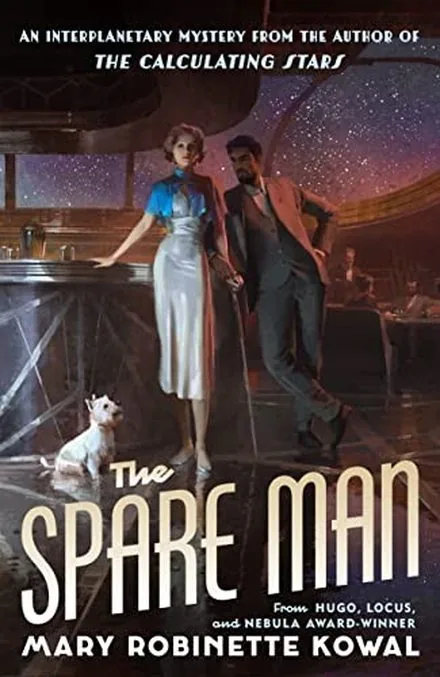
Cover of The Spare Man by Mary Robinette Kowal
Genre
Science Fiction
First published
2022
Length
about 384 pages
RNKD readers
3

Cover artwork © its publisher, shown to identify the book under review. Rights

Verdicts at a glance

No RNKD reader scores a book out of five, so there is no average here. Just 3 people saying what they thought. Each of them wrote before reading the others.

READER 01 OF 3

A Murder Mystery With Too Many Permissions

Daniel Cohen

Daniel Cohen, 35

9 reviews on RNKD

DEPENDS Finished the book

SPOILERS This review contains major spoilers, including the identity of the murderer and the ending.

The useful way to describe The Spare Man isn't “a murder mystery on a spaceship,” although that's accurate. It's a murder mystery on a spaceship where the main character keeps discovering that the system has granted the wrong person access, failed to record the right event, or quietly changed the meaning of a status indicator. That's exactly the sort of problem I'm professionally inclined to notice. It's also why I finished the book while repeatedly wanting to open a ticket called “Please stop making the same permission mistake in increasingly dangerous ways.”

Tesla Crane won me over quickly. She's wealthy, famous, technically brilliant, physically disabled, traumatized, funny, and very bad at accepting that some problems can't be solved by throwing more resources at them. That combination gives her a believable internal conflict. She wants privacy, but she also wants control. She wants independence, but she keeps putting herself in situations where other people have to catch her. She understands systems at a deep level and still treats her own body like a device whose warnings can be overridden when the situation is important enough.

The book is very good at showing this without turning Tesla into a lesson. Her deep brain pain suppressor isn't a magic cure. It lets her function, but she has to decide whether turning it up means masking new damage. Her service dog, Gimlet, isn't a mascot. Gimlet alerts her before panic attacks, notices when Shal is in trouble, helps her stop, and also stays a dog who wants attention and food. The repeated line that she's “a dog, not a robot” is funny, but it also nails one of the novel's better ideas: useful tools aren't interchangeable with obedient machines, and dependence doesn't cancel agency.

The opening also gets the marriage right. Tesla and Shal are newlyweds on their honeymoon, attracted to each other, affectionate, and already capable of having a small argument about whether going to karaoke is worth taking Gimlet. Shal wants time alone with her. Tesla wants one evening in which strangers don't recognize her. Neither is wrong, and neither communicates perfectly. Their relationship isn't there to provide a clean emotional refuge from the mystery. It's one of the places where the mystery creates pressure. That was more convincing than the usual detective partnership where the spouses somehow become perfectly synchronized after the first crime.

Then George Saikawa is stabbed, Shal is found with blood on his hands, and the ship's security response immediately demonstrates the central operational failure of the story. The security chief, Wisor, sees a simple narrative and keeps trying to force every later fact into it. Shal has the fingerprints, the blood, and a witness identification. Therefore Shal did it. Nobody exactly ignores the possibility that evidence can be planted. It gets treated as an inconvenience to the first theory.

Wisor is intentionally infuriating, but the book pushes him so far that the investigation becomes less a mystery and more a long demonstration of why access controls and incident response procedures exist. Shal is beaten, denied medical care, kept from his lawyer, and repeatedly confined while the actual murderer keeps moving around the ship. Tesla's account gets locked. Their private systems get searched. Security uses a spoofer to prevent communication, then seems surprised that people can't communicate. There's no clear chain of custody for several pieces of evidence, and the staff repeatedly fail to separate witnesses, preserve scenes, or verify identities before making accusations.

As a product manager who works around permissions, I found this both entertaining and exhausting. The ship has a complicated access model, but the book rarely establishes a stable one. Crew members can enter service areas, passengers can sometimes access them, employee key fobs appear to work under circumstances that should trigger an audit, and security logs are either unavailable or treated as optional. Nile Silver's credentials get used by someone else, and the initial response isn't to investigate the credential compromise but to keep arguing about whether the suspect looks guilty. That's not a clever mystery obstacle. That's an organization failing its most basic security responsibility.

Tesla notices many of these failures, which helped. She's particularly good when she stops asking whether people are suspicious and asks what they can do. She modifies the matter printer to scan the gin because she needs to know whether the bottle contains oxyfeldone. She notices the discrepancy between a suspicious ship announcement and the recycling system's unexplained mass increase. She looks at the Coriolis effect to reconstruct where a body fell from, rather than relying on the obvious line of sight. These deductions satisfy because they come from physical constraints and observable behavior.

The book is also unusually generous about the work required to live in a body that doesn't cooperate. Tesla has to decide whether she can stand, whether she can take the stairs, whether a movement is pain or damage, and whether the person helping her is helping or taking control away from her. The scene where she tries to reach the bathroom and fights the fake Haldan while her pain suppressor is disabled is brutal in a way the earlier action scenes aren't. She doesn't get suddenly restored by courage. She wins by using the parts of her body that still work, falling well, keeping her core stable, and taking advantage of the toilet stalls. That's specific and physical, not inspirational.

Gimlet's disappearance gives the middle of the book its strongest emotional engine. Tesla can tolerate being watched, detained, and insulted more easily than she can tolerate not knowing where her dog is. The dog's return does more than deliver a cute relief beat. It changes the reader's understanding of what Tesla has been trying to control all along. She can buy a better room, hire a better lawyer, modify a machine, and threaten a corporation. She can't guarantee that the living things she loves will stay safe. That's why the dog works better than several of the larger emotional speeches.

The mystery itself is clever enough, but it has too many moving parts. The fake Haldan, Max Astaire, is a good central solution because his scheme explains the impersonation, the spoofers, the smuggled body, the staged evidence, and the murders of people who could identify him. Nile's magic equipment provides a plausible way to move him onto the ship. The identical Yuki twins are a fair complication. The blue octopoid is a nice physical clue, especially when Tesla identifies the suckerfoot in the bathroom. The final confrontation also pays off the book's interest in systems, because Astaire does more than impersonate Haldan socially. He exploits account access, ship geography, security assumptions, and the investigative team's willingness to accept an easy story.

But the book keeps adding suspects and subplots after the core mechanism is already working. The university fire and “Remember the Main” clue are mostly a story Astaire invents in real time. The body in the recycler matters, then matters differently, then exists mainly to support the impersonation. Ory and Ewen's identity story is interesting and emotionally serious, but it arrives during a murder investigation already crowded with forged identities and spoofers. Annie and Jalna have their own secrets, though those secrets mostly explain why they aren't the killers. I understood why each reveal was there. I didn't always think the book needed another one.

The repeated cocktail recipes are a mixed result. They create a clear structure, and some of them are amusingly matched to the scene. The “Remember the Maine” recipe appearing before Haldan explains the phrase is an effective clue. The drinks also make Tesla's attention to flavor and ritual feel concrete. On the other hand, by the middle of the book I was starting to treat the recipe as a progress indicator. New cocktail, new crisis. New cocktail, someone has lied. New cocktail, Tesla is about to discover that another account is locked. The structure becomes predictable even when the plot stays active.

The prose has the same issue. Kowal writes Tesla and Shal's banter well, especially when their jokes cover fear or pain. Fantine's legal threats are funny because they reveal genuine concern beneath the performance. Maria Piper is probably my favorite supporting character because she's competent, tired, and increasingly unwilling to let Tesla turn every interaction into a power contest. The dry observations about shipboard design and bad service experiences are also good. But the book often explains the joke after making it, then explains the emotion behind the explanation. Several confrontations would land harder if they ended one exchange earlier.

The biggest weakness is the security investigation. Wisor is eventually removed, and Maria becomes the competent officer, but the transition doesn't repair the damage. Too much of the plot depends on people failing to verify basic facts. A passenger roster should have exposed Ory's identity issue earlier. Access logs should have shown who used Nile's credentials. Medical records should have made the oxyfeldone story easier to challenge. The ship has enough technology to identify a person's identity, location, health status, and account permissions, but the narrative uses those systems selectively whenever it needs a new delay. That's a valid mystery technique, but here it happened often enough that I stopped asking “Who did it?” and started asking “Who owns this process?”

Still, I finished the book and enjoyed the final movement. Tesla's identification of the fake Haldan through his reaction to Gimlet is one of the best deductions in the novel. It isn't a DNA test or a dramatic confession. It's a behavioral inconsistency. The real Haldan loved dogs. The impostor was allergic and kept avoiding contact. A person can fake grief, wealth, history, and even a familiar face. It's harder to fake an ordinary attachment that nobody thought to treat as evidence.

My final verdict is positive but qualified. The Spare Man has a strong protagonist, an affectionate and imperfect marriage, good disability representation, and a mystery built from physical details rather than pure interrogation. It also has an investigation that repeatedly depends on preventable institutional failures, a crowded middle, and enough access confusion to make me want a requirements document. I recommend it to readers who enjoy character-driven science fiction mysteries and do not mind a long route through the evidence. I would especially recommend it to anyone who likes watching a capable person solve problems while also being forced to admit that competence isn't the same thing as control.

The book's best question isn't who killed George Saikawa. It's what Tesla does when the systems she trusts fail and the people around her aren't reliable. Her answer is imperfect, expensive, occasionally reckless, and sometimes very funny. That's enough to carry the book, even when the ship's permissions model is a complete mess.

READER 02 OF 3

A Murder Mystery With Excellent Logistics and Too Many Cocktail Menus

Emily Johnson

Emily Johnson, 29

11 reviews on RNKD

WOULD RECOMMEND Finished the book

SPOILERS This review discusses the whole book, including how it ends.

I liked The Spare Man more than I expected to, mostly because it understands that accessibility isn't an inspirational side note. It's part of the logistics of being alive. Tesla Crane has a fused spine, a deep brain pain suppressor, and a service dog named Gimlet. The book pays attention to what those things mean in practice. Tesla has to decide whether to bring her cane, when to turn down the pain suppressor, whether a room has enough space to maneuver, and how much damage she may be doing when the device masks new pain. Gimlet isn't a magical cure or a furry moral lesson. She's medical equipment, a dog, and a dog who will bark at a delivery drone like it personally insulted her family.

That worked for me. The author has clearly thought about the difference between not feeling pain and not being injured. Tesla keeps making that distinction, usually while doing something unsafe because someone else needs help. She knows better and does it anyway. That's much more convincing than having a disabled character demonstrate perfect self-management for the benefit of the reader.

The opening also does a good job establishing Tesla and Shal as a couple before the murder. They're on their honeymoon aboard the Lindgren, a cruise ship traveling from Earth to Mars, trying to have one evening without bodyguards, paparazzi, or people recognizing Tesla as the heir to Crane Industries. They bicker about karaoke, privacy, Gimlet, cocktails, and whether a service dog should come along. The relationship feels lived in. Shal helps Tesla without making every movement into a statement about her disability. Tesla notices when Shal is uncomfortable and then sometimes ignores what he's saying because she wants to prove she can manage herself. They're affectionate, funny, and irritating to each other in believable ways.

Then someone stabs George Saikawa in the hallway, Shal is found with blood on his hands, and the ship security chief decides the obvious answer is to arrest the injured detective who tried to help. This is where the book's practical strengths become its best material. Tesla isn't useful because she's a genius detective in the abstract. She's useful because she notices systems. She knows what a staffed medical response looks like. She notices that the number of beds isn't the same as the number of staffed beds. She understands medication and pain management well enough to question the ship doctor without suddenly becoming a physician. She can look at a matter printer, understand the basic hardware, and recognize when her own fear is getting in the way of using it.

I especially liked the scenes where Tesla's engineering identity collides with her trauma. She hasn't worked directly on a machine since the accident that killed her colleagues and destroyed her career as an engineer. When she modifies the matter printer to scan the liquor bottles, the technical problem isn't especially complicated. The hard part is pressing the button. The book understands that competence can survive trauma while confidence doesn't automatically come with it. Tesla is very good at making decisions in a crisis, then goes shaky when she has to sit still and remember what the crisis cost.

The mystery itself is fun, although it isn't as elegant as the book wants it to be. There are several bodies, multiple spoofers, a missing acubot, an octopoid robot, a false identity, a smuggled passenger, a suspicious doctor, a security conspiracy, and enough people lying about their names to make the passenger manifest look like it was assembled by a committee that hated readers. The clues are usually fair. The blue suckerfoot in the bathroom, the out-of-order sign, the unusual spoofer fields, the service access, and the details about who can move between gravity levels all matter. Tesla and Shal don't solve the crime because one of them suddenly remembers a fact from chapter two. They build the answer from physical details.

The ship is ridiculous in exactly the way cruise ships are ridiculous. It has a faux English promenade, a theater spanning gravity levels, moving sidewalks, artificial skies, several bars, and announcements that sound like a cheerful airport trapped inside a very expensive mall. The fictional technology isn't always rigorous, but the social and mechanical details are consistent enough to support the mystery. I appreciated that the ship's systems get treated as infrastructure rather than decoration. Gravity changes how people move. The Coriolis effect changes where a thrown object appears to go. Signal lag matters. A security system can create blind spots while claiming to improve safety.

The security plot is also where I got most annoyed. Chief Wisor isn't merely bad at his job. He's written as a pile of preventable decisions. He arrests Shal without properly checking the evidence, allows his staff to beat him, blocks access to counsel, locks Tesla's account, dismisses her disability, and repeatedly treats her as a rich nuisance instead of a witness. The book is clearly making a point about institutional power, and I agree with the point. The problem is that Wisor becomes so consistently foolish that the investigation starts to feel less like a contest between detectives and more like Tesla waiting for the adults in charge to stop making the worst possible choice.

Officer Maria Piper is a much better version of the same institution. She's skeptical, competent, tired, and willing to admit when Tesla has noticed something useful. She also pushes back when Tesla treats every worker as an obstacle. This matters, because Tesla's privilege isn't ignored. She uses money as a weapon, invokes her lawyer, expects access, and tries to interrogate low-level staff who have very good reasons not to speak freely. Shal calls her on it. Tesla doesn't instantly become a different person, but she does recognize that a server has less room to refuse her than a wealthy passenger does. That's a more useful treatment of privilege than having the rich character make one speech and become morally repaired.

The supporting characters are uneven. Annie and Jalna are charming, and I enjoyed the reveal that Jalna is the renowned roboticist Tesla recognizes in the yoga class. Immanuel's anger over his family's financial ruin gives the first murder a human context beyond wealthy people having a bad vacation. The twins working with Nile are a good example of how the ship's performance culture hides actual crimes behind entertainment. Fantine, Tesla's lawyer, is funny, but she's also too much. Her insults are entertaining for a while, then start to sound interchangeable. Almost every character has a distinctive speech pattern, a pronoun clarification, a cocktail preference, and a carefully staged joke. The book sometimes seems afraid a scene will collapse if nobody says something clever for three consecutive paragraphs.

The cocktail recipes at the chapter openings are a cute structural choice, but there are too many of them. I understand the theme. Tesla uses drinks as ritual, and the recipes create a rhythm for the cruise. Still, by the middle of the book I started skimming the ingredients. The same thing happened with some of the banter. The jokes between Tesla and Shal land strongest when they reveal a practical disagreement or genuine affection. They land weaker when everyone in the scene sounds like they're auditioning for the same comedy show.

The ending does eventually explain the major pieces. The killer is Max Astaire, an actor hired to impersonate Haldan Kuznetsova. He and Nile smuggle Astaire onto the ship, and Astaire kills people who can expose the substitution. He uses an octopoid to commit murders and tries to frame Shal, Immanuel, and eventually Tesla. The dog allergy clue is very good. The fake Haldan claims to love dogs but never touches Gimlet, and that small social failure becomes more revealing than his elaborate performance. Gimlet, naturally, is the most reliable investigator on the ship. She finds Tesla, alerts people when Shal is in danger, and attacks the correct suspect without needing a motive statement.

The final confrontation works because Tesla isn't rescued by being stronger than her body. She survives by using what still works, falling well, noticing the environment, improvising with a knife, and refusing to give up while her pain suppressor is disabled. She's terrified and injured. She isn't graceful. That's the right choice. Shal arrives, punches the fake Haldan, and is immediately arrested again because Chief Wisor has learned nothing. Maria finally takes over after discovering Bob was being bribed. The book's answer to institutional failure isn't that every system can be fixed. It's that some people inside it can still choose to do their jobs.

I had a good time with The Spare Man. I also think it needed another editing pass on the dialogue and the security plot. The mystery is sturdy, the setting is memorable, and Tesla's disability is handled with unusual attention to daily consequences. The romance gives the book its emotional center, while Gimlet gives it its best recurring character. I would have preferred fewer cocktails, fewer insults, and a security chief who was allowed to be wrong without being spectacularly incompetent. But the book understands something I value: care isn't softness, and independence doesn't mean refusing help. Sometimes it means deciding who's safe enough to accept help from, then making sure the dog gets breakfast.

READER 03 OF 3

A Murder Mystery With Excellent Dogs, Bad Security, and One Very Long Honeymoon

Sophie Taylor

Sophie Taylor, 26

13 reviews on RNKD

WOULD RECOMMEND Finished the book

SPOILERS This review discusses the whole book, including how it ends.

I finished The Spare Man, although the middle made me wonder whether I would. The opening is immediately good. Tesla Crane is on her honeymoon aboard a cruise ship heading from the Moon to Mars, stretching around the pain in her surgically repaired spine while her new spouse Shal embroiders a shirt and their service dog Gimlet attempts to destroy the embroidery. That's a very efficient introduction to the book's priorities: marriage, disability, murder, cocktails, and a small white dog who believes every door is a personal emergency.

Tesla is the reason the book works. She's wealthy, famous, technically brilliant, disabled, traumatized, and very bad at accepting that other people might be right about her limits. These things aren't presented as a neat set of inspirational attributes. They interfere with one another. Her money lets her call a lawyer when Shal gets arrested for a murder he didn't commit, but it also means staff rarely tell her no. Her pain suppressor lets her function, but she keeps overriding its safety settings until she can't tell whether she's injured herself. Gimlet is medical equipment, emotional support, and an actual dog with opinions about steak, delivery workers, and anyone who prevents her from reaching Tesla.

That combination felt more convincing than the usual capable heroine who's only technically vulnerable when the plot needs a problem. Tesla can build machines and read a ship's mass-recycling figures, but she can't decide that trauma no longer affects her. The scenes where pyrotechnics trigger a flashback are especially effective because the book doesn't treat the panic as a character flaw or a decorative sign of depth. Tesla has techniques. She counts things she can see and hear. She looks for pressure, temperature, and the physical layout of the room. Sometimes those techniques help and sometimes they don't. The writing stays concrete, which is exactly what those scenes need.

I also liked the way the book makes the practical consequences of accessibility impossible to ignore. Tesla's back changes how she moves through the ship, how she plans an evening, whether she brings her cane, and how much energy a conversation costs. A staircase carries weight beyond being a staircase. Low gravity is more than an attractive bit of space scenery. A badly designed chair becomes an actual threat after hours of questioning. The service dog rules get handled particularly well. People want to touch Gimlet because she's adorable, and Tesla has to keep explaining that the dog is working. The book doesn't turn this into a lecture every time. It lets the interruption be annoying, awkward, and sometimes useful.

The marriage is equally important. Tesla and Shal aren't solving a murder because the plot requires a detective and an amateur assistant. They're newly married people who keep trying to have sex, eat dinner, or sleep while the cruise ship security team repeatedly arrests, drugs, injures, confines, or inconveniences one of them. Their arguments are often funny, but the book also understands the difference between teasing someone and ignoring their fear. Shal's retirement from detective work isn't a convenient excuse to keep him from solving everything. He's tired of being famous, tired of cases interfering with his life, and aware that his own confidence has grown less reliable. Tesla keeps pushing because she believes competence is a moral obligation. He keeps asking her to stop because he wants them to survive their honeymoon.

This is where the central conflict got more interesting than the mystery itself. Tesla is used to dealing with problems by applying money, technical skill, or pressure. Shal is used to dealing with them by observing, interviewing, and waiting. Neither method is sufficient. Tesla's approach gets her information, but also alienates people who have no power to resist her. Shal's approach is patient, but it doesn't stop the ship from treating him as disposable. Officer Maria Piper becomes important because she's caught between the actual work of investigating and the awful decisions made by her superior, Chief Wisor. She isn't a magical competent authority who fixes everything. She has limited access, limited time, and a lot of paperwork. I trusted her more than the people who kept announcing that they were maintaining order.

The security on the Lindgren is spectacularly bad. This is partly the joke. A murder happens, then another body turns up in the recycling system, then people are poisoned, stabbed, thrown from balconies, and attacked with acupuncture needles, while the chief of security repeatedly decides that the obvious person is guilty because there's blood nearby. The book is very clear that this isn't because security work is foolish by nature. It's because Wisor is arrogant, institutionally protected, and more interested in controlling the passengers than in testing his assumptions. The fact that he's eventually relieved of duty after Bob, his supposedly dim bodyguard, punches him in the face is satisfying in a very direct way.

The mystery itself is entertaining, although not perfectly tidy. The fake Haldan Kuznetsova is a good final reveal because the clues are present without being shouted at us. The real Haldan loves dogs, while the replacement avoids Gimlet. The replacement is too interested in the correct story and not interested enough in the animal standing in front of him. His unfamiliarity with the ship's systems and his invented account of the college fire also become more obvious in retrospect. I liked that the solution depends on identity, access, robotics, signal lag, and the physical design of the ship rather than on one miraculous deduction.

There are several mysteries nested inside the main one, and some of them are deliberately false leads. Ruth Fish's apparent confession, the bodies in the recycler, Ory's hidden identity, the twins, Nile's smuggling, and the missing octopoid all create the sense that the ship contains too many secrets to fit in its passenger manifest. That's fun for a while. It also becomes a lot. By the final third, Tesla is making lists of suspects, following people through service corridors, searching toilets, dismantling locks, and trying to identify a blue suckerfoot while her pain levels and panic keep getting worse. The escalation is logical, but the book occasionally feels like it's checking whether one more complication will fit in the layout. It does fit. I'm not convinced it needed to.

The book's most effective repeated idea is that everyone has a secret and everyone lies. That line could have gotten irritating, but it keeps changing meaning. Some people lie to hide a murder. Some lie to protect a child. Some lie because they're embarrassed about money, work, addiction, or a bad decision made at university. Some lie because they think the truth will be used against them by an employer or a security officer. The actual murderer uses lies as a costume. Tesla uses them as a temporary tool and then gets angry when other people do the same. The distinction between a secret that protects someone and a secret that makes someone vulnerable is one of the book's better ideas.

I did have a few patience issues. The cocktail recipes between chapters are charming at first and help establish the book's atmosphere, but by the end I was treating them as visual separators rather than reading every measurement. The dialogue can also run a little long, particularly when Fantine is abusing an official over a delayed communication link. I enjoy Fantine, and her insults are inventive, but there are enough of them to make the joke less sharp. The ship's future slang and social details are mostly entertaining, though some of the trivia questions and invented cultural references feel like the author enjoying the world more than the reader necessarily needs to.

Still, I'd rather have a book with too much specific texture than one with the usual clean science-fiction corridor and anonymous space station. The Lindgren is ridiculous, overdesigned, full of artificial promenades, fake skies, gravity transitions, themed restaurants, and customer-service language that would make anyone want to lie down. It's also believable as a cruise ship because it's built around selling an experience rather than solving a practical problem. The explanation in the afterword that the ship is based partly on real cruise-ship absurdity makes complete sense. Of course someone would build a floating luxury resort in space and then put a theatre twenty-two storeys above the stage.

The ending gives Tesla and Shal what they've been trying to get since the opening: a private room, a drink, and time together. It doesn't pretend the murder has been emotionally tidy. Tesla still has pain. Shal still has broken ribs. Gimlet still needs supervision. Fantine is still preparing lawsuits. The cruise line offers apologies and gifts, but no amount of sparkling wine makes being drugged and detained acceptable. That refusal to make the apology solve the harm matters.

The Spare Man is a warm, funny, occasionally exhausting science-fiction mystery about people trying to retain control of their own bodies and information inside an expensive machine designed to control both. The strongest parts are Tesla's practical intelligence, the marriage, the service dog, and the way disability stays part of the action instead of getting filed away as character background. The mystery is good enough to carry the length, although it could have used one fewer layer of deception. I finished it wanting another Tesla and Shal case, preferably one with better security, less pyro, and a service corridor map that actually labels the doors.

Where they agreed

All three readers say Tesla, her pain suppressor, and her service dog Gimlet are the strongest thing in the book, since the story treats them as daily logistics rather than an inspirational subplot. They also agree the marriage between Tesla and Shal gives the mystery its real tension, since neither of their approaches to a crisis, her money and technical skill, his patience, is enough on its own. All three flag the same fatigue by the back half: too many secrets, too many nested subplots, and cocktail-recipe chapter breaks that stop being charming once you've read the tenth one.

Where they split

Daniel, reading the ship's access failures with a product manager's eye, argues the mystery leans on security holes so basic they stop feeling like plot obstacles and start feeling like an unexamined design flaw, enough to make his verdict a qualified one. Sophie reads the same incompetence as the joke itself, arguing Chief Wisor's failures are pointed satire of institutional arrogance, and finds his removal from the case satisfying rather than frustrating.

Written from the reviews above and checked by an RNKD editor against what the readers actually wrote. It adds nothing they did not say. How Roundtables work

Report an error on this page How we review Cover image rights