Roundtable 6 READERS · 1 BOOK

Swan Song

by Robert R. McCammon · Horror · 1987

Six readers praised the survival-by-labor ethic despite the book's near-thousand-page length, splitting mainly over how hard to press on its dated treatment of race and disability.

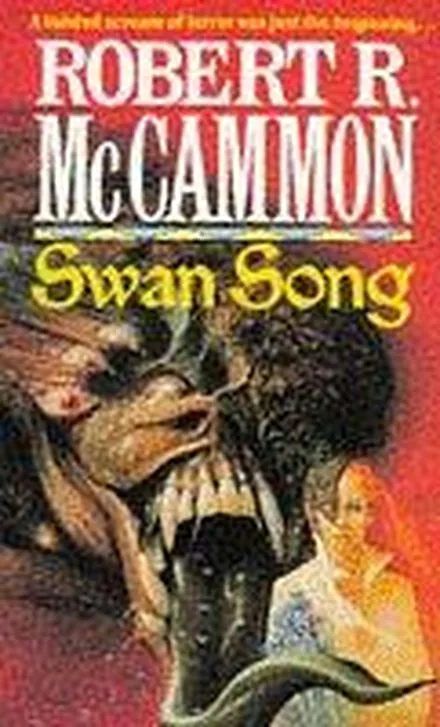
Cover of Swan Song by Robert R. McCammon
Genre
Horror
First published
1987
Length
about 956 pages
ISBN
9780751501964
RNKD readers
6

Cover artwork © its publisher, shown to identify the book under review. Rights

Verdicts at a glance

No RNKD reader scores a book out of five, so there is no average here. Just 6 people saying what they thought. Each of them wrote before reading the others.

READER 01 OF 6

The World Ends, Then the Work Starts

Avi Mizrahi

Avi Mizrahi, 61

7 reviews on RNKD

WOULD RECOMMEND Finished the book

SPOILERS This review discusses the entire book, including the ending.

The first thing I check in a disaster story isn't the size of the explosion. It's whether anybody knows what to do five minutes afterward. Who has water? Who has tools? Who can still walk? Who's counting the food? Who's making the decisions, and who's only shouting? Swan Song understands those questions better than many novels of this kind. It also understands that the end of the world doesn't end human behavior. It just removes the paperwork and leaves the behavior exposed.

The opening is a nuclear exchange caused by fear, machinery, bad information, and men who think force is the same as control. The American president is shown receiving reports about Soviet submarines, missiles, reconnaissance satellites, and military readiness. He's frightened, but the generals around him keep translating fear into an instruction to act. They talk about Defcon levels, first strikes, and the point of no return as if naming the problem makes it manageable. The president finally authorizes escalation. The missiles fly. The United States and the Soviet Union destroy each other, along with most of the northern hemisphere.

The scene works because the decision doesn't feel like one dramatic villain pressing a red button. It feels like a loading sequence gone wrong at every handoff. One side changes readiness. The other side reads the change as preparation. Somebody launches without proper authorization. Somebody else responds. Then the original question, who fired first, becomes useless. The process has moved past the people operating it. That's the strongest idea in the book, and McCammon returns to it through almost every surviving character.

After the missiles, the book follows several groups. Sister Creep, a homeless woman in Manhattan, survives the blast in a subway tunnel. Josh Hutchins, a former football player and professional wrestler, survives in a buried grocery-store basement with nine-year-old Swan Prescott. Colonel James Macklin survives the collapse of Earth House, a private survivalist bunker in Idaho, with Roland Croninger, a teenage boy who treats the apocalypse as a real version of his King's Knight computer game. These stories eventually connect, but the book earns the connections by making each group carry a different piece of the ruined country.

Sister is the emotional center for me, though Swan becomes the moral one. Sister begins as a street woman who believes Jesus is arriving in a flying saucer and sees demons in ordinary people. She's filthy, violent when necessary, funny in a damaged way, and capable of kindness she doesn't recognize as virtue. Her transformation isn't a clean conversion. She never becomes respectable. She keeps stealing food, swearing, and making hard decisions. What changes is that she begins to remember who she was before she became Sister Creep. The dead child in the basement forces that memory back into her. She'd been a mother. She'd killed her daughter while drunk and lost herself afterward.

That reveal could have been sentimental, but the book handles it through action. Sister takes the dead child from another mother who can't release it. She carries the body. She understands the other woman, because she's lived inside the same guilt. Later she refuses to give up the glass circle to the creature wearing Doyle Halland's face. She fights with a bag full of frozen dinners and cans, then uses one of the glass spikes to injure him. The point isn't that Sister becomes innocent. She doesn't. The point is that she accepts responsibility and keeps going anyway.

The glass circle is the book's best object. It's made from melted glass and jewels in the ruins of Fifth Avenue, and it responds to the heartbeat of whoever holds it. It gives Artie Wisco a vision of his young wife and gives Beth Phelps the water she's dying for. It lets Sister understand Julia Castillo's Spanish. It shows images that may be dreams, memories, predictions, or locations. McCammon never reduces it to a clean technical explanation, which is sensible. Some systems aren't improved by a manual.

The circle finally becomes a crown of light for Swan. That's where the novel's central argument gets clear. Survival alone isn't enough. People need something to move toward. Sister survives because she believes the glass may hold beauty. Swan survives because she can recognize life where everyone else sees only dead earth. When she plants the kernels of corn in Mary's Rest, she works until her hands are ruined and nearly freezes to death. The corn grows. The apple tree grows. This isn't a reward for being morally pure. Swan has suffered, made decisions, and accepted responsibility. She isn't saved from work. She's given more of it.

That part suits me. The world gets rebuilt through repeated, unglamorous tasks. Someone digs a well. Someone carries water. Someone gets a printing press working again. Someone guards the corn from crows. Someone repairs a door. Someone buries the dead instead of throwing them into a common pit. The book's heroes aren't only the people who shoot well. They're the people who keep a schedule and do the next necessary thing.

Josh is the clearest example. He begins as a giant who thinks he has no family, since his wife divorced him and he's stayed away from his sons. He isn't a strategist, a scientist, or a political leader. He's a wrestler who knows how to carry weight and keep moving after injury. He protects Swan because someone, or something, tells him to, but the command turns into a choice. He buries Darleen. He digs himself and Swan out of the basement. He crosses the ruined country with a horse and a dog. When Swan grows strong enough to lead others, he understands that protection doesn't mean keeping her beside him forever. He leaves her to begin the next field while he goes to find his family.

That's one of the better decisions in the novel. He doesn't turn his love for Swan into ownership. He doesn't say that because he saved her, she belongs to him. He knows when his part of the work is finished. Give me the quantity, the time, and who signed. Josh has the quantity. He knows what food remains, what the body can carry, and what the next mile will cost.

The book is less convincing when it turns to its villains. Friend, the shapeshifting creature who's encouraged wars and terrorism across history, works as an image of destruction but not always as a character. He laughs at death, wears human faces, emerges from the mouth of a movie theater, and spends the postwar years persuading people to lose hope. He's frightening when he appears suddenly in a ruined world, especially when he pursues Sister. But his speeches become repetitive. He says it's his party, that hope is dangerous, that he'll dance on the graves of survivors. I understood the point the first time. By the fourth time, I was checking how much longer he planned to stand there talking.

Macklin and Roland are more interesting, because their evil is human before it turns theatrical. Macklin knows Earth House is structurally unsound and keeps taking money from survivalists anyway. When the missile strikes, he refuses to open the bunker to a family in an approaching RV, because more mouths mean less food. He then orders civilians to clear rubble while hiding the danger from them. Roland becomes his trigger finger after cutting off Macklin's hand in the dark. The boy has always used fantasy to manage humiliation, and the collapse of the world hands him permission to turn that fantasy into a system.

The scene where Roland attacks Freddie Kempka is disgusting, but it matters. Kempka drugging and attempting to assault him doesn't make Roland's later career acceptable. Roland has already killed people, tortured prisoners, and helped build the Army of Excellence. His response isn't justice. It's the discovery that he enjoys power. Later, Macklin and Roland build an army that kills people marked by radiation burns, calling those growths the mark of Cain. They claim they're rebuilding America. In practice, they're collecting food, vehicles, women, and obedient men. The quantity is never enough, because the real supply they want is control.

I did have problems with the book's scale and repetition. At more than a thousand pages, it sometimes explains the same moral point through another settlement, another starving group, another argument about whether to stay or move. The winter lasts so long I felt it in my own shoulders. The novel wants the reader to experience exhaustion, and it succeeds, but success isn't always the same as enjoyment. Some scenes could have been shorter without losing their force.

There's also a lot of graphic violence, including violence against children, and some of it is written with the excitement of a horror film rather than the restraint of a witness. The setting is harsh enough without every corpse getting a detailed inspection. The treatment of race, disability, and mental illness also belongs to the period the book was written in. Some characters get introduced through crude labels or sensational descriptions. The novel is often interested in the dignity of damaged people, especially Sister, Josh, and those with Job's Mask, but it sometimes uses those same people as grotesque scenery. Both things are true at once.

The ending brings the main conflict together at Warwick Mountain. Friend tries to use the old nuclear command system to destroy the earth, while the President, broken by guilt, believes the talons of Heaven will cleanse the world. Swan reaches the computer and types the command that ends the prayer. She doesn't defeat evil by overpowering Friend. She refuses his definition of the future. Sister is shot and survives long enough to see the sun return. She dies on the mountain, and her death is earned by the work she's done, not handed to her by a last-minute miracle that erases her suffering.

The final image is the right one. Swan, Robin, and the others don't restore the old world. They begin with fields, orchards, water, schools, churches, and settlements. They repeat work that was once ordinary until ordinary life becomes possible again. Swan isn't a queen sitting above the rebuilt country. She's a worker moving from field to field. The crown isn't a medal for her to wear. It's a responsibility.

Swan Song is too long, too loud, and sometimes too pleased with its own horrors. It is also serious about the difference between surviving and rebuilding. Its best question isn't whether humanity deserves another chance. Its best question is what people will do if they get one. The answer here is practical. They'll plant seeds, carry water, repair a machine, bury their dead, and stand watch through the night. Then they'll do it again tomorrow.

READER 02 OF 6

A Very Long Way to Find Out What Survives

David Thompson

David Thompson, 63

7 reviews on RNKD

WOULD RECOMMEND Finished the book

SPOILERS This review discusses the whole book, including how it ends.

I finished Swan Song. That's worth stating, since this isn't a small book, and it gives you several opportunities to abandon it. It begins with a nuclear exchange, moves through the immediate destruction of America, follows several groups of survivors across the ruins, introduces a supernatural enemy who can change faces and bodies, and eventually builds toward a conflict involving rival armies, a magic glass crown, and a computer system capable of ending the world for good. There's a lot going on. Some of it is very good. Some of it is excessive in ways the book seems to regard as a virtue.

The opening is strong because McCammon understands that catastrophe isn't an abstract event. It's a sequence of practical failures. Reconnaissance satellites go blind. Commanders misread intentions. Submarines move into position. The President is asked to decide whether showing force will prevent war or cause it. He's been trained to make decisions, but the decision in front of him isn't a bridge alignment or a budget line. It's whether millions of people live for another hour.

The President isn't presented as a monster. He's frightened, confused, and physically overwhelmed by the machinery around him. He remembers a film, thinks about John Wayne, and keeps returning to the point of no return. The phrase repeats often enough that it should have become irritating, but in the first section it works. A decision made in a room by men with folders and telephones becomes a line that can't be uncrossed. Once the missiles launch, the novel makes the consequences immediate. New York, Washington, cities across America, and targets in Russia get hit in a sequence of fire, pressure, and falling debris. The important point isn't who fired first. The important point is that nobody can make the damage stop.

McCammon is particularly effective when he follows people who aren't in command. Sister Creep, Joshua Hutchins, and Swan Prescott become the emotional structure of the novel. Sister begins as a homeless woman in New York, mentally fractured and living among garbage bags, rats, and other people who've fallen through ordinary society. Her encounter with the dead infant is one of the most difficult scenes in the book. It's ugly, but it isn't merely there to shock. It reveals the wound inside her memory, the daughter she believes she killed while drunk, and the guilt that's turned into religious fantasy.

After the bombs fall, Sister doesn't become a saint. She stays argumentative, practical, and capable of violence. She steals food, scavenges clothes, and walks west because standing still means dying. She also becomes the person who keeps other survivors moving when they have no sensible reason to continue. That's what makes her worth following. She doesn't have a plan in the usual sense. She has the next step. In conditions where a road may be blocked, a tunnel may be flooded, and the water may kill you, that's a proper plan.

The passage through the Holland Tunnel is one of the best sequences in the novel. Sister, Artie, Beth, Julia, and Jack wade through rising water, wrecked vehicles, and dead bodies while the tunnel threatens to collapse around them. The scene works because the danger is physical and specific. Water reaches the waist, then the shoulders. A lighter is the only light source. Someone panics and turns back. The survivors have to keep hold of one another, because losing the chain means losing the person. There's no speech about courage while they do it. They take the next step.

The glass circle found in the ruins of the Steuben Glass shop is where the book changes from post-nuclear survival story into something more like a myth. It shows people what they need. Artie sees his wife and a picnic from the past. Beth sees clean water. Julia sees her dead child and receives forgiveness. Sister sees a burned field, a buried dome, and a child's Cookie Monster doll. The circle also lets people who speak different languages understand one another. It's an object that turns regret into temporary relief, but it can also offer direction.

I liked the idea more than I liked every scene built around it. The magic is strongest when it stays tied to character. Beth drinking imaginary water tells us what thirst has done to her. Artie tasting a sandwich with his young wife shows that memory can feed a person for a few minutes, even when it can't keep the body alive. The object is less successful when the novel treats it as a device for arranging the next stage of the plot. By the end, the explanation isn't an explanation, which is acceptable in a book about miracles, but the symbolism gets laid on with a trowel.

Swan is the most interesting character because she isn't a chosen one waiting to be told what she is. She's nine when the bombs fall, already able to hear the hurting sound of living things. She grows plants in trailer parks and understands that grass, animals, and trees have their own ways of speaking. After the blast, she grows green shoots in a sealed basement without sunlight or water. Later she revives an apple tree, then plants corn in ground everyone else considers dead. Her power isn't presented as domination. She pays attention. She puts her hands in the dirt and listens.

The book's best argument is that rebuilding requires more than surviving. Josh initially thinks in terms of food, shelter, and protection. Those things matter, obviously. He's a large, damaged wrestler who carries Swan out of a buried basement after the nuclear blast. He buries her mother, shares the last food, and gives her the truth when she asks whether they'll escape. His strength is practical and decent. He doesn't become a leader because he wants authority. He becomes one because he keeps carrying people when there's no reward for doing so.

Swan gradually understands that the future can't be built by one person's miracle. The corn grows because she plants it, but other people make the fires, guard the field, dig the water source, and harvest the crop. That's a useful distinction. A community isn't created by a gifted individual standing in a field. It's created by people doing ordinary work around that individual and deciding not to take what's grown.

The book is less subtle about evil. The supernatural antagonist, known through several names and faces, is a creature who feeds on destruction. He appears as the man who likes films of death, as the thing in the theatre, as Doyle Halland, and later as Friend. He can alter his appearance, manipulate people, and set his hands on fire. He's also given an extensive appetite for mockery, cruelty, and theatrical speeches. Sometimes this works. The first encounter in the cinema is memorable, because the creature enjoys human violence as entertainment. The later appearances are less frightening, because he grows too talkative and too plainly symbolic. Evil is more unsettling when it's quietly present in a decision, rather than announcing that it intends to dance on somebody's bones.

There's a similar problem with Colonel Macklin and Roland Croninger. Macklin begins as a survivalist soldier who knows Earth House is structurally unsound but keeps accepting money to endorse it. The drainage failures aren't background decoration. They're the physical evidence that the fortress is badly maintained, and Macklin knows it. When the nuclear attack destroys Earth House, his military discipline becomes a method of avoiding responsibility. He leaves a vehicle full of desperate people outside because there are too many mouths to feed. He orders civilians to clear a dangerous passage while keeping them in the dark about the ceiling. He isn't merely hardened by war. He's choosing the people who'll be sacrificed.

Roland is worse in a different way. He begins as a lonely, frightened boy who's built a fantasy around King's Knight, then receives an actual king in the form of Macklin. The moment when he amputates Macklin's trapped hand is horrifying, but it also shows how quickly fantasy can turn into a moral system. Roland learns that violence gives him control. He stops searching for his parents because they interfere with his new identity. By the time he's running an army, he's turned killing into a game with rules he can revise whenever it suits him.

The Army of Excellence is where the novel's scale becomes both impressive and tiring. McCammon shows how quickly survivors can build hierarchies around weapons, food, and a leader who promises order. Macklin's slogans about discipline and control are simple, but they aren't wrong in every context. The trouble is that he uses discipline to remove responsibility from himself. He wants obedience, not competence. He wants an army because an army gives his fear a uniform.

The great battle at Mary's Rest is entertaining in the way a demolition site can be entertaining if you're standing behind a strong enough barrier. There are trenches, frozen walls, traps, gasoline bombs, armored vehicles, and a tank that can't be used properly. The defenders aren't professionals, but they understand their ground. Their victory isn't based on superior firepower. It comes from preparation, cooperation, and the fact that the attackers assume fear will do half the work for them.

I did think the book went too far with the final confrontation at Warwick Mountain. The President's Doomsday system, the tarot language, the black box, the silver key, and the prayer from T. S. Eliot's The Waste Land all fit the novel's concerns, but the machinery becomes crowded. The President is still alive after the opening attack, hiding in an underground complex and preparing to launch the Talons. That's a good idea in principle. It gives the book a final human decision to set against the supernatural one. The problem is that the scene has to carry too many meanings at once, and the result lands less powerfully than the simpler scenes of survivors sharing water or guarding a field.

Still, the ending gets the main thing right. The President doesn't save the world by being clever. Swan persuades him to stop. She tells him that machines can't distinguish Good from Evil and that destroying everyone would only make him part of the Evil he wants to eliminate. That isn't a technical solution. It's a moral one. The world is saved, if that's the right word, because someone argues for the value of continued human life at the exact moment a machine has been programmed to erase it.

Swan Song is too long, too crowded, and sometimes too pleased with its own grotesque inventions. It repeats its symbols, explains its themes, and occasionally mistakes volume for force. But it also understands something important. Survival isn't the same as living, and rebuilding isn't the same as restoring the old world. The people in this book can't get back what they had. They can only decide what to make from the wreckage.

The final image is the one I'll remember. Josh leaves Swan so he can return to Glory and Aaron, while Swan, Robin, and the others begin the work of waking the land. Josh says the work will proceed field by field. That's right. You don't repair a country in one speech, and you don't restore a dead landscape with one miraculous tree. You start with one field, one seed, one person who decides not to leave the job for somebody else.

For all its excess, Swan Song earned its ending. The world isn't made safe. It's made possible. That's a better result.

READER 03 OF 6

A Long Way to Go After the World Ends

Michael Davis

Michael Davis, 44

11 reviews on RNKD

DEPENDS Finished the book

SPOILERS This review discusses the whole book, including how it ends.

I finished Swan Song, and I am still not sure whether I admire it more than I distrust it. This is a very long novel about a nuclear war, the people who survive it, and the question of whether survival is enough. It begins with a president trying to prevent a first strike, moves through the destruction of New York, Kansas, Idaho, and much of the United States, then follows several groups through the poisoned aftermath. The book gives you a homeless woman, a wrestler, a traumatized child, a survivalist colonel, a priest, a doctor, a teenage warlord, a scavenger army, and an evil creature wearing human faces. It also gives you cornfields, wolves, radiation sickness, religious cults, ruined shopping malls, and one magic circle of melted glass filled with jewels.

That sounds excessive because it is excessive. The book isn't interested in one clean version of the apocalypse. It wants the military explanation, the human explanation, the supernatural explanation, the ecological explanation, and the fairy-tale explanation all at once. Sometimes that works. Sometimes it feels like McCammon has kept adding another truck to the convoy because he doesn't want the road to look empty.

The strongest material comes early, when the novel shows how ordinary failures turn deadly once the larger system breaks. The opening in the Situation Room works because the president isn't presented as a genius or a monster. He's tired, frightened, and trapped inside a chain of reports, assumptions, and military habits. Nobody has complete information. Everybody interprets partial information through the lens of what they already believe. The decision to move to Defcon Three is framed as a bad handoff between institutions, with each side convinced the other understands force better than restraint. That part felt uncomfortably plausible. A war doesn't need a villain twirling a mustache. It needs people who can't verify the last message before acting on it.

Then the missiles come, and the novel moves from institutional failure to physical horror. The scenes in the New York subway, the cornfield near PawPaw's store, and the survivalist bunker at Blue Dome Mountain are brutal and memorable. The bunker especially is a warning about confusing preparation with competence. Earth House is marketed as an impregnable survivalist fortress, complete with weapons, air filtration, and organized drills. The ceilings leak. The drainage system is failing. The staff knows the structure is unsafe and keeps reassuring paying customers anyway. That isn't a subtle point, but it's a good one. A plan is only as good as the person who has to execute it at six in the morning when something has already gone wrong.

The novel's best character is Sister Creep, partly because she's the least reliable narrator of her own life. At the start she's a homeless woman who believes Jesus will arrive in a flying saucer, fights with a straight razor, and collects whatever seems useful or beautiful. Her encounter with the dead infant in Manhattan is difficult to read, but it establishes what the disaster does to her before the larger destruction begins. She interprets the nuclear attack as Judgment Day, then gradually understands it was human destruction rather than divine judgment. Recovering the memory of her dead daughter gives her religious confusion an actual source. It isn't just colorful eccentricity. It's damage.

Sister's movement from Sister Creep to Sister is the emotional center of the book. The change isn't a neat conversion. She stays violent, suspicious, and rough. She still steals food, carries weapons, and makes practical decisions that would sound cruel in a normal setting. But she learns to care for other people without turning that care into a sermon. Her argument with Paul Thorson is one of the most useful parts of the novel. Paul wants to stay in his cabin because he's decided the world is finished. Sister wants to leave because continuing to move is the only proof she has that life isn't finished. Neither position is obviously the smarter one. The difference is that Sister is willing to test hers.

The glass circle gives the story its fantasy structure. It provides food, water, language, visions, and eventually a form of protection. It also gives Sister a reason to keep moving after ordinary reasons have failed. I liked how the object's meaning shifts depending on who holds it. Artie sees his young wife and a picnic. Beth sees clean water. Julia Castillo can communicate across languages while holding it. The evil creature can't use it at all, because it turns black in his hand. Those scenes work better than the book's explanations of what the object is. The crown doesn't need an operating manual. Its meaning comes from what people hope for when they touch it.

Swan is the other reason the book works. She begins as a nine-year-old girl trapped with an abusive mother and a violent man, but she isn't written as a miniature adult in every scene. She's frightened, lonely, perceptive, and sometimes still childish. Her ability to hear plants and sense death could have become a decorative supernatural talent. Instead it becomes the book's main answer to the destruction around her. She grows corn in contaminated soil, revives an apple tree, and eventually becomes the person who can make people imagine a future rather than just defend the next meal.

I did have a problem with how often the novel explains Swan's importance before letting her demonstrate it. PawPaw's corpse says "Protect the child." The glass crown points toward her. Leona's tarot reading predicts the Devil and the Page of Swords. Characters keep announcing that Swan is special, powerful, or destined for something. By the time the cornfield grows, the book has already underlined the moment several times over. The scene still works, but it would work better if the novel trusted the image of one green stalk rising from dead dirt without so much commentary around it.

The major weakness is repetition. People repeatedly discover that the world has changed, that food and water are scarce, that armed groups are dangerous, and that the weather has become impossible. These are important facts, but the book often delivers them through another settlement running the same pattern: frightened survivors, contaminated water, a local tyrant, a desperate bargain, and a violent departure. The scenes are individually vivid, but the structure starts to feel like a series of service calls to damaged buildings. You arrive, find the failure point, patch what you can, and move on because the next building is already in worse shape.

The villains are more uneven. Colonel Macklin begins as a convincing portrait of a disciplined military man whose discipline is partly a response to terror and shame. His decision to leave civilians outside Earth House, because they'd consume food, shows how quickly his survival principles become excuses for power. Roland Croninger is also effective as a boy who turns a computer game into a moral system. When he kills people to save Macklin, he isn't becoming brave. He's learning that violence gives him an identity. Their rise from bunker survivors to the Army of Excellence is a logical progression, and it's one of the book's strongest arguments about institutions. Give frightened people uniforms, supplies, and a clear enemy, and many will accept cruelty as organization.

The creature called Friend is less convincing to me. He's memorable, certainly. He changes faces, commands animals, sends flies out to search for Sister, and treats apocalypse as a party. But he's also a direct explanation of evil in a novel that was more interesting when evil came from human decisions. He's at his best when he's tempting or manipulating people. He's less effective once he becomes a supernatural villain explaining that hope is dangerous and that everything belongs to him. The dialogue often turns theatrical, and the creature's repeated references to parties get old fast. I understood the point well before the book stopped making it.

The ending earns some of its sentiment. Sister dies after saving the world from the Talons, and she gets the sunlight she's wanted since the first pages. It's a clean emotional payoff, but not a cheap one, because the book has spent hundreds of pages showing her earn it through decisions rather than speeches. Her final advice to Swan is also the right advice for the novel: do the work while the sun is shining. That's better than a grand declaration about rebuilding civilization. It's a schedule, not a slogan.

I was less convinced by how neatly the final arrangement wraps up. The Talons are stopped, Friend is gone for the moment, Swan and Robin have children, crops return, and Mary's Rest becomes a center of renewal. The book knows this is a fairy tale, and the "Once upon a time" framing gives it permission to end on hope. Still, the restoration moves faster than the hard logistics that made the first half so compelling. Water, seed storage, sanitation, medicine, tools, and governance don't become simple just because the sun returns. The novel understands that at the level of individual scenes, but the ending compresses the work of rebuilding into a few bright images.

Even with those reservations, I'm glad I finished it. Swan Song is too long, too dramatic, and too willing to explain its own symbols. It's also unusually serious about the difference between surviving and building something worth surviving for. The book's best people don't win because they're pure. Sister steals and kills. Josh makes mistakes. Paul wants to quit. Swan is afraid. They keep going anyway, and they learn that a working community is built out of specific tasks: carrying water, guarding crops, repairing a door, burying the dead, sharing food, and deciding who's responsible when the next problem arrives.

That's why the book stayed with me. The explosions are large, but the important question is smaller: after the walls go up, who's going to maintain them? If the answer is nobody, the wall is only a delay. Swan's real gift isn't making one field grow. It's making people believe the field belongs to them too. That's a better ending than the apocalypse deserves, and McCammon mostly earns it.

READER 04 OF 6

A Very Long Way to Get Back to the Human Bit

Oliver Evans

Oliver Evans, 23

7 reviews on RNKD

WOULD RECOMMEND Finished the book

SPOILERS This review discusses the whole book, including how it ends.

Swan Song is about nuclear war, but it's also about what people decide to do once the ordinary rules have stopped working. Some of them try to keep other people alive. Some of them build little empires out of bottled water and guns. Some of them discover they were already monsters and no longer have to hide it. There's also a magic glass crown, a girl who can make dead soil grow again, a shapeshifting demon who enjoys watching disaster films, and a former wrestler who spends a surprisingly large amount of time digging holes. I finished all of it. That's worth mentioning, because the book is roughly the size of a small domestic appliance and occasionally seems determined to make sure I understand every single thing that happens to every single person.

The opening is excellent. The president sits in the Situation Room, paralyzed by the possibility that the Soviet Union is preparing a first strike, while the military men around him keep presenting escalation as the sensible option. He moves from Defcon Three to nuclear war because each individual step has been framed as defensive. That's the book's first strong idea: catastrophe doesn't require one uniquely evil person making one uniquely evil decision. It can arrive through a chain of reasonable responses made by frightened people who believe they're preventing something worse.

The first chapters then cut between Sister Creep in New York, Josh Hutchins in a wrestling ring, Swan in an abusive trailer, and the Croninger family arriving at Earth House, a survivalist bunker with the structural integrity of a damp biscuit. This structure works because the characters aren't just introductions to future plot lines. Each one shows a different response to the world before it ends. Sister is already living outside respectable society but still has a fierce instinct to protect what she considers hers. Josh performs violence for money but understands the difference between a staged punch and a broken leg. Swan notices living things in ways nobody around her can. Roland wants apocalypse because he's already turned his life into a game where power is the only rule.

Sister's first chapter is also where McCammon's strengths and problems arrive together. The writing is vivid, fast, and willing to look directly at terrible things. The dead infant in the garbage isn't there merely to make the setting unpleasant. It breaks through Sister's religious explanations and starts the process by which she recovers the memory of killing her own daughter while drunk. That's a real emotional turn. She starts as a woman who interprets the world through demons, Jesus arriving in a flying saucer, and X-rays trying to scramble her brain. She slowly becomes someone who can admit the world has suffered an event without pretending it's divine justice.

But the book is often too pleased with its own grotesque imagery. The same chapter may move from a serious insight about poverty and delusion into a joke about a dead body, then into another description of melted flesh, then back to a serious insight. Sometimes the tonal instability works. The world has become absurd, and Sister's mind has to use black comedy to keep going. Sometimes it feels like the author is standing beside the scene, pointing at the nastiest object in it, waiting for applause. There are a lot of dead bodies in this book. After a while the corpses start to function like repeated error messages. I understand that the system has failed. You can stop displaying the warning.

The nuclear exchange itself is one of the best sections. The missiles launch across the United States and the Soviet Union while the president watches the world turn into fire. The sequence is melodramatic, but it earns much of that melodrama through concrete details: the president remembering his wife choosing his tie, the airborne command plane being struck by a burning Greyhound bus, the black briefcase, the final conversation with the computer. The president isn't a heroic leader. He's a frightened man with a responsibility too large for any human being. That's more convincing than the military speeches about courage and force.

The most successful relationship in the novel is between Josh and Swan. Josh begins as a professional wrestler who jokes through danger and thinks he has no family, since his wife has divorced him and his sons live elsewhere. He becomes a protector almost by accident, first in the collapsed basement at PawPaw's store and then because a dead man tells him to protect the child. His development isn't subtle, but it's emotionally direct. He stops thinking about survival as a private problem and starts treating Swan's survival as a task he's responsible for.

The scene where Josh and Swan dig through the earth after weeks underground is exactly the sort of thing the book does well. They have no reason to believe there's anything outside except more death, but they keep digging, because the alternative is staying in a grave. When they reach the surface, Josh briefly considers killing Swan and then himself, since he sees no future worth living for. Swan walks away from the hole without waiting for him. He follows, because she's done the practical thing he was too exhausted to do. That's a good reversal of their roles. She's nine, but she's also the person who can still make the next decision.

Swan's abilities are presented through plants, animals, and the strange glass circle. She hears the hurting sound of living things. She understands horses, grass, insects, and eventually the damaged land itself. The book is at its best when this gets treated as attention rather than magical superiority. Swan notices what other people ignore. She understands that the gopher isn't just a symbol but an animal that's found a way through the earth. She sees that the dead child in Mary's Rest was trying to plant corn kernels before freezing. Her power grows out of care, patience, and a willingness to do boring work. She doesn't restore the world by waving her hands. She plants seeds one at a time while freezing to death.

Her transformation after the glass crown touches her is more conventional fantasy, but the final image of Swan leaving Josh to restore the land still works. Josh has spent years believing that protecting her means keeping her close. He finally understands that protection can also mean letting someone go and trusting what they can do. He returns to Glory, who's waited for him, while Swan and Robin begin the larger work. That ending is sentimental, but the book has earned some sentiment by then. I wasn't expecting the line about the children named Joshua and Sister to be subtle. It isn't subtle. It's still effective.

The characters who make the book genuinely disturbing are Macklin and Roland. Macklin is initially presented as a survivalist leader who knows Earth House is unsafe but keeps taking money and reassuring the residents. After the bunker collapses, his military identity becomes a justification for abandoning everyone who can't serve him. He lies about the distance to the food stores, sends civilians into unsafe tunnels, and later builds an army around the idea that people with radiation marks are contaminated or morally unfit. His nailed wooden hand is a ridiculous object, but it also explains him. He turns suffering into a uniform. Pain becomes proof of authority.

Roland is worse because he's young enough to have been made. He turns the apocalypse into King's Knight, a game in which dead bodies are scenery and other people exist to be used. He helps amputate Macklin's hand, murders the men who attack him, and eventually becomes the person who understands how power works. The moment when he kills Freddie Kempka isn't a triumph. It's the point where his fantasy of being a knight becomes indistinguishable from sadistic violence. Macklin thinks he's the leader, but Roland understands the structure underneath him. That relationship is much more interesting than the eventual military battles. It's a study of how authoritarian systems recruit people who want to feel chosen.

The Army of Excellence is where I had the most difficulty. The book clearly intends Macklin's movement as a warning about fascism, survivalist paranoia, militarized masculinity, and the desire to make the world simple by killing everyone inconvenient. It succeeds in showing how a frightened population can accept cruelty when cruelty gets described as discipline. But the repeated language about the mark of Cain, the cleansing of scarred people, and the exclusion of disabled or visibly changed survivors sometimes comes close to using the people being oppressed as visual shorthand for moral corruption. The story eventually makes the politics of this clear, but it doesn't always handle the imagery with enough care.

There's also an uncomfortable amount of racial and sexual material that the narration presents through the conventions of an older horror novel. Some of it belongs to the villains, and some of it is clearly meant to expose the ugliness of the people saying it. That doesn't make every use of it comfortable. The book knows Macklin and the men around him are monstrous, but it also spends a long time repeating their language and staging their violence. I understand the purpose. I didn't always think the purpose justified the amount.

The villain who calls himself Friend works in a different way. He isn't merely a demon who enjoys killing. He understands that human beings can be pushed into doing the work for him. He tells people that suicide is noble, that children are burdens, that hope is a disease. His shapeshifting is less interesting than his ability to spot the private fear already present in a person and press on it. He doesn't need to invent much. The world has supplied most of the material.

The confrontation between Friend and Swan works because she refuses to beat him by becoming more violent than he is. She offers him an apple and says, "I forgive you." He can't accept it. Not because forgiveness is a magic attack that makes him good. It's because it hands him a choice he doesn't know how to take. He wants to believe everything is his party, with himself making the rules. Swan shows him a different arrangement. He rejects it, but his inability to destroy her is still a crack in his certainty.

The final confrontation at Warwick Mountain is more complicated. The President, now an old man living beside the automated nuclear system, has decided the world must be destroyed again so it can be cleansed. The computer's countdown is based on lines from T. S. Eliot's "The Waste Land," and the machine reads the poem as if it were a ritual. Swan stops the detonation by typing "Amen." This is a very large gesture, and the book doesn't pretend otherwise. It's also the right ending for a novel that's been asking whether people will repeat the same choices. The President believes a machine can execute a moral judgment. Swan refuses to let the machine make the decision.

I was less convinced by the exact mechanics. The nuclear satellites, the black box, the surviving power system, and the computer that responds in literary quotations are all deliberately pulp inventions. The problem isn't that they're unrealistic. The problem is that the novel spends so much time grounding its human suffering in physical detail that the final system feels like it belongs to a different book. The emotional choice works better than the hardware.

That's probably my final view of Swan Song. It's overlong, excessive, uneven, and sometimes so determined to be horrifying that it forgets how powerful ordinary details can be. It is also sincere about the value of work, memory, loyalty, and the decision to help someone else when there is no reward for doing so. The book's answer to the apocalypse isn't that good people win because they're morally pure. It's that they keep planting things, repairing machines, feeding strangers, burying their dead, and refusing to let cruel men define what survival means.

There's a lot of damage in this book. Some of it is earned, and some of it is just more damage because the author has another page to fill. But the central image stays strong. The world isn't restored by one grand act. It's restored field by field, one seed at a time, while people argue, fail, grieve, and carry on. That's a better ending than the book strictly needed, which is fortunate, because this book needs rather a lot.

READER 05 OF 6

A Big, Messy Book About What People Do After the World Ends

Omer Friedman

Omer Friedman, 22

8 reviews on RNKD

WOULD RECOMMEND Finished the book

SPOILERS This review discusses the whole book, including how it ends.

I finished this book. That isn't the same as saying it always respected my time. Swan Song is a very large post-apocalyptic novel about nuclear war, radiation, supernatural evil, survival, and the possibility that people might still build something decent after destroying almost everything. It's also a book where a badly managed underground bunker can collapse, a horse can become a major character, a magical ring can heal a bullet wound, and somebody can still find time to argue about food storage. I appreciated that last part more than I expected to.

The book begins with the end of the world as a chain of military decisions rather than one clean villainous act. The president is frightened, the generals are confident, the submarines are moving, the reports are incomplete, and everyone keeps interpreting the other side's fear as aggression. The United States and the Soviet Union launch their missiles, and within hours Washington, New York, Kansas, Idaho, and most of the northern hemisphere have become fire, rubble, radiation, and black rain. The scene where the president has to decide whether to use the final weapon is deliberately theatrical, but the underlying point holds up: nobody needs to be completely insane to destroy everything. They only need to keep accepting the next supposedly necessary step.

The novel then follows several survivors whose lives would never have crossed in the old world. Sister Creep is a homeless woman carrying a canvas bag full of junk, a straight razor, religious fragments, and trauma she can't remember clearly. Josh Hutchins is a huge former football player and professional wrestler who's lost his family, his job, and almost half his ear, but not his instinct to protect a child. Swan is a nine-year-old girl who can hear the pain of living things and make plants grow. Colonel Macklin is a survivalist military hero who discovers his fortress is unsafe, then turns his own fear and old war trauma into a dictatorship. Roland Croninger is a lonely, damaged boy who decides the apocalypse is the greatest possible version of his computer game. These characters carry the book, especially when the supernatural parts get a little too obvious.

Sister is the strongest character for me. Her early chapters are brutal, sometimes almost too brutal. She sleeps in a cardboard box, fights men over it, finds a dead baby in a garbage pile, then walks through the ruined city while still trying to work out whether God has abandoned her. Her mind is damaged, but she isn't presented as a helpless victim. She's violent, funny, greedy, compassionate, and capable of noticing beauty in a way the supposedly sane people around her often can't. Her attachment to the Steuben Glass shop gives her an actual emotional history before the novel starts. She doesn't just want food and shelter. She wants proof that beauty existed and might exist again.

Her relationship with the glass ring is where the novel gets most interesting. The ring is made from jewels and glass melted together in the nuclear blast. It responds to the heartbeat of whoever holds it. It shows people visions of what they desire or what they may need: Artie sees his dead wife as a young woman during a picnic, Beth sees clean water, Julia can communicate in English while holding it, and Sister sees a ruined field, a child's Cookie Monster doll, tarot cards, and eventually the people she's searching for. The ring isn't just a magic object. It's a test. It can offer comfort, but it can't replace the work required to survive. Dream water can't keep a group alive forever. A beautiful vision doesn't bury the dead or build a wall.

Sister eventually understands that the ring is a crown, and that its purpose is tied to Swan. She carries it for years, but she doesn't own it in the deepest sense. Giving it to Swan is the right ending for their relationship. Sister's role was to keep the possibility alive until someone younger could use it. I liked this, because it avoids making the older survivor secretly more important than the child. Sister doesn't become the chosen one. She becomes the person who recognizes the chosen one and gets out of her way.

Josh and Swan are the emotional center of the book. Their survival in the basement under PawPaw's grocery store is where the novel loses interest in apocalypse spectacle and gets interested in practical life instead. They ration canned food, dig a latrine, bury Darleen, find a flashlight that barely works, and use a gopher hole to escape. That sequence works because Josh doesn't become a heroic warrior immediately. He's burned, hungry, afraid, sick, and tempted to kill Swan and himself, since he can't imagine a future worth entering. Then he chooses the child. Protection isn't just a brave pose. It means continuing to dig when the air is bad, admitting the truth when false reassurance is useless, and carrying someone who can't walk.

Swan's powers could have become unbearable. A child who grows gardens, hears the pain of plants, communicates with animals, and eventually restores crops sits very close to a fantasy symbol instead of a person. The book mostly avoids that problem by giving her fear, anger, confusion, and practical intelligence. She doesn't want to be a savior. She wants to grow flowers, live somewhere for more than a few months, and not lose everyone she loves. Her decision to stay and defend Mary's Rest isn't because she suddenly enjoys being important. It's because she understands that running won't solve the problem. That felt believable.

The Mary's Rest section is where I started thinking about the screws before the slogan. People build a wall from dead trees, dirt, wire, and ice. They assign lookouts, dig trenches, organize ammunition, find water, and argue about whether to fight. It's the best part of the book, because the community isn't saved by one person's special power. Swan makes the crops grow, but everyone else keeps the crows away, digs the wells, carries the water, builds the walls, cooks, repairs, and stands guard. The book's idea of hope isn't optimism. It's maintenance. Somebody has to keep the fire going and make sure the label matches the product.

The siege itself is violent and often effective, though it's also excessive. The Army of Excellence arrives with armored vehicles, machine guns, a tank, a siege tower, and a belief that people with radiation burns are marked by Satan. Colonel Macklin begins as a damaged survivalist who knows his bunker is collapsing, but he responds to that knowledge by forcing civilians into dangerous labor in the dark and then building a private army. His transformation isn't subtle, but it's psychologically clear. He's terrified of being weak, so he turns discipline into cruelty. He'd rather kill strangers than admit he made a bad decision.

Roland is even worse, because he's more adaptable. He sees the ruined earth as a real version of King's Knight, his computer game. He amputates Macklin's hand, kills people over food, executes Freddie Kempka, and eventually helps run the Army of Excellence. His imagination isn't a harmless escape. It gives him a language for power. When he thinks of other people as tunnel trolls, he can kill them without having to see them as people. The book is very good at showing how games, military language, religious certainty, and political slogans can all become tools for avoiding responsibility.

The novel is less convincing with its direct explanations of good and evil. The creature who becomes Doyle Halland, Dal Hallmark, and finally the man with the scarlet eye is an effective threat, but he often feels like Evil with a costume budget. He changes faces, burns people, manipulates survivors, and wants the glass crown destroyed. His conversations are sometimes entertaining, but the character is most frightening when he enters a ruined room and acts as if other people's suffering is a show arranged for him. When he explains himself too much, he becomes less interesting.

The President's underground computer and the Talons weapon are also too much. The nuclear war is already frightening, because it grows out of human decisions. Adding a hidden doomsday system that can melt the polar ice caps gives the ending another layer of machinery it doesn't need. The scene works emotionally, since the President finally refuses to complete the final command, but the mechanics are hard to accept. The computer asks for a tarot-like exchange, the dead President's codes get involved, and Swan somehow finds the command that ends the prayer. I understood the symbolism. I didn't always believe the hardware.

The length is the main problem. This book is almost a thousand pages, and it repeats its themes several times over: fire, masks, the point of no return, the world as a game, the difference between real and false faces, and the question of whether people deserve another chance. Some repetition is deliberate, especially with the recurring phrase "one step," but the novel often explains a scene after the scene has already made its point. The reader sees that Macklin is becoming cruel. Then the narration explains it. Then the Shadow Soldier explains it again. Then Macklin explains it to someone else. The same screw gets tightened four times.

Still, I finished it, because the book kept producing scenes I wanted to remember. Sister giving the dead Spanish child to the mother. Josh and Swan discovering the gopher hole. The old apple tree blooming in the middle of winter. Rusty Weathers fighting the creature with the flaming hand. The people of Mary's Rest dancing around the new corn. Sister dying in sunlight after finally seeing her shadow. These moments earn their emotional force through accumulated work. The book can be loud, sentimental, and excessive, but it knows that hope isn't the same as a happy speech. Hope is a field that needs planting again tomorrow.

The ending is clear about its argument. The world can't return to what it was. Swan won't restore the old civilization like replacing a broken appliance with the same model. She'll move from field to field, helping people begin again, while others build schools, churches, roads, newspapers, and communities. Josh goes home to Glory, Robin stays with Swan, and Sister rests under the sun. The book's final promise isn't that suffering has ended. It's that people can choose not to repeat the exact machinery that produced it.

I liked Swan Song more than I liked parts of reading it. That sounds contradictory, but it's accurate. The book is too long, too repetitive, and too willing to turn its ideas into speeches. It's also generous, inventive, emotionally direct, and unusually serious about the work of rebuilding. The strongest characters aren't the ones who win battles. They're the ones who keep caring for something that may not reward them: a child, a horse, a dying friend, a printing press, a corn seed, or a town made from damaged people. That is enough to make the long trip worthwhile.

READER 06 OF 6

The World Ends, Then the Work Starts

Robert Martinez

Robert Martinez, 67

7 reviews on RNKD

WOULD RECOMMEND Finished the book

SPOILERS This review discusses the whole book, including how it ends.

The first thing this book does is make the end of the world sound like a systems failure. Too many people refused to verify the label. Satellites go blind, military men guess at what the other side is doing, presidents push buttons, and everybody discovers too late that the access was never there. I finished all of Swan Song, including the ending, so this review gets into the major events and the final outcome.

McCammon starts with a nuclear exchange and then follows several groups of survivors through the wreckage. That description makes it sound like a disaster novel built around explosions, but the explosions are only the first service call. The real book is about what people do after the old rules stop protecting them. Some people rebuild. Some people prey on anybody weaker. Some people need a leader so badly that they'll follow the first man who puts on a uniform and tells them where to stand.

The book is huge, sometimes too huge, but its central idea is easy to grasp. The world has been damaged by human beings, and the survivors have to decide whether they're going to repeat the damage at a smaller scale. McCammon doesn't make that decision abstract. He puts it in basements, muddy fields, broken towns, military camps, and the hands of people trying to keep one child alive.

The characters who stayed with me were Sister Creep and Josh Hutchins. Sister begins as a homeless woman in New York who's mentally ill, violent when necessary, and convinced that Jesus is late for an appointment in a flying saucer. She finds a dead infant in the garbage and then survives the nuclear blast in a subway tunnel. That's already enough for a novel, but she keeps moving. Her recovery of memory is one of the better parts of the book. She remembers that she caused her daughter's death while drunk, and that memory has been buried beneath religious language, street life, and fear. She doesn't become innocent after remembering it. She becomes more honest. That's better.

The glass ring she finds in the ruins of the Steuben Glass shop is the book's most important object. It looks like melted junk with jewels trapped inside, but it produces visions, lets people understand one another across language, gives Artie a memory of his wife, gives Beth water, and later cauterizes a bullet wound in a boy's chest. It also becomes a crown, which isn't subtle, but the symbol works because Sister has spent her life believing she's worthless. The ring shows her beauty and possibility when she needs both.

Sister's argument with Doyle Halland is the argument of the whole novel. Halland isn't just a killer. He's destruction with a sense of humor, a creature who thinks hope is a contagious disease. He follows Sister because the glass ring threatens his way of understanding the world. He can change faces and bodies, but he can't make the ring work for him. When Sister offers him an apple and says she forgives him, he can't accept it. That moment matters more than the later battles. She doesn't defeat him by being stronger. She refuses to become what he is.

Josh is the practical center of the book. He's a professional wrestler who's spent years playing a monster for crowds, but once the bombs fall he has to stop pretending and become responsible for a real child. He saves Swan from the burning missile site, shares a buried basement with her, buries her mother, digs their way out through dirt, and keeps walking when there's no good reason to believe anything is waiting ahead. He isn't educated, philosophical, or especially graceful. He's a big man with a bad ear, burned skin, a sore body, and enough sense to admit when a problem is bad. That's why I trusted him.

The scene where Josh and Swan leave the basement is one of the strongest in the book. He considers killing her and then himself, since he thinks the whole world may be dead and there's no reason to continue. Swan won't let him sit down. She points away from the wind, because walking with the wind at their backs will be easier. That's her leadership in its simplest form. No speech. No miracle. Just a practical decision that gets them moving.

Swan grows into the book's hope, but McCammon doesn't make hope soft. She's frightened, exhausted, badly burned, and eventually covered by Job's Mask, a radiation-related growth that hides her face. She can hear the hurting sound of plants and death. She can bring life back to a tree, grow corn from dead soil, and eventually heal her own face. More important, she learns that her power isn't for making herself comfortable. It's for rebuilding.

The apple tree in Sly Moody's yard is where the book's meaning becomes plain. Sly can't cut down the last tree, because it carries his life in its branches. Swan touches it, and it blossoms overnight. Later she plants the corn kernels held by a dead child in Mary's Rest. She doesn't just grow food. She honors the work the dead child began. That distinction matters. Swan isn't a machine that produces crops. She's a person who understands that the future is made by continuing somebody else's unfinished work.

The worst parts of the novel are the people who decide survival excuses everything. Colonel Macklin begins as a damaged military man running a survivalist fortress called Earth House. The fortress has leaking ceilings, failing drainage, structural cracks, and a management team that keeps saying the mountain is safe. Macklin knows it isn't safe, but he keeps taking people's money and letting them inside. When the nuclear strike hits and the mine collapses, his moral failure is already complete.

He becomes more dangerous after Roland Croninger helps amputate his trapped hand. Macklin turns the bunker survivors into a private army, abandons people because there isn't enough food, and eventually creates the Army of Excellence. He talks about discipline and control, but what he wants is authority without accountability. The nail-covered wooden hand he wears is a good symbol. It looks like strength, but it's a prop attached to a stump.

Roland is worse in a different way. He's a bullied, intelligent, isolated boy who's built a fantasy around being a King's Knight. After the blast, he turns his fantasy into a manual for cruelty. He kills people, enjoys it, and believes the weak deserve what happens to them. He isn't corrupted by the disaster. The disaster gives him permission to display what he'd been hiding. The scene where he kills his parents without recognizing them, then follows Macklin because he wants a king to serve, is genuinely disturbing.

The Army of Excellence isn't a military organization in any respectable sense. It's a theft operation with ranks, uniforms, and paperwork. Macklin's plan to remove everyone with radiation scars, calling them the mark of Cain, turns his private fear into policy. The group's attack on Broken Bow and the murder of the family pushed out of their tent show what happens when procedure gets used to disguise murder. Robert Caidin's son later losing the Job's Mask and revealing the face he was born with gives that ideology its answer. Macklin calls scarred people contaminated. The book shows them as people whose lives are still worth protecting.

I also appreciated the smaller survivors. Artie Wisco wants to return to Detroit because his wife is there, even though Detroit may not exist. Paul Thorson keeps a group alive with a shortwave radio ritual, letting them believe they might hear a voice tomorrow. Rusty Weathers carries a magic mirror and performs tricks in a circus caboose after everyone else is dead. These people don't defeat the apocalypse. They keep one another from becoming animals, which is sometimes the harder job.

The book isn't clean about its violence. Some scenes are excessive, and McCammon sometimes spends too long describing bodies being damaged after the point has already landed. The story also repeats its themes. We hear about discipline and control, the coming winter, the dead cities, the need to protect the child, and the struggle between hope and destruction many times over. At 900 pages, repetition becomes an access problem. The book could have been shorter without losing its argument.

There are also moments when the supernatural material works better as symbol than as plot. The creature's changing faces, the glass ring, the magic mirror, the talking corpse, the visions, the Green Man quality of Swan, and the computer complex under Warwick Mountain all belong to different kinds of stories. McCammon makes them work together through the idea that the world has become a place where old categories no longer hold. Still, some of the explanations arrive late or stay deliberately unclear. I was willing to accept that, but readers who want every wire labeled may get frustrated.

The ending brings the major pieces together. The President's Doomsday system, Talons, is about to fire nuclear weapons at the ice caps and supposedly cleanse the world. Swan stops the countdown by completing the old prayer with the word Amen. That could have been ridiculous. Instead it works, because she understands what the President has forgotten. The world can't be saved by destroying everybody in it. The final answer isn't a stronger bomb. It's a refusal to obey the logic that made the bombs possible.

Sister dies after leading Swan toward her work. Her last advice is simple: work while it's still summertime. Josh returns to Glory and begins a life that's no longer organized around mourning Rose and his sons. Robin chooses Swan, and the two eventually have children named Joshua and Sister. The story closes with the world beginning again, field by field, and with people telling the story of Swan as a person who brought life back to the earth.

I have a practical objection to the ending. It resolves a great deal through prophecy, magic, and symbolic machinery, and some readers will think the book earns more certainty than the story can support. I didn't mind it. After watching Macklin build an army out of fear, I wanted the book to make a clear choice. It chooses life, work, memory, and the hard business of rebuilding. It also says survival isn't enough. You have to decide what kind of survivor you're going to be.

Swan Song is too long, too violent in places, and occasionally too pleased with its own monsters. I still finished it because the people mattered, and because the question underneath all the explosions mattered more than the explosions themselves. The old world ends in fire. The next one starts with somebody putting a seed in the dirt and somebody else deciding to guard it.

Where they agreed

Avi, Omer, and Robert all zero in on the same idea, that the book's heroes aren't the ones who win fights but the ones who keep planting corn, digging wells, and burying the dead. Several reviewers single out Sister's arc from street preacher to grieving, practical survivor as the novel's emotional center, and nearly everyone tires of the villain Friend's repeated speeches about hope being a disease.

Where they split

Avi and Oliver spend real space on the novel's dated, sometimes crude treatment of race, disability, and gender, calling some of it more scenery than substance. Robert and Omer barely raise the issue, staying focused on the practical work of rebuilding, while Michael lands in between, unconvinced by the villain but not dwelling on the book's period attitudes.

Written from the reviews above and checked by an RNKD editor against what the readers actually wrote. It adds nothing they did not say. How Roundtables work

Report an error on this page How we review Cover image rights