Marlowe, Maintenance Required

David Thompson, 63
16 reviews on RNKD · 8 min read
SPOILERS This review discusses the whole book, including how it ends.
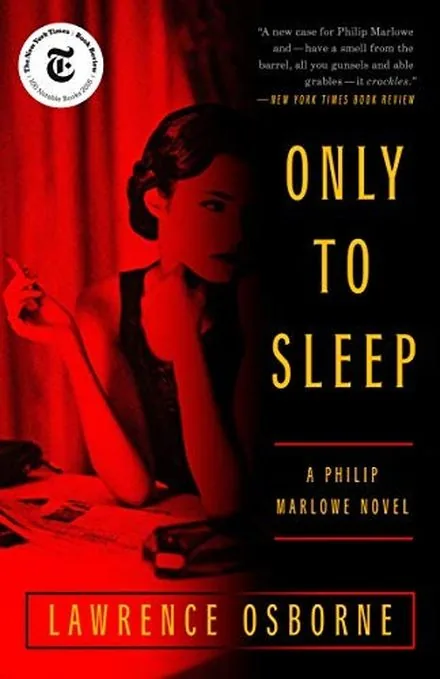
Philip Marlowe spends a surprising stretch of Only to Sleep nearly dead, drunk, injured, or lost in some Mexican town whose name he only just learned, and that's a big reason the book took me longer to finish than it should have. The story is set in 1988. Marlowe is seventy-two now, retired in Baja California, which is as sensible a starting point as any for a new Marlowe novel. The old detective no longer pretends his knees, his liver, or his professional usefulness are what they used to be. He owns a cane with a sword hidden inside it, keeps a maid and a stray dog, and carries enough memories of dead clients to fill a small cemetery. Then two insurance men show up and offer him a job: investigate the apparently accidental drowning of Donald Zinn, a wealthy, heavily indebted property developer. Marlowe takes the case because he's bored, flattered, and not quite ready to admit that retirement took away the thing that made him feel necessary.
That is the real subject of the novel, and it is considerably better than the mystery. The investigation takes Marlowe from San Diego to El Centro, Mazatlán, Puerto Vallarta, Caleta de Campos, Colima, Guanajuato, Mexico City, and finally back to the California desert. He follows a dead man who may not be dead, a widow who may be more dangerous than her husband, and a trail of false names, corrupt officials, abandoned resorts, yachts, old hotels, and people who know more than they intend to say. The basic mechanism is a familiar one. Zinn has used the death of another man, Paul Linder, to fake his own death and collect an insurance payout. The interest comes from what this fraud does to Marlowe, not from the ingenuity of the fraud itself.
Osborne has understood something important about taking over a famous character. You cannot simply make Marlowe young, fast, and conventionally heroic. This Marlowe is a tired professional whose body has become part of the case. He struggles up hills, loses feeling in his arm, suffers a frightening episode of paralysis, and gets badly cut in a fight with the man called Topper. He is still capable of violence, but it is no longer effortless. Drawing the blade from his cane and wounding Topper works as a scene because Marlowe survives through experience and timing rather than physical superiority. He does not win cleanly. He bleeds, collapses, and has to be taken to a retired doctor who charges him for treatment while pretending that the Hippocratic Oath is a form of private accounting.
That physical decline gives the novel some genuine feeling. Marlowe is checking whether there is still a reason for him to leave the house, not merely investigating an insurance scam. He says plainly that retirement has been sad and that he wants one last outing. The case becomes a final attempt to prove that he can still follow a trail, still read a lie, still walk into a dangerous room and come out with enough of himself intact. I believed this part. Marlowe's boredom is not decorative. It is the engine of the story.
The trouble is that the novel keeps interrupting its own strongest idea with extended displays of Marlowe-style atmosphere. The prose is often vivid, but it is also determined to make every bar, hotel, desert road, waitress, ruined resort, and old man at a fishing wall carry the weight of a final statement about civilisation. There are many good observations here. The abandoned Palm Dunes Resort, with its empty pools and sand entering the buildings, is an effective image of a property dream collapsing under its own debt. Zinn's mansion in Coronado Cays is equally useful because it shows a man trying to make wealth look permanent while owing money everywhere. Marlowe understands that the house is not a home but a display cabinet for anxiety.
But after a while every landscape seems to be waiting for a funeral speech. Mexico is repeatedly described as beautiful, corrupt, violent, ancient, ruined, and dreamlike, sometimes in the same paragraph. Marlowe sees a village, then tells us what it means about death. He sees a hotel, then tells us what it means about memory. He sees a woman, then compares her to an animal, a flower arrangement, a mythological figure, or a film star. Some of this is faithful to Chandler's method, but imitation is not the same as control. Chandler's metaphors usually sharpen a character or a situation. Here they can become a running commentary that keeps the reader outside the scene.
Marlowe himself is aware that he is performing the old role. He describes his clothes, his jokes, his cane, his drinking, and his memories as if he were both the detective and the audience watching the detective. That self-awareness is sometimes clever and sometimes exhausting. He knows he is an old man pretending to be an old-school private eye, but the book does not always know when to stop showing us that it knows. The result is a strange mixture of vulnerability and vanity. Marlowe is moving because he is diminished. He is irritating because he is still convinced that every woman he meets exists partly to confirm that he is not diminished.
Dolores Araya is the strongest character in the book, though the novel does not always treat her with the consistency she deserves. She is introduced as Zinn's glamorous young widow, a former waitress from Mazatlán who now runs the failed Palm Dunes Resort. Marlowe initially reduces her to the familiar hard-boiled categories: beautiful fraud, dangerous widow, possible femme fatale. He keeps changing his mind about her, which is one of the better features of the investigation. She is not simply manipulating everyone. She is also living with a violent man, trying to escape debt, and attempting to construct a future from the wreckage of a marriage that may never have been a marriage in the emotional sense.
The bruise on her neck matters more than Marlowe wants it to. He notices it, but he is slow to understand what it means because he is distracted by her beauty and by his own old habits. Later, when Dolores follows him from Zinn's party, she appears frightened and stripped of the control she has displayed throughout the investigation. Her final meeting with Marlowe in the cemetery is quiet and sad. She pays him the agreed amount, apologises for the way he was treated, and admits that she and Zinn will keep moving because a fixed life would expose them. Marlowe wants to rescue something from this relationship, perhaps her, perhaps the memory of his own younger life, but he mostly manages to accept the money and keep looking at her.
The gender politics of the book are less comfortable. Marlowe's observations about women are deliberately old-fashioned, and the author is clearly using that language as part of the character. Even so, the repeated references to girls, muchachas, loose women, and women as dangerous or decorative become tiresome. Marlowe can recognise exploitation when it happens to him, but he is less reliable when he is the one doing the looking. His attraction to Dolores is not meant to become a romance, but the novel spends enough time on it that the reader is asked to share a fascination which is often more about Marlowe's fear of ageing than Dolores herself.
The mystery is serviceable rather than exceptional. There is a good turn when an old fisherman, Nestor, reveals that the body found on the beach carried identification belonging to Paul Linder, not Donald Zinn. Another useful detail is the wet ATM receipt found by Rubio Pez, which allows Marlowe to track the supposedly dead man through a series of Mexican hotels. The chase has energy because Marlowe is improvising with very limited resources. He dyes his hair, grows a moustache, rents rooms near his quarry, bribes hotel employees, and follows Zinn through a bullfight and a fairground. These are entertaining scenes, particularly because the investigator is plainly too old for the physical work and knows it.
The ending is both satisfying and evasive. Marlowe discovers a disfigured body in the abandoned Guanajuato villa and is briefly arrested because he is the only suspicious foreigner on the premises. He assumes the body is Donald Zinn's, and the reader is encouraged to make the same assumption. Later, though, the epilogue complicates that certainty. Marlowe meets Paul Linder's elderly father in the desert and learns that Linder really had gone to work on Zinn's yacht, then disappeared. The father collected the ashes believed to be his son's and scattered them in the desert. Marlowe gives him the remaining money from Dolores, or at least offers it, and sits beside him drinking Japanese whisky. The case has not been solved in the tidy sense. Zinn is probably dead, Dolores has vanished, Linder is still an uncertainty, and the insurance company has received something less useful than the full truth.
That uncertainty suits the book. The final conversation is better than the revelations that lead to it because Marlowe finally stops trying to force every clue into a complete arrangement. He has been searching for closure, but what he finds is a lonely old man beside a canal, fishing in water where there are no fish. The detail is funny, sad, and properly plain. Marlowe apologises for not finding Linder, although the apology cannot repair anything. He has spent the entire book treating information as more valuable than money, and the old man does not understand that. Neither, perhaps, does Marlowe.
I liked the book more when it was about that problem than when it was trying to be a luxurious Chandler pastiche. Osborne is particularly good at Marlowe's physical vulnerability, his boredom, and his reluctant recognition that usefulness is not the same thing as virtue. He is less successful when he piles on the atmosphere or makes every woman into a test of the detective's remaining vitality. The novel has a strong central character and several memorable scenes, but it is too pleased with its own surface. A little less tequila, myth, and cemetery philosophy would have improved the journey by several hundred miles.
Still, I finished it, which is not nothing. The best reason to read Only to Sleep is not to find out whether Donald Zinn has faked his death. It is to watch a seventy-two-year-old Marlowe discover that his last case cannot restore his former life. He can still follow a trail, make a joke, take a beating, and identify a lie. He cannot make the past return, and he cannot turn a woman he admires into a proper ending. In the final pages he is left with a boat, some money, a few scars, and another old man's address. That is not closure, but it is a proper job of unfinished business.


